
Qualcomm Patents an AI That Guesses Cell Tower Signals Your Phone Can't Hear
Your phone figures out where you are by listening to cell towers, but what if it could guess a tower's signal even when it can't hear it? That's the core idea in Qualcomm's latest patent.
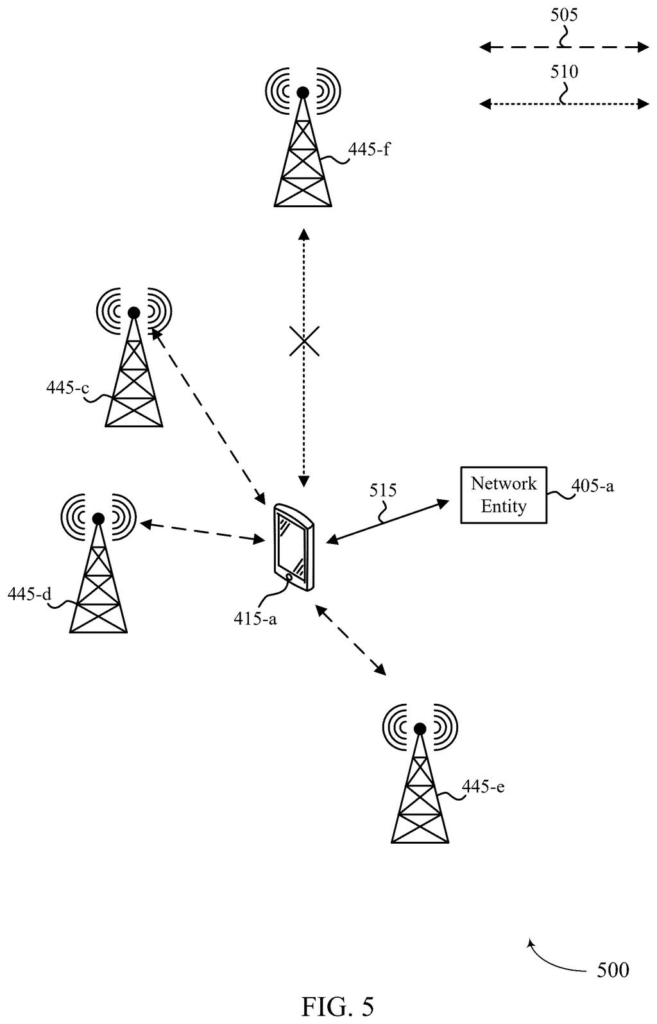
How Qualcomm's AI fills in missing tower signals
Imagine you're trying to pinpoint your location on a map, but half the landmarks you'd normally use are hidden behind buildings. Your phone faces a similar problem: it locates you by measuring signals from multiple cell towers, and if some towers are blocked or temporarily silent, its position estimate gets worse.
Qualcomm's patent describes an AI model that runs directly on your phone. When one or more towers go quiet, the AI uses the measurements your phone can pick up from nearby towers to predict what those silent towers would have measured. It's a bit like a weather model estimating rain in a blind spot using readings from surrounding stations.
The predicted measurements are then sent to the network just like real ones, so the location system can keep working at full accuracy even with gaps in coverage. The fix happens automatically, without you or the network doing anything differently.
How the AI model predicts measurements without a signal
The patent describes a wireless device (essentially any modern smartphone or cellular modem) equipped with an AI/ML positioning model that can perform what the filing calls "spatial prediction."
Here's the chain of events the system carries out:
- The device takes a real measurement from at least one nearby transmission-reception point (TRP), a cell tower or base station antenna that is currently sending a reference signal.
- It feeds that real measurement into an on-device AI model, which has been trained to understand the spatial relationships between towers in an area.
- The model outputs a predicted measurement for a second tower that is not currently sending a usable reference signal, no actual signal from that tower is needed.
- The device reports the predicted measurement to the network as positioning data, allowing the network to compute a location estimate as if both towers were heard.
The key distinction from ordinary AI-assisted positioning is the "without reference signaling" part. Most AI positioning approaches still require at least a weak signal from every tower they reference. This system works even when a tower is completely silent from the device's perspective, using neighboring signal data to fill the gap.
What this means for phone location accuracy indoors
Cell-based positioning is most important exactly when GPS fails: indoors, in dense urban canyons, or in parking garages. Those are also the environments where some towers are most likely to be blocked or temporarily out of range. A system that can intelligently fill those gaps could meaningfully improve the accuracy of navigation, emergency 911 location services, and the kind of fine-grained positioning that next-generation 5G networks are supposed to deliver.
For Qualcomm specifically, this fits a broader push to bake AI deeply into its modem chips. If the prediction model runs on the device itself (which the patent implies), it doesn't require extra round-trips to a server, which keeps the process fast. That matters in real-time applications like turn-by-turn navigation or indoor wayfinding in large buildings.
This is a genuinely useful idea for a real problem: location accuracy degrades precisely in the environments where people need it most. The approach of predicting missing tower data rather than simply ignoring it is technically sound, and Qualcomm is in a strong position to implement it at the modem level. Whether the prediction accuracy is good enough to matter in practice is the open question, but the concept is worth taking seriously.
There are more where this came from
We read every patent application Big Tech publishes and send you the ones worth knowing. Plain English, free, every week.
The drawings
24 drawing sheets from US 2026/0214616 A1 · click any drawing to enlarge


Want this weekly breakdown for a company we don't cover? Patentlyze Pro →