
Nvidia Patents a Way to Stitch Camera Feeds Across Two Chips Without Extra Software
Combining footage from multiple cameras usually means a lot of processing overhead. Nvidia's new patent describes a way to let the data transfer itself do the stitching, by embedding routing instructions directly into the data packages being sent between chips.
How Nvidia moves camera images between chips automatically
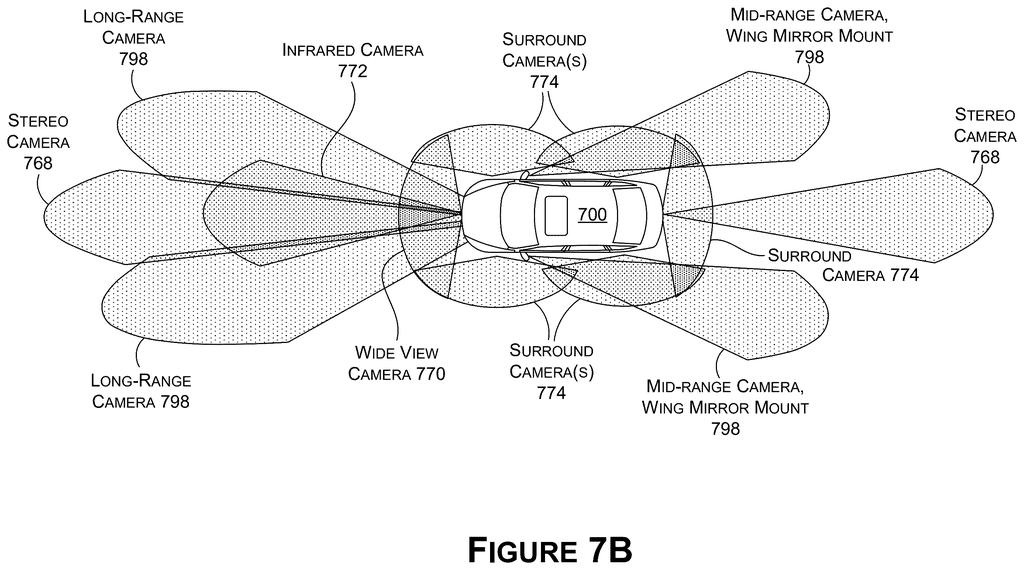
Imagine your car has four cameras, each watching a different angle. To get a single wide view of what's around you, all that footage has to be combined, or "stitched," into one image. Normally that requires a processor to actively pull the images together. Nvidia's patent describes a way to do that stitching almost as a side effect of simply moving the data from one chip to another.
The trick is something called a descriptor, which is basically a label attached to each chunk of image data. The label tells the system: "I came from this camera, I belong in this spot in the final image, and I should land at this address on the receiving chip." The receiving chip doesn't need extra instructions because the data arrives already sorted into the right slots.
This approach is aimed at systems with multiple cameras feeding into a central processor, like the kind you'd find in a self-driving car or a multi-sensor robot. By making the data transfer handle the heavy lifting, Nvidia could reduce the amount of dedicated processing power needed to combine camera views in real time.
How the descriptor system routes image slices chip-to-chip
The patent describes a setup involving two system-on-a-chip processors, or SoCs (think of an SoC as a full computer crammed onto a single chip). The first SoC collects raw image data from multiple camera sensors and stores each camera's feed in its own dedicated memory area called a source buffer.
Each block of image data is tagged with a descriptor, a small data structure that carries four key pieces of information:
- Which source buffer the data is coming from
- The exact memory address within that source buffer
- The exact memory address where the data should land on the second chip (the destination buffer)
- How many bytes of data are being transferred
When the data is transmitted from the first SoC to the second SoC over a chip-to-chip communication interface, the descriptors act as routing instructions. The first camera's data lands in one section of the destination buffer, the second camera's data lands in an adjacent section, and the result is a pre-arranged, stitched image waiting in memory on the second chip.
The patent also mentions that the same mechanism can handle other tasks like image cropping and format conversion, meaning the descriptor system is flexible enough to reshape or reformat image data during transit, not just stitch it.
What this means for multi-camera systems in cars and robots
Multi-camera systems are everywhere in Nvidia's core markets: autonomous vehicles, robotics, and industrial inspection rigs. All of these systems need to combine camera feeds in real time, and every millisecond of processing delay matters. By offloading the stitching work to the data-transfer layer, Nvidia could free up the main processor for the tasks that actually require intelligence, like detecting objects or planning a route.
For you as an end user, this kind of efficiency work is invisible but consequential. It's the sort of plumbing that determines whether a self-driving system can react fast enough or whether a robot camera array can keep up with fast-moving environments. The patent doesn't name a specific product, but it fits squarely within Nvidia's existing line of automotive and robotics processors.
This is solid, unglamorous infrastructure work. Descriptor-based DMA transfers (direct memory access, where data moves without tying up the CPU) are a well-established idea, but applying the pattern specifically to image stitching across SoCs is a concrete and useful refinement. It's not a headline-grabbing AI patent, but it's exactly the kind of low-level optimization that makes Nvidia's automotive chips competitive.
There are more where this came from
We read every patent application Big Tech publishes and send you the ones worth knowing. Plain English, free, every week.
The drawings
17 drawing sheets from US 2026/0212450 A1 · click any drawing to enlarge


Want this weekly breakdown for a company we don't cover? Patentlyze Pro →