
Air Conditioner Patent Detects When You Fall Asleep
Samsung is patenting an air conditioner that doesn't just follow a timer, it figures out on its own when you've gone to bed and adjusts accordingly, using motion and light sensors to make the call.
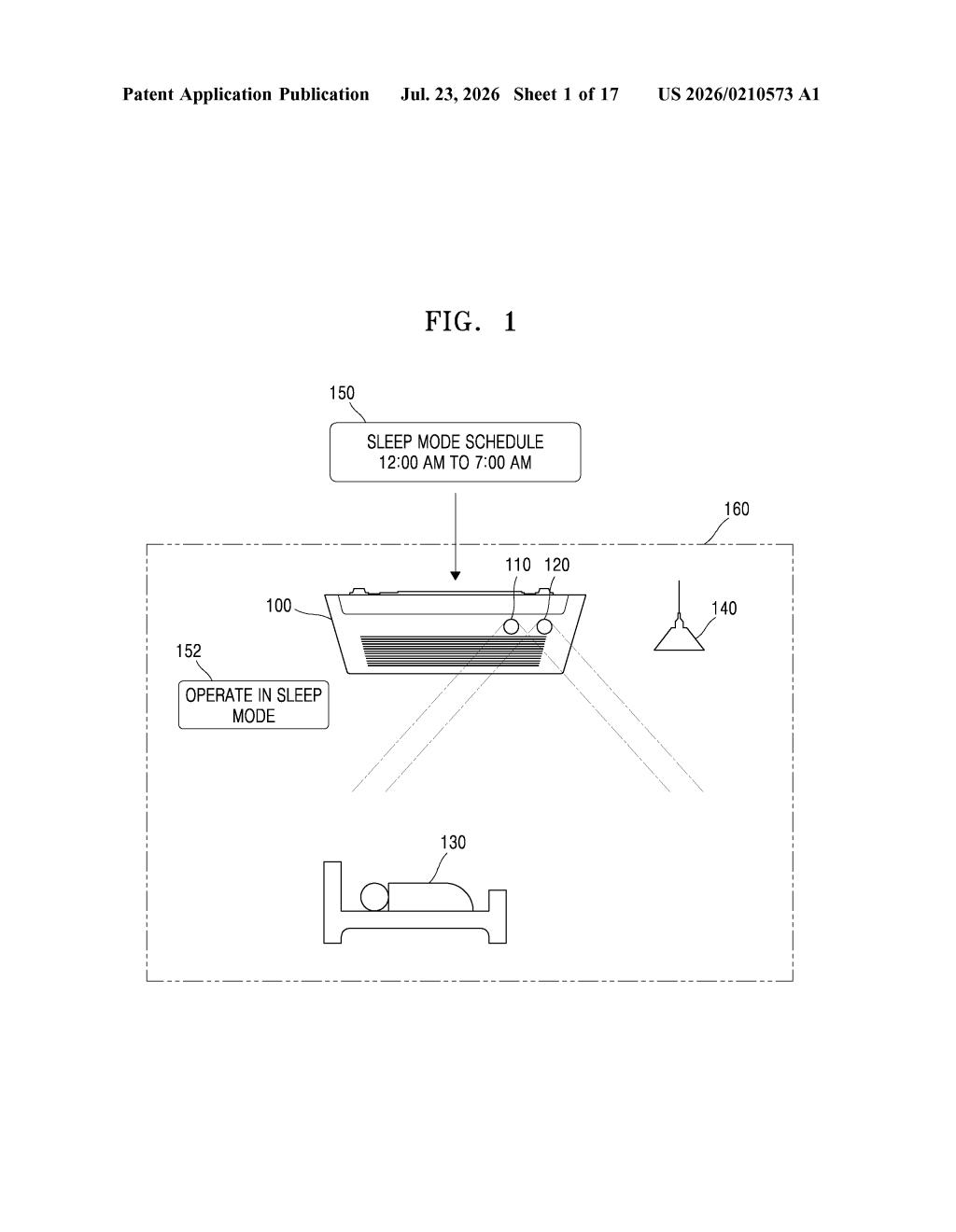
How Samsung's AC figures out you're asleep
Imagine you set your AC to "sleep mode" on your phone before bed, but you end up dozing off on the couch an hour early. A regular AC has no idea, it just runs at full blast until its programmed time kicks in. Samsung's patent is meant to fix that.
The idea is to pair a scheduled "sleep window" (set from your phone or an app) with two real-time checks: whether anyone is still moving around the room, and whether the lights are off or very dim. Only when both conditions are met does the AC actually switch to its quieter, gentler sleep mode.
The result is a unit that doesn't rely purely on a clock. If you fall asleep early, the room goes dark and stays still, and the AC catches up. If you're still up reading with a lamp on, it holds off. It's closer to how a person would manage the thermostat than how a timer does.
How the sensors and schedule logic work together
The patent describes an air conditioner equipped with a motion detection sensor, an illuminance (light level) sensor, a wireless communication module, and the logic to tie them all together.
Here's the flow the patent lays out:
- A user schedules a "sleep window" from an external device (a phone app, for example), which the AC receives over its communication module.
- During that window, the AC starts tracking how long no person has been detected in the room, the absence duration.
- If that absence duration crosses a set threshold (the "sleep reference value") and the room's light reading falls below a set brightness threshold (the "illuminance reference value"), the AC shifts into sleep mode.
The two-condition check is the key design choice here. Motion alone could be misleading, someone asleep in bed barely moves, but they're still there. Light level alone isn't reliable either, since someone might dim the lights while still awake. Combining both gives the system a more confident read on whether the room is genuinely in sleep conditions.
Sleep mode in this context likely means quieter fan operation, slower temperature adjustments, and generally less aggressive cycling, common features in AC units designed to avoid disturbing a sleeper.
What this means for smart-home climate control
For consumers, this is about getting comfort-setting automation that actually reflects reality rather than a schedule you set and forget. Most smart AC features today are either fully manual or tied to rigid timers, and neither handles the unpredictability of when someone actually falls asleep.
For Samsung, this fits into a broader push to make its home appliances context-aware, meaning they respond to what's actually happening in the room rather than just following instructions. Whether this appears in a future SmartThings-connected unit or a standalone product isn't clear from the patent, but the sensor and communication architecture it describes is exactly what Samsung's higher-end air conditioner lines already carry.
This is a tidy, practical idea rather than a technical showpiece. The two-sensor logic (motion plus light) is simple enough to be reliable, which is actually a point in its favor. It won't blow anyone away on paper, but it's the kind of feature that would make a real difference in daily use.
There are more where this came from
We read every patent application Big Tech publishes and send you the ones worth knowing. Plain English, free, every week.
The drawings
17 drawing sheets from US 2026/0210573 A1 · click any drawing to enlarge


Want this weekly breakdown for a company we don't cover? Patentlyze Pro →