
Salesforce Patents a System Where One AI Watches Over All Your Other AIs
Salesforce wants to solve a growing problem with AI agents: who's making sure they don't go off-script? Its answer is to deploy a second AI whose only job is to watch the first one.
What Salesforce's AI-watching-AI system actually does
Imagine your company sets up an AI assistant to handle customer refund requests. It works great most of the time, but one day a user asks it something it shouldn't answer, or it starts giving out information that violates your company's policies. With today's tools, you might not even find out until the damage is done.
Salesforce's patent describes a system that puts a supervisor AI in the middle of every conversation your AI agent has. Before your AI agent sees a user's message, the supervisor checks it against a set of rules you wrote in plain language. Before the agent's response goes back to the user, the supervisor checks that too. If something doesn't comply, the system can block or flag it.
The rules aren't code, they're instructions you type in yourself, like "never discuss competitors" or "only respond to topics related to billing." That makes it something a business manager, not just a developer, could set up and adjust.
How the watchdog LLM intercepts and judges each message
The patent describes a two-layer AI architecture. The first layer is the agent LLM, the AI that actually does the work (answering questions, running tasks, pulling up records). The second layer is a separate evaluator LLM, which acts as a gatekeeper sitting between users and the agent.
Here's how the flow works:
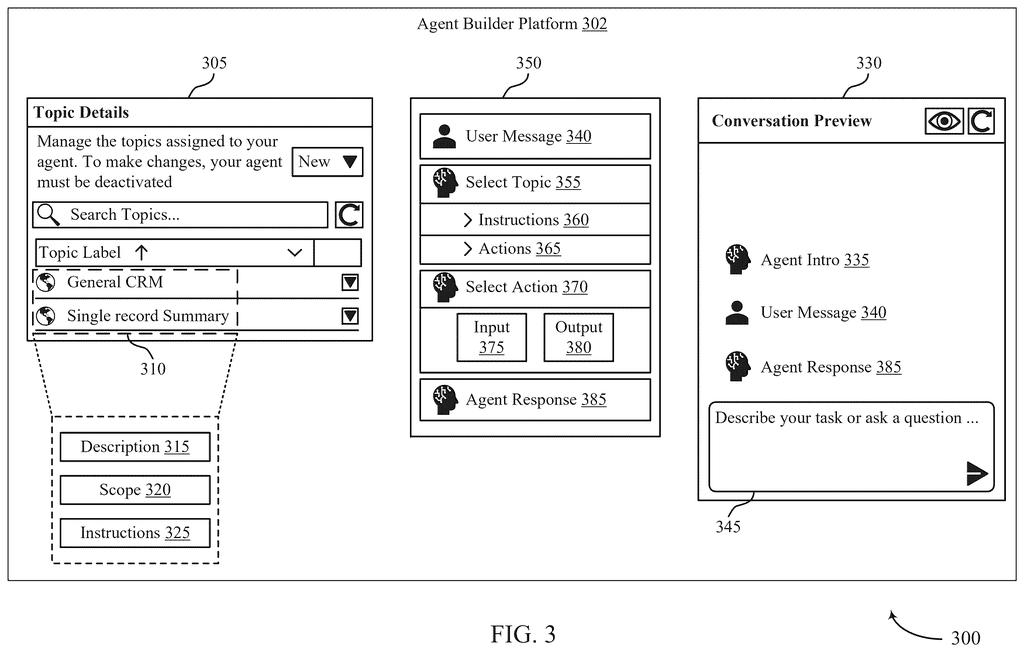
- A business administrator types a set of plain-language instructions into a dashboard, defining what the AI agent is and isn't allowed to do.
- When a user sends a message, the evaluator LLM reads it first and checks whether it complies with those instructions.
- If the input passes, it gets forwarded to the working agent LLM. If not, it can be blocked or modified.
- When the agent LLM generates a response, the evaluator LLM checks that too before it reaches the user.
Importantly, the system is designed for multi-tenant platforms (meaning many different companies share the same infrastructure). Each company's rules are kept separate, so one tenant's instructions don't bleed into another's. The evaluator LLM is configured per tenant, giving each organization its own independent policy layer without needing to run entirely separate AI infrastructure.
What this means for businesses deploying AI agents
As businesses plug AI agents into customer service, sales, and operations, the question of behavioral guardrails is becoming urgent. Right now, most companies rely on baked-in training or basic content filters, which are brittle. A rule written in natural language and enforced by a second AI is more flexible and easier for non-technical staff to update.
For Salesforce, which sells its Agentforce platform to enterprise customers, this is a direct answer to the liability question: "What happens when your AI agent does something it shouldn't?" A documented, auditable monitoring layer is exactly what compliance teams at large companies want to see before they sign off on deploying AI agents at scale.
This is a genuinely practical patent, not a moonshot. The core idea, using one AI to police another AI's inputs and outputs against plain-language rules, maps directly onto a real and unsolved problem that every enterprise Salesforce customer faces right now. It won't win awards for technical novelty, but it could become standard infrastructure for anyone running AI agents in a regulated industry.
There are more where this came from
We read every patent application Big Tech publishes and send you the ones worth knowing. Plain English, free, every week.
The drawings
8 drawing sheets from US 2026/0220474 A1 · click any drawing to enlarge


Want this weekly breakdown for a company we don't cover? Patentlyze Pro →