
Google Files Patent for AR Waveguide Grating That Reduces Ghost Reflections
One of the most persistent complaints about augmented reality glasses is that the lenses look weird from the outside, throwing off odd reflections and glowing patches. Google is working on a fix built into the glass itself.
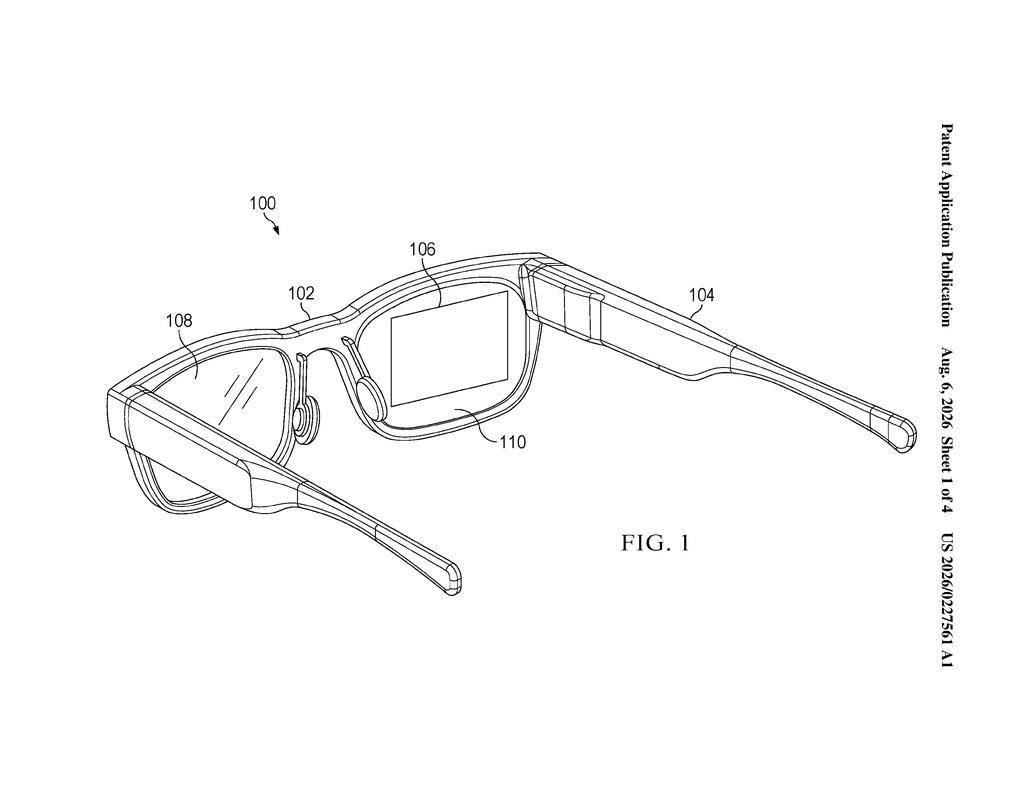
What Google's waveguide grating fix actually does
Imagine putting on a pair of AR glasses and looking in a mirror. Instead of seeing your eyes, someone else sees a faint glow or a strange colored shimmer coming from your lenses. That's the reflection problem that plagues most AR headsets today, and it's both a privacy annoyance and a social barrier.
Google's patent describes a new way to engineer the tiny microscopic ridges etched into AR lenses, called gratings, so they guide light toward your eye more efficiently while bouncing far less of it back outward. The trick is packing multiple distinct regions into each repeating unit of the pattern, rather than the simpler two-region designs that are common today.
The result, at least in theory, is a lens that looks more like ordinary glass to anyone facing you, while still delivering a sharp, bright image to your eye. That balance has been frustratingly hard to achieve, and this patent describes a specific structural approach to getting closer to it.
a periodic structure having periods defined along an axis, the periodic structure including alternating regions of differing refractive indices; and a plurality of first regions, having a first refractive index, within each period of the periodic structure.
Translation: The core pattern uses alternating materials that bend light differently to control optical paths.
How the multi-region grating pattern controls light
AR glasses work by projecting images through a thin piece of glass called a waveguide. Light from a tiny projector enters the edge of the glass, bounces around inside via gratings (microscopic ridged patterns etched into the surface), and eventually exits toward your eye at the right angle.
The problem is that gratings are imperfect mirrors. Some light leaks back out the wrong way, creating visible reflections on the outside of the lens. Standard gratings use a simple alternating pattern: one high-refractive-index ridge, one low-refractive-index gap, repeat. The refractive index is just a measure of how much a material bends light.
Google's patent proposes replacing that simple two-region pattern with one that places multiple high-refractive-index regions inside each repeating unit. The patent covers both:
- 1D gratings: ridges running along a single axis, now with several sub-regions per period
- 2D gratings: a grid pattern (lattice) with multiple high-index spots per unit cell, giving more directional control
By tuning the number, size, and arrangement of these sub-regions, engineers can independently adjust how much light couples into the eye versus how much escapes outward as reflection. It's a fine-grained optical knob that simpler patterns don't offer.
The 1D grating also includes a plurality of high-refractive-index regions within each period of the periodic structure. In another configuration, the waveguide includes at least one two-dimensional ( 2 D) grating disposed at the waveguide.
Translation: Adding extra high-index zones helps shape the light precisely across one or two dimensions.
What this means for the next wave of AR glasses
Reflection management is one of the core unsolved problems in consumer AR optics. Every major AR glasses maker, including Google, Meta, and Apple, has to balance display brightness against how strange the lenses look from the outside. A lens that glows or mirrors clearly signals to everyone nearby that you're wearing a camera-equipped computer on your face, which slows adoption.
This patent fits a clear pattern in Google's recent AR work: incremental, materials-level improvements to waveguide optics that would matter most in a thin, socially wearable form factor like smart glasses. If the approach works as described, future lenses could look closer to ordinary prescription glasses while still delivering a usable display, which is the threshold most analysts think the category needs to cross.
This is genuinely interesting optics engineering, not a broad software claim or a defensive filing. Waveguide grating design is a real bottleneck for AR glasses, and the specific structural idea here, packing multiple sub-regions into each grating period, is a concrete approach rather than a vague concept. Whether it outperforms existing designs in practice is a manufacturing question, but the direction is right.
There are more where this came from
We read every patent application Big Tech publishes and send you the ones worth knowing. Plain English, free, every week.
The drawings
4 drawing sheets from US 2026/0227561 A1 · click any drawing to enlarge


Want this weekly breakdown for a company we don't cover? Patentlyze Pro →
Be the first to weigh in