
Apple Patent Refines the User Interface for Wireless Contactless Payments
Most contactless payments require you to hold your phone or watch within an inch or two of a terminal. Apple is patenting a system that could let the terminal and your device talk, and complete a payment, from a much greater distance.
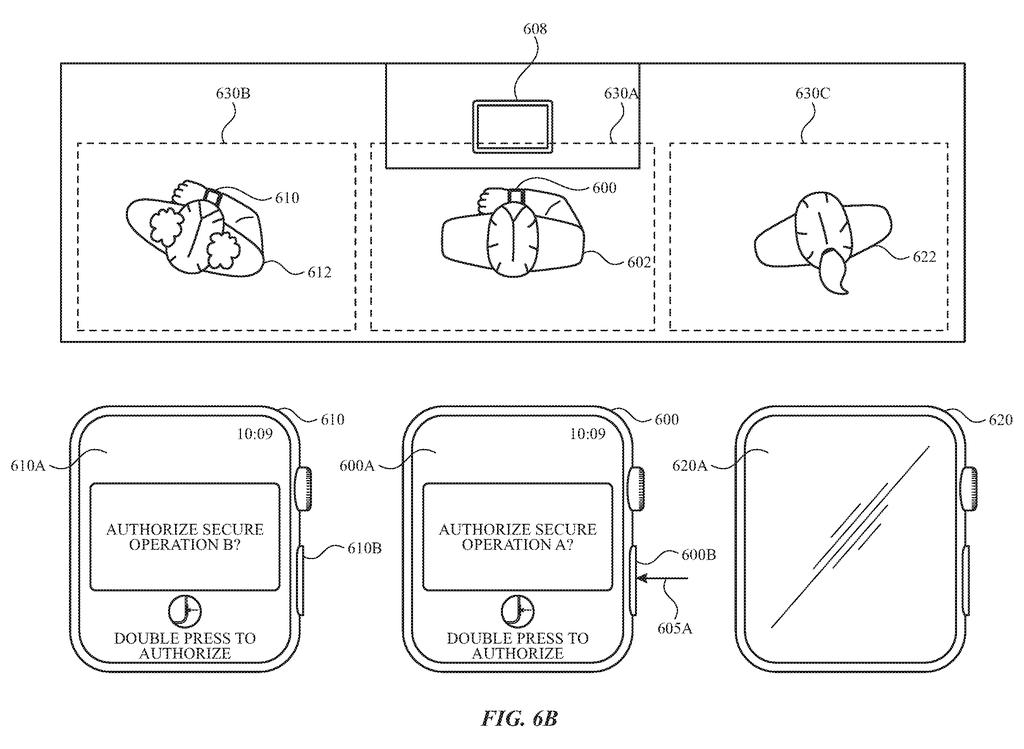
What Apple's long-range payment patent actually does
Picture this: you walk up to a checkout counter and, before you even reach for your phone, the payment terminal has already sent a request to your device asking for your card details. Your phone (or watch) gets that request, shows you a prompt, you confirm with a tap or a glance, and the payment goes through, all without ever pressing your device against the reader.
That's the core idea in this Apple patent. Today's tap-to-pay systems are designed to work only at very close range, typically a centimeter or two, so that your card doesn't get charged accidentally. Apple's filing describes a system that works at distances of more than 5 centimeters, which sounds small but is a meaningful jump for the underlying wireless technology.
The key safety detail is that your explicit approval is still required before any account information is sent. The terminal can ask, but your device waits for your confirmation before transmitting anything. So the convenience goes up without removing the human check.
while the computer system is a threshold distance away from a contactless terminal system, wherein the threshold distance is more than 5 centimeters: wirelessly receiving, directly from the contactless terminal system via the one or more wireless receivers, a request for account information to proceed with a transaction …
Translation: Your phone can receive payment requests from a contactless terminal from farther than five centimeters away.
How the device authorizes a payment from a distance
The patent describes a computer system (think iPhone or Apple Watch) that can communicate with a contactless payment terminal at distances greater than 5 centimeters. That threshold matters because current NFC (Near Field Communication, the radio technology in most tap-to-pay setups) is intentionally limited to very short ranges as a security measure.
The sequence the patent lays out works like this:
- The contactless terminal sends a wireless request for account information directly to the device.
- The device receives that request and prompts the user for authorization via an input device (a button, Face ID, Touch ID, etc.).
- Only after the user explicitly approves does the device transmit account information back to the terminal.
The account data itself is stored on a secure element, a dedicated, tamper-resistant chip inside the device that holds payment credentials separately from the main processor. This is the same architecture Apple Pay uses today; the patent extends the range at which that existing secure system can operate.
The filing doesn't specify which wireless technology would carry signals at these extended distances. It could be a longer-range NFC mode, Ultra Wideband, or another protocol. The claim is technology-agnostic on that point.
The present disclosure generally relates to wireless data communications, such as between a mobile electronic device and a contactless terminal.
Translation: This patent covers wireless data sharing between a phone and a payment reader.
What this means for Apple Pay and contactless checkout
For everyday shoppers, a longer-range payment system could make checkout faster and more accessible, particularly for people who find it physically awkward to tap a phone against a small reader. It could also open up new form factors: smart glasses or a device kept in a bag might authenticate a payment without needing to be held directly against anything.
For Apple, this fits a broader pattern of trying to make Apple Pay feel less like a workaround and more like a first-class checkout experience. The mandatory user-authorization step in the patent suggests Apple is aware of the obvious concern (nobody wants their phone charged by a rogue terminal across the room), and the design keeps the human in the loop. Whether this shows up as a tweak to existing iPhone hardware or something built into a future wearable is an open question.
This is a modest but sensible evolution of tap-to-pay. The 5-centimeter threshold is a technical detail that will matter a lot to payment-standards engineers and almost nobody else, but the user-experience implication, pay without pressing your phone against a reader, is genuinely useful. It's not a headline product announcement, but it's the kind of incremental infrastructure work that makes Apple Pay better over time.
There are more where this came from
We read every patent application Big Tech publishes and send you the ones worth knowing. Plain English, free, every week.
The drawings
28 drawing sheets from US 2026/0228714 A1 · click any drawing to enlarge


Want this weekly breakdown for a company we don't cover? Patentlyze Pro →
Be the first to weigh in