
Nvidia Patent Equips Robots With Memory-Enhanced Reinforcement Learning Capabilities
Nvidia has filed a patent for a training system that gives robots a kind of short-term memory, letting them factor in what they've already done before deciding what to do next. It's a meaningful step toward robots that can handle messy, real-world situations without constant human guidance.
How Nvidia wants robots to get better at deciding what to do next
Imagine a robot arm trying to pick up a coffee mug. If it only looks at what's in front of it right now, it might reach the wrong way because it doesn't remember that its last move pulled it slightly off course. Nvidia's patent addresses exactly that problem.
The system gives a robot a kind of rolling memory. Instead of just reacting to what its sensors pick up at any given moment, it also weighs what it has done in recent steps and what its internal state looked like before. That combination helps it build a much better picture of the situation.
From there, a second layer of the system scores each possible next move based on how likely it is to lead to a good outcome. The robot learns over time which moves earn good scores and which don't, tuning its behavior automatically. You don't have to reprogram it every time something changes.
… generating, via execution of one or more first machine learning models, a latent state at a current time step based at least on (i) the set of embedded features, (ii) one or more actions performed by the machine at a previous time step, or (iii) a history of latent states preceding the current time step; …
Translation: The system tracks past actions and previous states to understand the robot's current situation.
How the latent-state and reward loop actually trains the robot
The patent describes a two-stage machine learning pipeline designed for robots and other physical machines.
Stage one: building a latent state. The robot's sensors (cameras, depth sensors, accelerometers, etc.) feed raw data into a set of first machine learning models. Those models compress the raw input into embedded features (compact numerical representations of what the sensors detected). Then they combine those features with the robot's previous actions and a history of latent states (internal snapshots of the robot's situation at earlier moments) to produce a latent state, a rich, compressed summary of where the robot is and how it got there.
Stage two: picking an action. The same first models also generate a policy state, which represents the probability of taking each possible action given the current situation. A separate set of second machine learning models using a reinforcement learning algorithm (a trial-and-error training method where the system gets reward signals for good outcomes) then produces a reward function, a score that tells the robot how valuable a given action is likely to be.
The robot combines the policy state and the reward signal to pick and output its next action. Because the system tracks history, it avoids the blind-spot problem where a robot makes poor decisions simply because it ignores its own recent behavior.
… converting a set of sensory inputs obtained using one or more sensors of a machine at a current time step into a set of embedded features.
Translation: Data from the robot sensors is translated into usable features for the AI.
What this means for real-world robotics and Nvidia's hardware ambitions
Robots that only react to the present moment tend to fail when things get slightly unpredictable, a moving conveyor belt, a shifted object, or a floor vibration can throw off a purely reactive system. A robot that factors in its own recent history is much harder to knock off course, which is the core practical benefit here.
For Nvidia, this fits squarely into its push to make its hardware the preferred platform for training and running physical AI systems, its term for AI that operates in the real world. If this approach proves effective, it could become a standard building block in Nvidia-powered robot training workflows, tying software capability directly to demand for its chips and its Isaac robotics platform.
This is genuinely interesting foundational work, not just a minor tweak. Teaching a robot to factor in its own recent history before acting is one of the real open problems in physical AI, and Nvidia is staking out clear IP in that space. Whether this specific architecture ships in a product or just influences future research, it signals that Nvidia is treating robotics training as a serious long-term priority, not a side project.
There are more where this came from
We read every patent application Big Tech publishes and send you the ones worth knowing. Plain English, free, every week.
The drawings
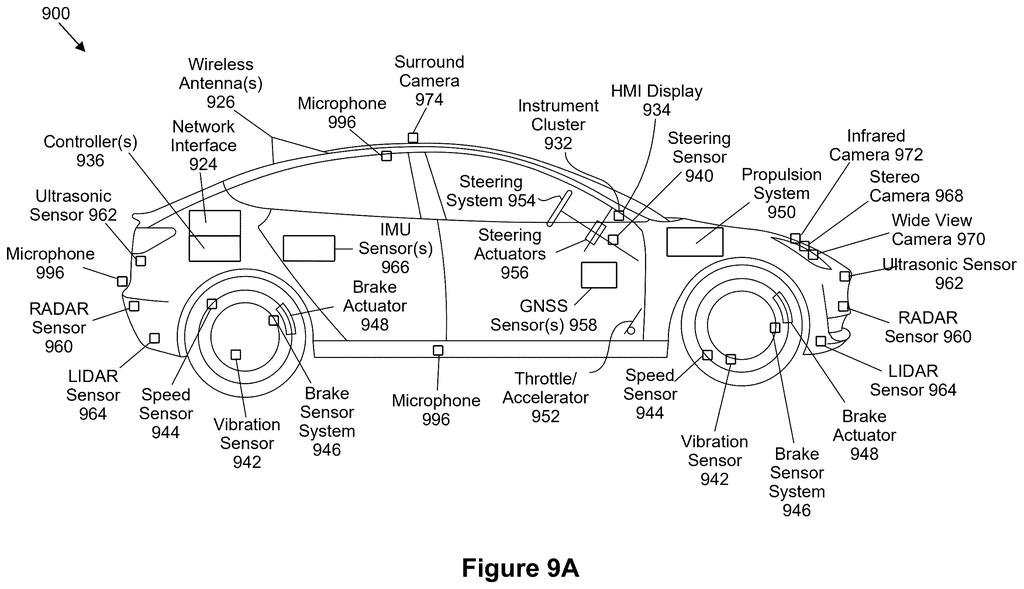
19 drawing sheets from US 2026/0228547 A1 · click any drawing to enlarge


Want this weekly breakdown for a company we don't cover? Patentlyze Pro →