
Nvidia Patents an AI Audio Generator That Cuts Its Own Memory Use During Training
Training AI to generate realistic audio is expensive, partly because the process eats up enormous amounts of memory. Nvidia's new patent describes a system that sidesteps that problem by throwing away intermediate calculations and recomputing them only when needed.
What Nvidia's AI audio system actually does
Imagine asking an AI to write a song lyric, and instead of keeping every rough draft in memory, it tosses the drafts and rewrites them on demand when reviewing its own work. That's essentially what this patent describes for AI-generated audio.
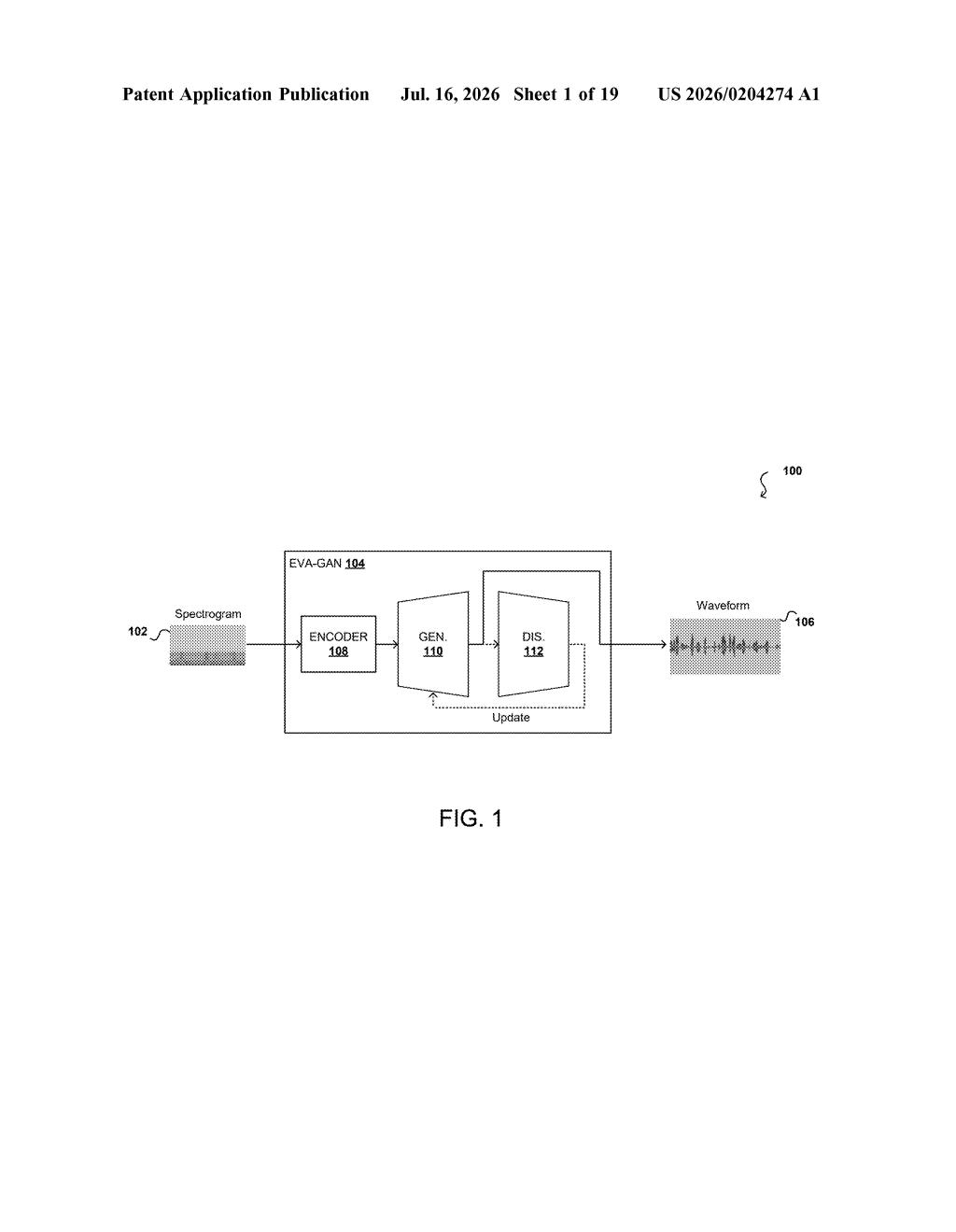
Nvidia's system takes a compressed "fingerprint" of a sound (called a mel-spectrogram, basically a visual map of audio frequencies over time) and uses a two-part AI to turn it into a full, high-quality audio waveform. One part encodes the fingerprint into a compact form; the other expands it into actual sound.
The clever part is what happens during training. Normally, an AI saves all its in-progress calculations so it can learn from its mistakes. Here, those intermediate saves are deleted as they're made, then recalculated only when the AI needs to correct itself. That saves a significant amount of memory without meaningfully slowing things down.
How the encoder, decoder, and gradient recompute work together
The system uses a classic encoder-decoder architecture. The encoder takes a mel-spectrogram (a compact, frequency-based representation of audio, think of it as a heatmap of sound) and converts it into an abstract numerical summary called an embedding. The decoder then takes that embedding and progressively "upsamples" it, meaning it fills in finer and finer detail until it produces a full audio waveform.
During training, a separate component called a discriminator (borrowed from the GAN, or generative adversarial network, family of AI techniques) listens to the generated audio and judges whether it sounds real. Its feedback is used to adjust the encoder and decoder weights (the internal parameters that shape how the AI behaves).
The memory-saving trick is called gradient checkpointing with recomputation. Normally during AI training, every intermediate calculation in the decoder is stored in memory so it can be used in the "backpropagation" step (the process where the AI figures out which internal adjustments to make after getting feedback). This patent deletes those stored checkpoints immediately after the audio is generated, then recomputes them from scratch during backpropagation using the original encoder output.
The tradeoff is slightly more computation time in exchange for a much smaller memory footprint, which matters a lot when training large audio models on hardware with limited GPU memory.
What this means for AI-generated speech and sound
High-quality AI audio generation, whether for speech synthesis, music, or sound effects, has historically required enormous amounts of GPU memory during training. That limits who can train such models and how large those models can grow. By cutting memory use without sacrificing audio quality, Nvidia's approach could let researchers train bigger, better-sounding audio models on the same hardware.
For you as a user, the downstream effect could be more realistic AI voices in products like virtual assistants, real-time translation tools, or game audio. Nvidia is also in a unique position here: it makes the GPUs that nearly every AI lab trains on, so optimizations like this could influence how the entire industry approaches audio AI training.
This is a solid engineering optimization, not a conceptual leap. The gradient recomputation trick is a known technique applied thoughtfully to audio generation, and Nvidia clearly has practical incentives to make AI training more memory-efficient on its own hardware. It won't get headlines, but it's the kind of infrastructure work that makes everything else better.
There are more where this came from
We read every patent application Big Tech publishes and send you the ones worth knowing. Plain English, free, every week.
Want this weekly breakdown for a company we don't cover? Patentlyze Pro →