
Disney Patents a System That Keeps Projected Images Locked to Moving Robots
Imagine a robot character at a theme park whose face and costume are actually painted by light, in real time, updating perfectly as the robot moves and turns. That's exactly what this Disney patent describes.
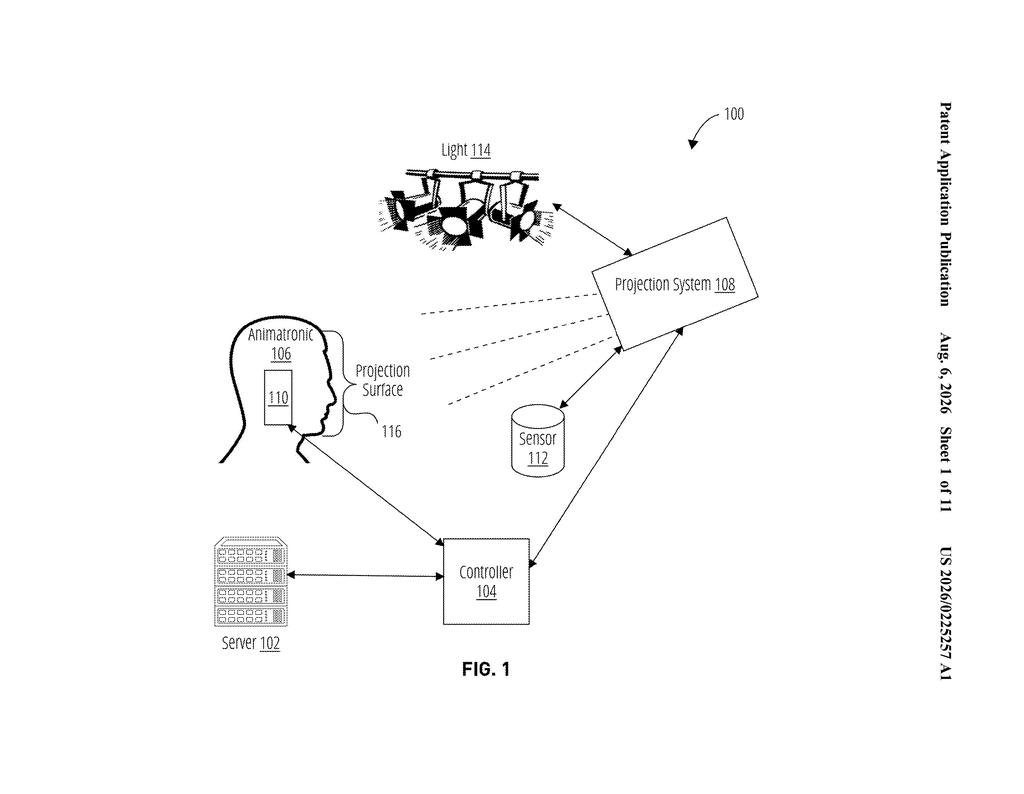
What Disney's moving robot projection system actually does
Picture a theme park robot that doesn't have a painted or molded face. Instead, a projector shines the character's expression, costume details, and even animations directly onto the robot's body, like a living digital skin.
The trick is keeping that projected image perfectly aligned even as the robot moves around. If the projector doesn't adjust, the image shifts and smears as soon as the robot turns or waves. Disney's patent solves this by using tracking sensors, some inside the robot itself and some placed around the surrounding space, to follow every movement in real time and instantly correct where the projector aims.
The result is a character whose appearance can change on the fly. The same physical robot could display different costumes, emotional expressions, or even transform into a completely different character, all controlled by software rather than swapping out physical parts.
… a tracking mechanism comprising at least one of: a first tracking mechanism positioned internal to the robotic structure and configured to generate intrinsic tracking data; or a second tracking mechanism positioned external to the robotic structure and configured to generate extrinsic tracking data; …
Translation: Sensors inside and outside the robot track its every movement in real time.
How the tracking system keeps the image aligned in real time
The patent describes a robotic system with a projection surface, essentially a specially shaped panel or shell attached to a robot, onto which a projector displays content. The challenge is that standard projectors are fixed, so any movement by the robot causes the image to drift out of alignment.
To fix this, the system uses a hybrid tracking approach combining two types of sensors:
- Intrinsic tracking: sensors mounted inside the robot (like joint encoders or inertial measurement units) that report the robot's own pose and limb positions from the inside.
- Extrinsic tracking: external cameras or motion-capture systems positioned in the environment that observe the robot from the outside, similar to how a film studio tracks an actor's movements for visual effects.
A controller processes data from both sensor types and continuously recalculates how the projector should adjust its output, warping and repositioning the projected image to compensate for every movement. The "hybrid" in the title refers to using both internal and external tracking together, since each fills gaps the other might miss.
… a hybrid approach to perform dynamic projection mapping onto robots in real-time are discussed herein.
Translation: The patent describes a method for projecting moving images onto active robots instantly.
What this means for Disney parks and live entertainment
For Disney's theme parks, this is significant. Physical animatronic characters are expensive to build and difficult to update. A system like this would let one robot body display multiple characters or update a character's look without any physical modifications, just a software change. You could theoretically see a robot dressed as one character in the morning and a different one in the afternoon.
Beyond parks, the technology applies anywhere a moving physical object needs a dynamically projected surface, live theater, themed entertainment, or interactive installations. The fact that Disney is patenting a hybrid tracking method suggests they found that relying on either internal or external sensors alone isn't reliable enough for the fast, continuous movements a park character would make.
This is a genuinely practical patent from Disney, not a far-future concept. The problem it solves, keeping a projected image locked to a moving robot body, is real and hard, and the hybrid tracking approach is a sensible engineering answer. If you've visited a Disney park recently and noticed how much more dynamic the newer animatronics are, this kind of work is exactly what's behind it.
There are more where this came from
We read every patent application Big Tech publishes and send you the ones worth knowing. Plain English, free, every week.
The drawings
11 drawing sheets from US 2026/0225257 A1 · click any drawing to enlarge


Want this weekly breakdown for a company we don't cover? Patentlyze Pro →
Be the first to weigh in