
Disney Patents Tech to Run Theme Park Robots Directly From Animation Data
Disney's animators already describe character motion as smooth mathematical curves on a timeline. A new patent wants those exact curves to control real, physical robots, no extra translation layer needed.
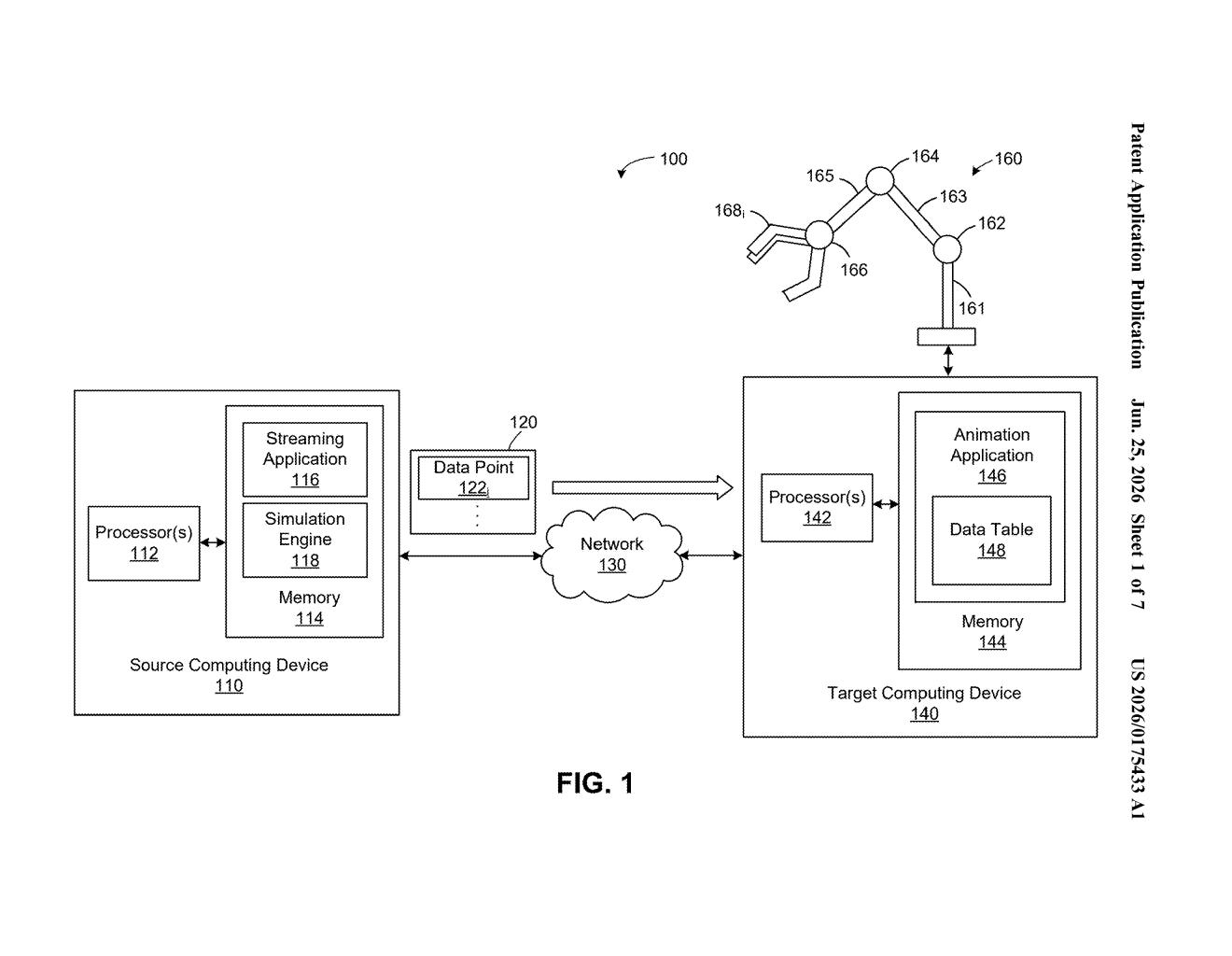
How Disney bridges film animation and physical robots
When animators create a character's movement in a Disney film, they don't draw every single frame by hand. Instead, they place a handful of key poses on a timeline and let the software draw a smooth curve connecting them. The result is fluid, natural-looking motion.
This patent describes taking that same curve data and feeding it directly into a physical animatronic figure, like the kind you'd see in a theme park ride or live show. The robot reads the curve, figures out where every joint needs to be at every moment in time, and moves accordingly.
The clever part is the word "non-deterministic" in the patent title. The system is designed to handle data that isn't perfectly clean or predictable, meaning animators may not need to specify every detail precisely. The robot can still interpret imprecise or incomplete input and produce smooth, convincing movement.
How animation curves get translated into physical motion
The patent describes a pipeline with three core steps:
- Receive data points: Each data point pairs a value (animation data, such as a joint angle or position) with a specific moment in time. These are the animator's "keyframes," the deliberate poses they set by hand.
- Compute a curve: The system fits a smooth mathematical curve through those keyframes. This is standard practice in computer animation, where software interpolates (fills in the gaps) between keyframes so motion looks fluid rather than choppy.
- Drive the actuator: The curve is then used as a direct command to the physical system, telling motors and servos exactly how to move over time.
The term "non-deterministic data" in the title suggests the system tolerates inputs that are incomplete, noisy, or loosely defined. Rather than requiring a fully specified motion plan before anything moves, the system can work with probabilistic or approximate animation intent.
This approach would let a Disney animator work in their normal software environment and have the result drive a physical character without a separate team having to re-author the motion for robotics hardware.
What this means for theme park characters and shows
For theme park operations, the gap between what animators create on screen and what a physical robot can actually perform has always required significant manual engineering work. A pipeline that accepts standard animation curve data directly could reduce that gap and let creative teams iterate on character performances much faster.
More broadly, this patent fits into a pattern of Disney exploring tighter integration between its film production tools and its physical entertainment hardware. If an animatronic figure can consume the same data format a film animator produces, the same performance could theoretically appear in a movie and in a park attraction with far less duplicated effort.
This is a real workflow problem with a sensible solution, not a flashy concept. The gap between digital animation data and physical robot control is genuinely painful in practice, and bridging it with standard curve data is a practical engineering goal. It won't make headlines outside of robotics and theme park circles, but for Disney's parks division it's the kind of infrastructure patent that saves months of production time.
There are more where this came from
We read every patent application Big Tech publishes and send you the ones worth knowing. Plain English, free, every week.
Want this weekly breakdown for a company we don't cover? Patentlyze Pro →