
Qualcomm Patents a Faster Way to Turn 3D Scene Data Into Flat Images
Qualcomm has filed a patent describing a structured pipeline for converting chunked 3D spatial data into normal 2D images on-device, a capability that sits at the heart of augmented reality, spatial video, and robotics perception.
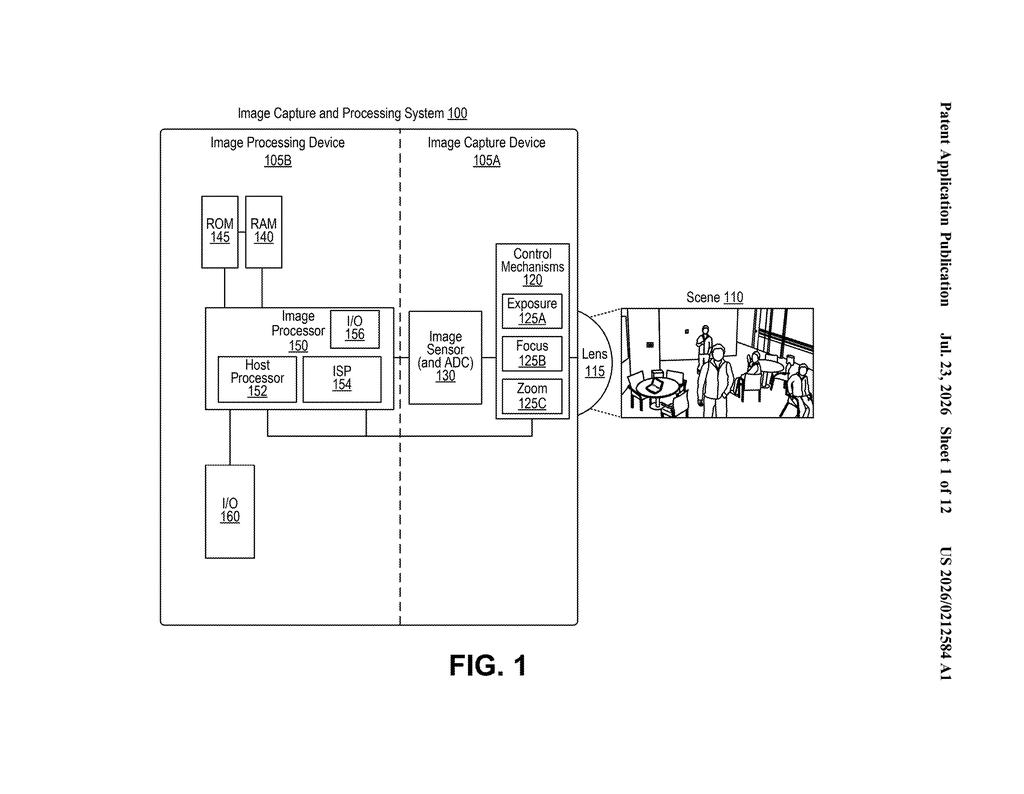
How Qualcomm converts 3D space into a viewable 2D image
Imagine you're wearing a headset that has scanned the room around you in 3D. Before you can actually see that scan as a picture, a computer has to figure out which parts of the room are visible from where you're standing, how far away each surface is, and what color each pixel in the final image should be. That process has to happen extremely fast, ideally right on the device in your pocket or on your face.
Qualcomm's patent describes a way to do exactly that. It breaks the 3D scene into small chunks called voxel blocks (think of tiny cubes stacked up to fill a room), projects those cubes onto a flat camera view, and then fires virtual rays through each pixel to figure out what color it should be. A sorting system using generated 'keys' keeps the depth order correct so closer objects appear in front of farther ones.
The whole approach is designed to run efficiently on hardware Qualcomm builds, which matters because the alternative is sending all that data to a cloud server and waiting for a result. Doing this locally means lower lag and better privacy.
How voxel blocks, keys, and ray casting combine on-device
The patent describes a rendering pipeline built around voxel blocks, fixed-size cubes that divide a 3D scene into a regular grid. Each block has a known position in 3D space, which makes it predictable and easy to handle in parallel hardware.
The system works in four main steps:
- Projection: The voxel blocks are projected onto a flat 2D plane from a given camera angle (called a camera pose), which produces depth information showing how far each block is from the viewer.
- Key generation: Each block gets a sort key combining its depth value and a patch identifier (a label tying the block to a region of the image). These keys let the system quickly order blocks from nearest to farthest without scanning everything.
- Ray casting: For each pixel in the output image, a virtual ray is fired through the scene. The system samples along that ray using the pre-sorted keys to find the correct color, stopping once it hits an opaque surface.
- Image output: The assembled pixel colors form the final 2D image.
By organizing the 3D data into uniform blocks and pre-sorting them with keys before ray casting begins, the pipeline avoids redundant computation and is structured to run on the kind of parallel processors Qualcomm designs for mobile and XR (extended reality) devices.
What this means for AR, robotics, and on-device 3D rendering
For augmented reality and spatial computing devices, the ability to render a 3D reconstruction into a convincing 2D view in real time is a core requirement. Current approaches often either require heavy cloud processing or sacrifice quality to hit acceptable frame rates on mobile chips. Qualcomm's block-based approach is explicitly designed to run on-device, which matters for latency and for scenarios where a network connection isn't guaranteed.
This also has implications for robotics and autonomous systems, where a device needs to build a 3D map of its surroundings and then reason about what it sees from a specific viewpoint. If Qualcomm can integrate this pipeline into its Snapdragon chips, it could give those platforms a meaningful edge in spatial AI workloads.
This is solid infrastructure work rather than a flashy consumer feature, but infrastructure is exactly what the XR and robotics markets are waiting on. Qualcomm is building the rendering primitives that would let its chips handle spatial AI without offloading to the cloud, and that is a strategically important position to hold.
There are more where this came from
We read every patent application Big Tech publishes and send you the ones worth knowing. Plain English, free, every week.
The drawings
12 drawing sheets from US 2026/0212584 A1 · click any drawing to enlarge


Want this weekly breakdown for a company we don't cover? Patentlyze Pro →