
Google Patents a System That Cross-Checks AI-Generated Code Before Running It
Most AI coding tools generate one answer and hand it over. X Development's new patent describes a system that generates several candidates, pits them against each other, and only runs the one that survives the comparison.
How X Development's self-checking code generator works
Imagine asking an AI assistant to write a small program for you. Today, most tools produce one answer and call it done. If that answer is wrong, you find out the hard way, usually when the program crashes or does something unexpected.
X Development's patent describes a different approach. Instead of generating one piece of code, the system generates several candidate versions from your plain-English request. It then translates each candidate into a comparable form and checks them against each other, looking for the version that is most consistent with what the others are saying. Think of it like asking three people to independently solve the same math problem: if two agree and one disagrees, you have a clue about which answer to trust.
The version that passes this internal consistency check is the one that actually gets sent off to run. The goal is to catch bad outputs before they cause problems, without requiring a human to review every line.
… stochastically sampling, as a plurality of candidate representations of the semantic concept in a second domain, a plurality of candidate source code instances from one or more stochastic processes that use one or more neural networks …
Translation: The AI generates multiple different code options using probabilistic neural networks.
How mutual constraint satisfaction picks the winning code
The patent describes a process built around what it calls mutual constraint satisfaction, which is a way of checking whether independently generated answers are consistent with one another.
Here is the basic flow:
- A natural language prompt (your plain-English description) is treated as the starting point, or first domain representation.
- One or more neural networks stochastically sample (meaning: generate probabilistically, not deterministically) several candidate source code outputs from that prompt. These are the candidates being evaluated.
- Each candidate is then converted into an evaluation representation, a form that can be compared against the others.
- The system scores pairs of these evaluation representations against each other, checking for a similarity threshold that signals the candidates are mutually coherent.
- The candidate that best satisfies the cross-comparison is selected and passed downstream for actual execution.
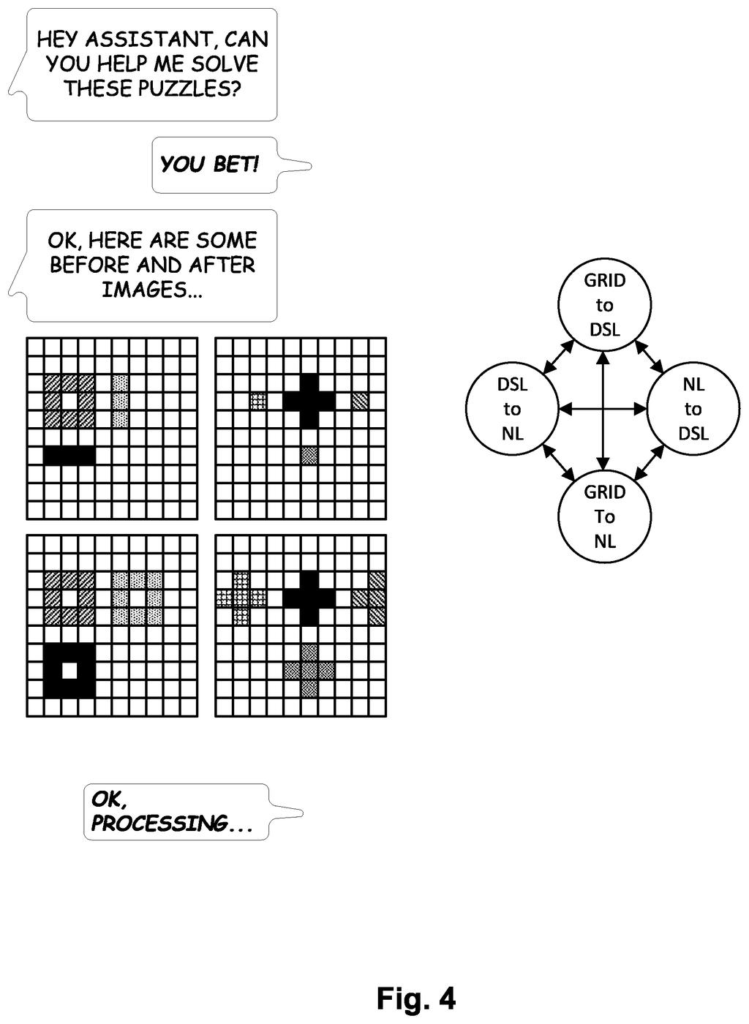
The broader architecture described in the abstract involves bouncing representations across multiple domains (text to code to a third format and back), which lets the system use different models at each step to triangulate the best output. The independent claim, though, focuses specifically on the text-to-code case.
Disclosed implementations relate to using mutual constraint satisfaction to sample from different stochastic processes and identify coherent inferences across domains.
Translation: The system cross-checks different AI outputs against each other to find the best match.
What this means for AI agents writing real code
AI coding agents are increasingly being used in automated pipelines where a human is not watching every step. When those agents produce bad code, the cost is no longer just an awkward suggestion in a chat window; it can mean a broken workflow, a failed deployment, or worse. A system that filters its own outputs before they run addresses exactly that failure mode.
X Development is the research and development arm of Alphabet (Google's parent company), and this patent fits into a broader industry push toward agentic AI, where AI systems take real-world actions rather than just producing text for a person to review. If this kind of self-checking becomes standard in code-executing agents, you would get a system that is more likely to do what you asked the first time, without needing you to babysit the output.
This is a real technical problem with a real engineering answer. AI agents that execute code without human review are only as trustworthy as their self-correction mechanisms, and the cross-checking architecture here is more principled than simply running the first output. Whether the approach scales to complex real-world tasks is the open question, but the direction is correct.
There are more where this came from
We read every patent application Big Tech publishes and send you the ones worth knowing. Plain English, free, every week.
The drawings
8 drawing sheets from US 2026/0228439 A1 · click any drawing to enlarge


Want this weekly breakdown for a company we don't cover? Patentlyze Pro →
Be the first to weigh in