
Qualcomm Patents Smart Glasses AI That Splits Processing Between Device and Cloud
Your smart glasses shouldn't have to beam every question to a distant server. Qualcomm's new patent describes a system that reads the situation around you and decides, on the spot, whether to answer your question on the glasses themselves or hand it off to the cloud.
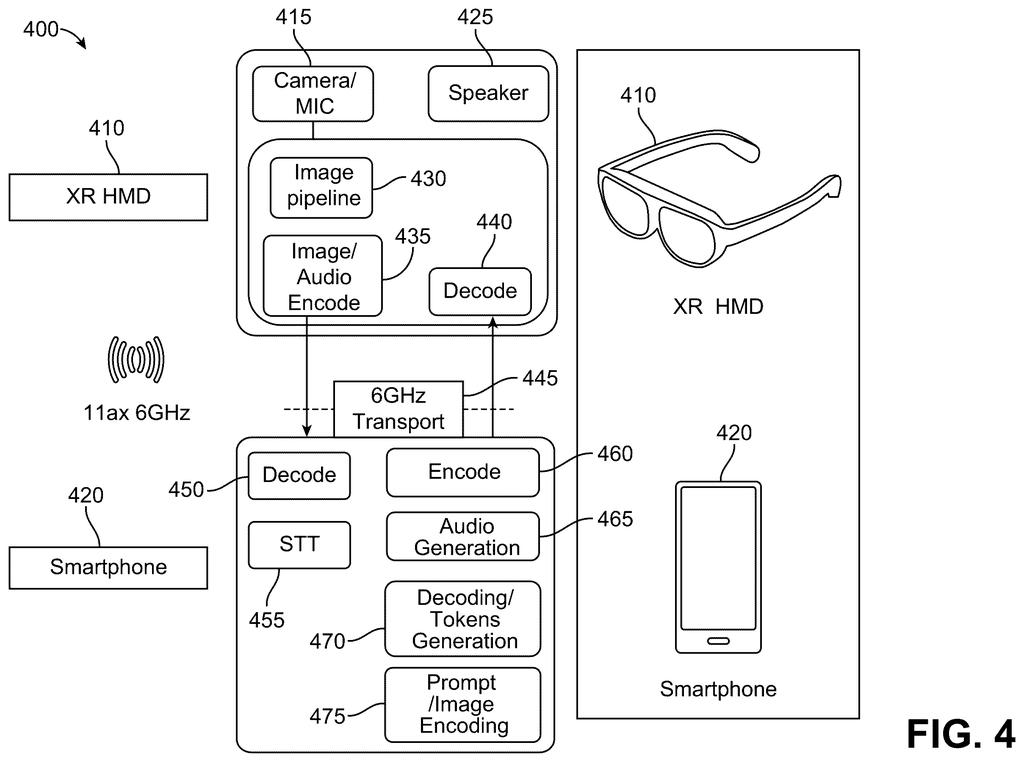
How Qualcomm's smart glasses decide where to think
Imagine you're wearing smart glasses at a noisy outdoor market and you ask, "What's that building?" The glasses look at the scene around you, figure out what's happening, and then decide the best way to answer you. Sometimes they can handle it themselves. Other times, they need backup from a server somewhere.
That's the idea behind this Qualcomm patent. The glasses use their built-in cameras and microphones to gather information about your surroundings, build up a picture of what's going on, and then route your question to whichever AI system can answer it fastest and most accurately given the situation. The device checks things like battery level, connection quality, and how complex the question is before deciding.
Qualcomm is positioning this as a smarter way to handle AI on wearable devices that have limited power and computing muscle compared to a phone or laptop. The goal is answers that feel instant, without draining your battery or requiring a perfect internet connection.
… determine an AI assistance processing strategy from a plurality of AI assistance processing strategies based on the one or more contexts, the prompt, one or more device properties, or a combination thereof …
Translation: The glasses figure out whether to handle tasks locally or in the cloud based on the situation.
How the glasses pick a processing strategy in real time
The patent describes an AI assistance processing strategy system built for a device like smart glasses. At its core, the glasses constantly take in sensor data, including camera feeds, audio, and potentially other environmental inputs, and use that data to build a context model of the current scene (think: indoors vs. Outdoors, crowded vs. Quiet, familiar location vs. Unfamiliar).
When you ask a question, the system doesn't just fire it off to an AI server automatically. Instead, it:
- Combines your question with the scene context to form a richer prompt (a structured request the AI can act on)
- Evaluates several processing strategies, such as running the AI entirely on-device, splitting the work between the glasses and a paired phone, or routing the full query to a cloud server
- Picks the strategy based on context, prompt complexity, and device properties like battery level and available bandwidth
The result is an answer generated through whichever path the system deemed best for that specific moment. This approach, sometimes called split inference (dividing an AI computation between two or more devices), is designed to balance speed, accuracy, and power consumption in real time.
… obtain, from sensor(s), sensor data associated with a scene. The computing device can determine, based on the sensor data, one or more contexts for the scene …
Translation: Sensors capture the user's surroundings to understand what is happening around them.
What this means for the next wave of AI glasses
Smart glasses are in a tough spot: they need to be light and battery-efficient, but AI assistants are power-hungry and often need fast internet. Shipping every question to a cloud server adds delay and burns through data. Running everything locally demands chips and batteries that don't yet fit in a lightweight frame. Qualcomm's approach tries to thread that needle by making the routing decision dynamic rather than fixed.
This matters because the company makes the chips that power a growing number of AI glasses and extended reality headsets. A patented strategy for intelligent workload splitting could become part of Qualcomm's chip platform, influencing how any device using its silicon handles AI queries, not just one product.
This is infrastructure-level work, and it's worth paying attention to. Qualcomm isn't building glasses itself; it builds the chips that go inside everyone else's glasses. A system that decides where AI processing happens, baked into the silicon, gives Qualcomm real influence over how the entire AI-wearables category behaves. The patent is broad, which cuts both ways: it covers a lot of ground but may face challenges being enforced narrowly.
There are more where this came from
We read every patent application Big Tech publishes and send you the ones worth knowing. Plain English, free, every week.
The drawings
15 drawing sheets from US 2026/0228256 A1 · click any drawing to enlarge


Want this weekly breakdown for a company we don't cover? Patentlyze Pro →
Be the first to weigh in