
Samsung Patents a Multi-Camera System That Eliminates Video Shake
Most phone stabilization fights shake after the fact. Samsung's new patent tries something different: pulling the steadiest slice from every camera at once and stitching those slices together into one rock-solid frame.
What Samsung's multi-camera stabilization actually does
Imagine you're filming a friend's birthday toast while holding your phone with one hand. Even with optical stabilization on, the footage comes out a little wobbly. Traditional stabilization tries to smooth that out after the fact, but it's still working from one shaky source.
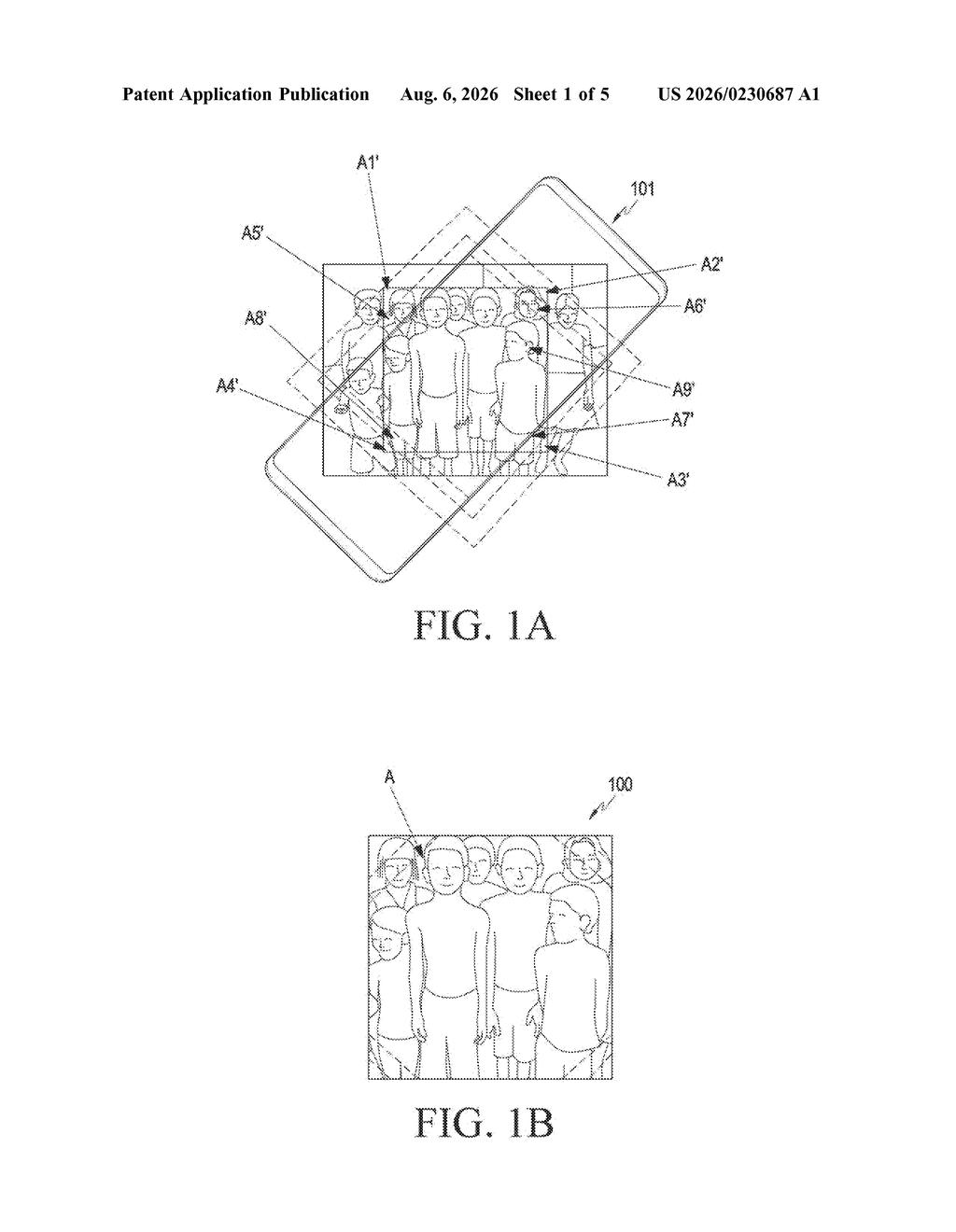
Samsung's patent describes a different approach. Your phone already has multiple cameras pointing at roughly the same scene. This system looks at the footage from all of them at once, figures out the steadiest central region each camera can reliably capture given its angle and zoom, and then cuts out that steady slice from each camera's feed.
Those slices are then assembled into a single composite video frame. The result is a final video that draws only from the parts of each camera's picture that barely moved at all, giving you footage that's far steadier than any one camera could deliver on its own.
… determining a plurality of largest central square field of views (LCSFoVs) of the plurality of cameras; based on the plurality of LCSFoVs, determining a retention area with respect to the plurality of video frames …
Translation: The software calculates the best overlapping visual zones to keep from all the lenses at once.
How the system picks and stitches the steadiest frame regions
The patent describes a process that runs across the multi-camera array of a device like a smartphone. Here's the sequence:
- Field width and tilt detection: The system reads each camera's field of view (how wide an angle it captures) and its tilt angle (how much the camera is physically angled relative to the others).
- Largest Central Square Field of View (LCSFoV): For each camera, the system calculates the biggest square crop that sits at the center of the frame and remains usable no matter how the device tilts. Think of it as the guaranteed-steady bullseye of each lens.
- Retention area: Across all cameras, the system finds a common retention area, the region that all cameras can reliably cover within their individual LCSFoVs.
- Fragment extraction and assembly: It pulls the matching fragment from each camera's video frames and stitches those fragments together into one composite output frame.
The approach is different from software stabilization (which crops and shifts a single camera's frames after recording) and from optical image stabilization (which physically moves a lens element). Instead, it treats the multi-camera array as a single distributed sensor and picks only the steadiest data from each.
… identifying, in the plurality of video frames, a plurality of video frame fragments corresponding to the retention area; assembling the plurality of video frame fragments to generate a hyper-stabilized composite video frame …
Translation: It crops the best pieces from each camera feed and stitches them together into one steady picture.
What this means for Galaxy video recording
Samsung's Galaxy phones already carry three or four cameras, and right now each lens mostly competes for the user's attention rather than cooperating with the others. This patent points toward a future where those cameras act as a team during recording, not just at the moment you switch between lenses.
For you as a user, the promise is video that stays steady even when you're moving, without the telltale zoomed-in, cropped look that aggressive software stabilization produces today. It could also matter for action or sports recording, where shake is unavoidable and every fraction of a degree of tilt costs you image quality.
This is a genuinely interesting idea because it reframes what a multi-camera phone array is actually for. Most manufacturers use multiple cameras to give you zoom options or depth data; using them cooperatively to build one steadier frame is a different bet entirely. Whether the stitching artifacts are manageable in real footage is the engineering question that will decide whether this goes anywhere.
There are more where this came from
We read every patent application Big Tech publishes and send you the ones worth knowing. Plain English, free, every week.
The drawings
5 drawing sheets from US 2026/0230687 A1 · click any drawing to enlarge


Want this weekly breakdown for a company we don't cover? Patentlyze Pro →
Be the first to weigh in