
Samsung Patent Covers AR Glasses That Stay Stable Inside a Moving Vehicle
AR glasses that work well while you're walking around are one thing. Getting them to work inside a moving car, where the vehicle's acceleration and vibration constantly fool the motion sensors, is a genuinely harder problem. Samsung has filed a patent that tackles exactly this.
Why AR glasses get confused inside a moving vehicle
Imagine putting on a pair of AR glasses in your car and trying to use them for navigation or entertainment. The problem is that the glasses track your head using motion sensors, and those sensors can't easily tell the difference between you moving your head and the car hitting a bump or turning a corner. The result is AR content that floats around or drifts out of place.
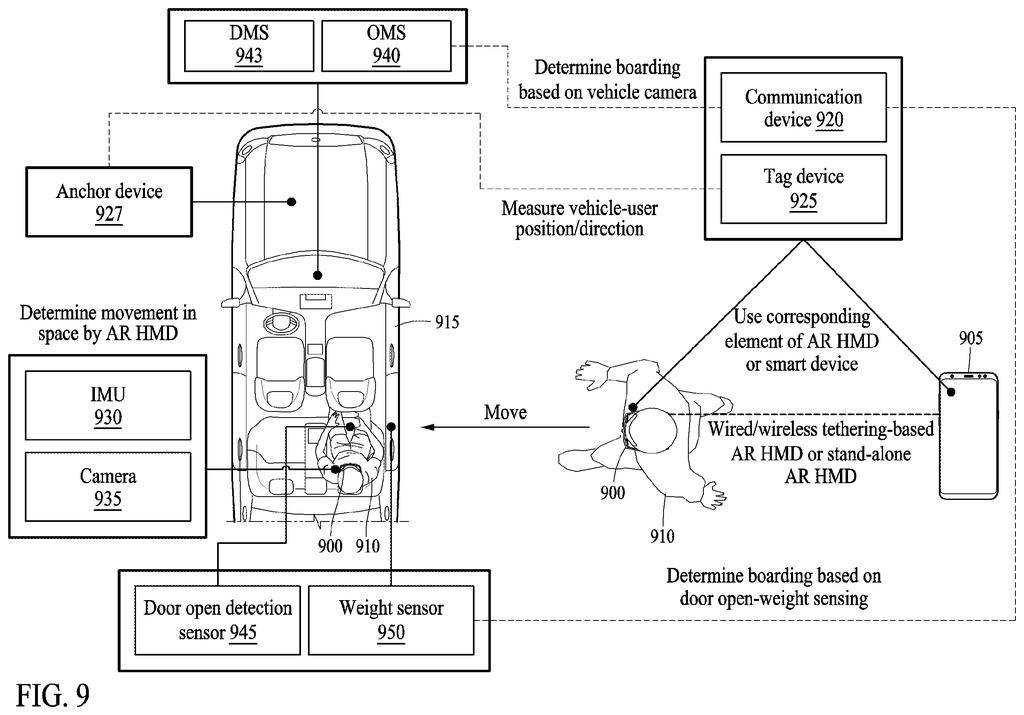
Samsung's patent describes a system that first detects when you're inside a vehicle, then switches the glasses into a special mode. Instead of relying purely on the motion sensors, the glasses use their cameras to look at fixed points inside the car (like the dashboard or door trim) to figure out exactly where your head is positioned and which direction you're looking. That camera-based position data is then used to correct the motion sensor readings.
The end result is AR content that stays put relative to your view, even as the car accelerates, brakes, or turns. Think of it as the glasses learning that the vehicle's cabin is their local ground truth, and ignoring everything happening outside.
determine whether the wearable AR device is within a space of a vehicle based on a value measured by the at least one sensor …
Translation: The glasses figure out if you are currently sitting inside a car or other vehicle using motion sensors.
How Samsung's system corrects motion sensor errors in a car
The patent describes a wearable AR device (think glasses or a headset) that runs a two-step process when you get into a car.
Step one: vehicle detection. The device uses its onboard sensors, specifically an inertial measurement unit (IMU) (a chip that measures acceleration and rotation), to figure out whether it's inside a vehicle. The movement patterns of a car are distinct enough from walking that the IMU data can flag the transition automatically.
Step two: position locking via camera. Once inside the vehicle, the device stops trusting the IMU alone. Instead, it uses the onboard cameras to identify visual reference points inside the car's cabin and uses those to calculate the wearer's precise head position and direction. This is similar to how a drone uses a downward-facing camera to hold its position above the ground, rather than relying on GPS alone.
Step three: IMU adjustment. The camera-derived position data is then used to correct, or "adjust," the IMU readings so that the motion sensor output reflects only the wearer's head movements, not the car's movements. The corrected data drives the AR display, keeping virtual content anchored to the right place in the wearer's field of view.
The patent also involves a companion electronic device (likely a phone) coordinating with the glasses, suggesting the processing workload may be shared.
… determine at least one of a position or a direction of the wearable AR device by using images acquired through the at least one camera and adjust inertia values measured by the IMU …
Translation: It tracks your exact location and heading using camera pictures while smoothing out motion sensor data.
What this means for in-car AR navigation and entertainment
For AR glasses to be useful in a car, this kind of correction isn't a nice-to-have; it's a basic requirement. Navigation arrows that drift, warning overlays that slide off the road, or entertainment content that bounces with every pothole would make the experience unusable. This patent addresses the core technical barrier standing between AR glasses and real in-car utility.
Samsung is actively competing in the AR glasses space, and in-car use is one of the clearest near-term markets: it's a controlled environment, people are captive, and there's obvious demand for heads-up information. A reliable solution to vehicle-induced sensor drift would give Samsung's AR hardware a meaningful advantage in one of the most practical settings your glasses could ever be used in.
This is a genuinely useful engineering patent, not a vague concept filing. The problem it solves is real and specific, the approach (using cabin visuals to re-anchor IMU data) is technically credible, and in-car AR is one of the few near-term contexts where people would actually wear AR glasses for extended periods. It's worth watching, especially given Samsung's recent push into the AR hardware market.
There are more where this came from
We read every patent application Big Tech publishes and send you the ones worth knowing. Plain English, free, every week.
The drawings
19 drawing sheets from US 2026/0227637 A1 · click any drawing to enlarge


Want this weekly breakdown for a company we don't cover? Patentlyze Pro →
Be the first to weigh in