
Apple Patents a Reminder System That Reads Your App Activity
Apple is patenting a way to make reminders aware of what you were doing when you set them, so picking up where you left off becomes automatic.
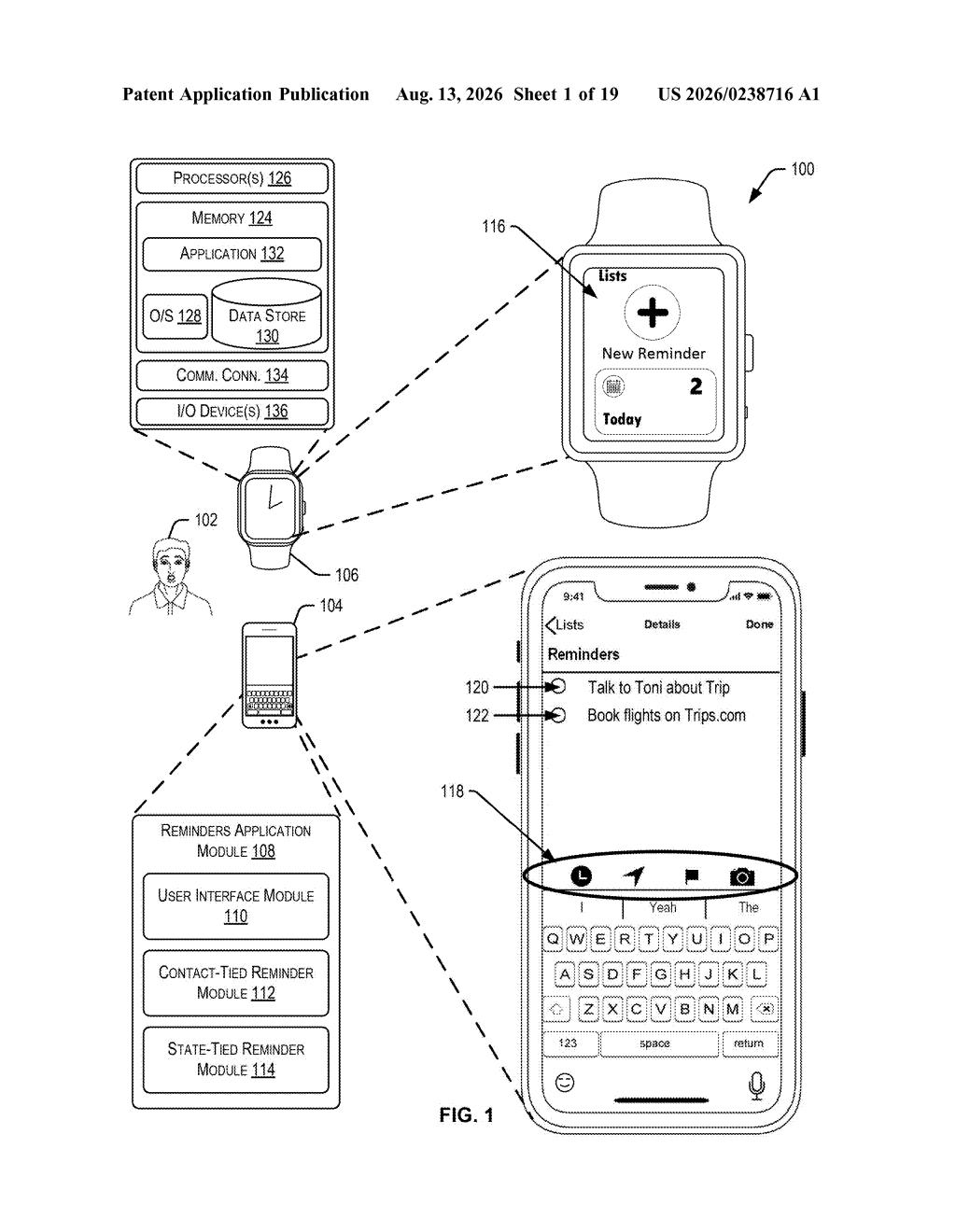
What Apple's context-aware reminders actually do
Imagine you're browsing a shopping app, spot something you want to buy later, and tap a button that sets a reminder. Today, that reminder is just a plain text note with a time or location attached. It has no memory of the page you were on, the item you were looking at, or anything else about that moment.
Apple's patent describes a system where reminders can be triggered by people or places, and can also save a snapshot of what you were doing inside an app when you set them. That means a reminder could not only ping you when you arrive at a store, but also drop you back into the exact screen you were on when you set it.
The patent also covers a more detailed configuration interface for building reminders, where tapping different options brings up a layered set of choices. It is mostly about making reminders smarter to set up and more connected to your real workflow.
… in response to detecting the input corresponding to the configuration option of the one or more configuration options, configuring the reminder based at least in part on the input corresponding to the configuration option of the one or more configuration options.
Translation: The system updates your reminder settings as soon as you select a specific option from the menu.
How the app state gets attached to a reminder
The patent covers two related ideas that work together to make reminders more context-aware.
First, the system allows reminders to be triggered by conditions beyond time. Specifically, it calls out other users (a reminder fires when you're near a specific contact) and locations as valid triggers. This is not entirely new to iOS, but the patent frames it as a configurable layer within a broader reminder-creation interface.
Second, and more interesting, the system can capture app state when a reminder is created. App state means a snapshot of what was happening inside an application at that moment: which screen was open, what data was displayed, where you were in a workflow. That state is saved alongside the reminder, so when the reminder fires, it can potentially restore that context rather than just alerting you with a text string.
The claim itself describes a layered configuration UI: you see a reminder element on screen, tap a configuration option, get a sub-menu of choices, select one, and the reminder is updated accordingly. The mechanics are fairly standard interface design, but the payload being configured (triggers, saved state) is the substantive part.
… reminders can be generated based at least in part on user interaction with an application, where state information can be saved and associated with the reminders.
Translation: The software tracks what you are doing inside an app and saves that context to help create your reminder.
What this means for iPhone's Reminders app
For everyday iPhone users, this could close a real gap. Reminders today are good at telling you when or where to do something, but they don't help you pick up from where you left off. Context-restoring reminders that return you to your exact place in an app are meaningfully more useful than a sticky note.
The software side of this patent is largely buildable with iOS tools that already exist. Apple does not need new hardware to ship most of what is described here, which puts this closer to the near-term end of the pipeline than many Apple filings. How deeply third-party apps could participate would depend on what Apple exposes to developers. This kind of state-aware reminder infrastructure sits alongside the broader wave of new Big Tech patents tightening the loop between productivity apps and the operating system, and it is the sort of quiet plumbing work that tends to surface in a dot release rather than a headline product launch.
The shortest path to shipping this is a software update to the existing Reminders app, possibly extended to third-party apps through a modest API addition. The layered configuration UI described in the claim already resembles what iOS shortcuts and focus filters do today, so the engineering lift is moderate. The app-state-snapshot feature is the one part that could get complicated fast, since it requires apps to expose their internal state in a standardized way. Apple controls enough of the default app ecosystem that it could ship a useful version of this without any developer buy-in at all.
There are more where this came from
We read every patent application Big Tech publishes and send you the ones worth knowing. Plain English, free, every week.
The drawings
19 drawing sheets from US 2026/0238716 A1 · click any drawing to enlarge


Want this weekly breakdown for a company we don't cover? Patentlyze Pro →
Be the first to weigh in