
Google Patents a System That Decides Which of Your Devices Should Answer You
Say "Hey Google" in a room full of smart speakers and every one of them tries to answer. Google is patenting a way to settle that argument before you ever hear a peep.
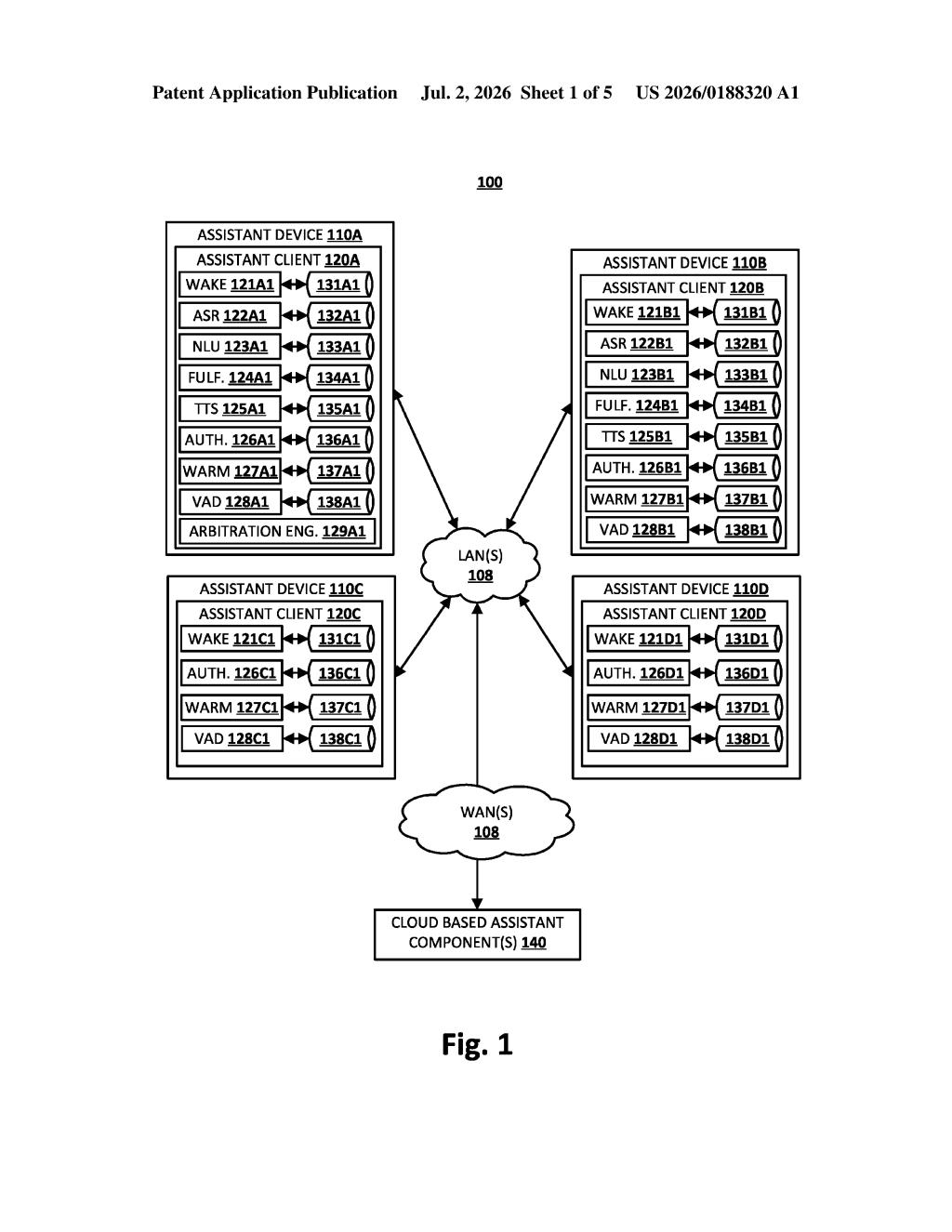
How Google picks one device when several hear you
Imagine you say "Hey Google, what's the weather?" and your Nest Hub in the kitchen, your Pixel phone on the counter, and a speaker in the living room all hear you at the same time. Right now, that can mean three devices lighting up, talking over each other, or giving you a chorus of responses. It's awkward.
Google's new patent describes a system where a server in the background notices that several of your devices all caught the same voice command at roughly the same moment. Instead of letting them all respond, the server quickly scores each device on two things: how clearly it heard you, and whether you've been actively using it recently. The device with the best combined score wins and answers; the rest are told to stay quiet.
The whole thing happens automatically, in the background, before any device actually speaks. You just ask your question and one device answers, the way it always should have worked.
How the similarity score and interaction signal work together
The patent describes a server-side arbitration system (a referee, essentially) that steps in whenever multiple devices tied to the same Google account all detect the same wake word within a short time window.
For each competing device, the server calculates a similarity score built from two inputs:
- Query signal: a measure of how confidently and cleanly that device detected the wake word, likely reflecting microphone quality and proximity to the speaker.
- Interaction signal: a record of whether the user was actively engaging with that device recently, such as touching its screen, playing audio through it, or using an app on it.
The server combines those two signals into a single score for each device, then picks the highest scorer as the target device. It sends a suppression instruction to every other device in the running, telling them to stand down and not activate their assistant functions.
The patent frames this as happening entirely at the server level, meaning the devices themselves don't need to negotiate with each other directly. The central server sees the full picture across all devices on the account and makes the call.
What this means for homes full of Google devices
If you own more than one Google device, you've almost certainly experienced the multi-device pile-up. This patent addresses one of the most consistently annoying parts of living with voice assistants in a connected home. The interaction signal detail is particularly thoughtful: the device you were just using is probably the one you want to answer, and factoring that in makes the selection feel less random.
For Google, this also matters at a product strategy level. Amazon's Alexa has had its own version of this problem for years, and Apple's "Hey Siri" handoff logic has been a selling point for the Apple ecosystem. A cleaner arbitration system makes Google's device lineup feel more cohesive, which is important as Nest and Pixel products increasingly overlap in function.
This is a genuinely useful fix to a real, everyday frustration, not a far-future concept. The scoring method, combining audio confidence with recent interaction history, is a reasonable and practical approach. Whether Google can make it fast and reliable enough that users never notice the latency of a server round-trip is the real engineering challenge, but the patent's logic is sound.
There are more where this came from
We read every patent application Big Tech publishes and send you the ones worth knowing. Plain English, free, every week.
Want this weekly breakdown for a company we don't cover? Patentlyze Pro →
Be the first to weigh in