
Sony's Smart Glasses Patent Spots Workout Opportunities in Your Everyday Surroundings
Sony has filed a patent for AR eyeglasses that watch your surroundings and nudge you to exercise when they spot an opportunity. Point them at a park bench and they might suggest push-ups; walk past a staircase and they could flash a reminder to take the stairs.
What Sony's exercise-spotting glasses actually do
Ever looked at a park on your lunch break and thought "I should really do something active", and then didn't? Sony's new patent is designed to solve exactly that moment of inertia.
The glasses use a built-in camera to look at whatever is in front of you. If the system decides your surroundings offer a chance to exercise, it overlays a prompt or graphic on your lenses to point that out. You don't have to open an app or set a reminder, the glasses just notice the opportunity and tell you about it.
Think of it as a fitness coach built into your eyewear, one that watches your environment so you don't have to. The patent doesn't lock in which exercises it covers or how it recognizes them, but the core idea is that your physical surroundings become triggers for movement prompts.
determine, based on image data of the camera, whether the environment offers a user of the eyeglasses an opportunity to perform a physical health exercise …
Translation: The glasses use their camera to scan your surroundings to see if there is a good place or reason to exercise.
How the glasses scan your surroundings for workout cues
The patent describes a pair of eyeglasses with three main components working together: a camera, a display, and processing circuitry (the onboard chip doing the thinking).
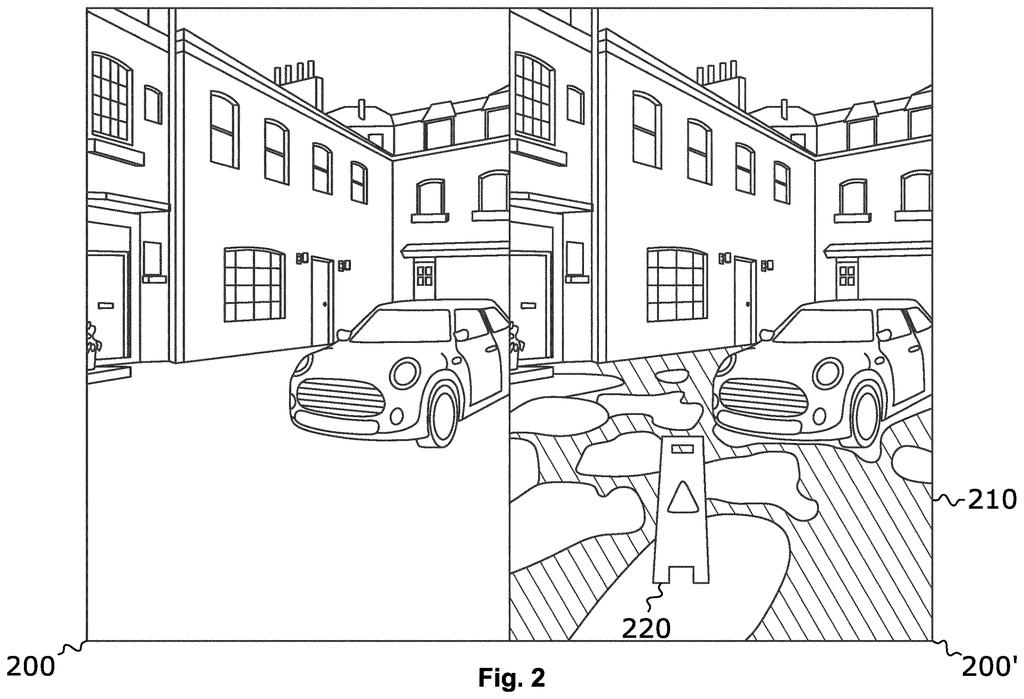
The camera continuously captures what you're looking at. The processor then analyzes that image data to decide whether the scene contains something that could be used for exercise. If it finds such an opportunity, it instructs the display, built into the lenses, to show one or more graphics tied to that opportunity.
- Camera: captures the real-world environment in real time
- Processing circuitry: runs image analysis to classify whether an exercise opportunity exists
- Display: overlays graphical prompts onto the wearer's field of view
The patent is deliberately broad about what counts as an "opportunity." A set of stairs, an open field, a park bench, or a stretch of sidewalk could all qualify depending on how the classification model is trained. The graphics shown could range from simple icons to step-by-step exercise instructions. The processing could run on-device or offload to a connected device, the patent doesn't specify.
If it is determined that the environment offers an opportunity to perform a physical health exercise, the processing circuitry is configured to control the display to output one or more graphical elements related to the opportunity to perform a physical health exercise.
Translation: When the glasses find a workout chance, they show visual cues on the lenses to prompt you to start moving.
What this means for wearable fitness technology
Fitness wearables have mostly worked by tracking what you already did, steps counted, calories burned, heart rate logged. Sony's approach flips that: instead of logging past behavior, the glasses try to shape future behavior by reacting to your environment in real time. That's a meaningful shift in how wearable health tech could work.
The practical hurdles are real. Accurate environment classification in unpredictable lighting and varied settings is hard, and users may find persistent exercise prompts annoying enough to disable the feature entirely. Still, Sony's work here fits into a broader wave of interesting tech patents exploring how AR eyewear can do more than display notifications, pushing toward glasses that act as context-aware health assistants rather than passive screens.
The design trade-off here is fundamental: for the glasses to be useful at all, the camera has to watch your surroundings constantly and correctly identify when a park bench means 'do dips' rather than 'sit down.' That's a high bar for on-device computer vision, and the cost of getting it wrong is user trust: a flood of false positives turns a fitness feature into an annoyance most users will switch off before it changes any habits. The patent is ambitious in concept, but the harder engineering and UX problem, making the prompts feel timely instead of intrusive, is left entirely unaddressed in the filing.
There are more where this came from
We read every patent application Big Tech publishes and send you the ones worth knowing. Plain English, free, every week.
The drawings
3 drawing sheets from US 2026/0235878 A1 · click any drawing to enlarge


Want this weekly breakdown for a company we don't cover? Patentlyze Pro →
Be the first to weigh in