
Google Patent Aims to Let Plain English Commands Direct Real-World Robots
Getting a robot to do what you say is harder than it sounds. Google has filed a patent for a system that lets a robot read a plain-text instruction, look at its surroundings, and figure out the right physical action to take.
How Google wants robots to understand your words
Today's robots typically need to be programmed with very specific commands for each task. Ask a robot to "put the red cup on the left shelf," and it probably won't know what to do unless a developer has pre-coded that exact sequence. Google wants to change that by giving robots a way to read ordinary instructions and connect them to what the robot can actually see.
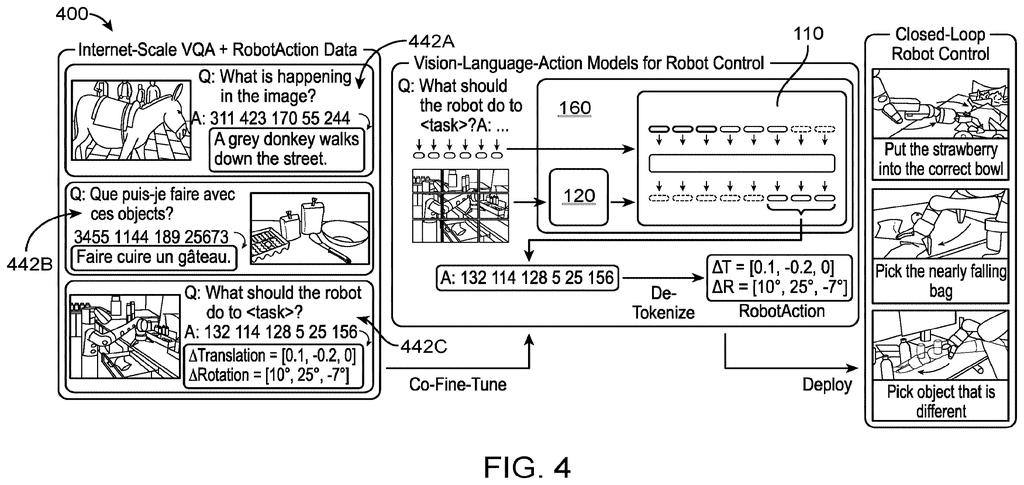
The system described in this patent takes a plain-text request from a user, rewrites it into a tidy format the AI can reliably work with, and then feeds that instruction alongside a live camera image into a neural network. That network then decides what physical action the robot should take next.
The goal is a robot that behaves more like a capable assistant than a pre-programmed machine. You give it a task in natural language, it looks around, and it moves accordingly.
receiving a user text sequence that characterizes a robotic task to be performed by the agent in the environment; converting the user text sequence into an input text sequence in a standardized format for a visual language understanding task …
Translation: The system takes your typed command and translates it into a format the robot brain can understand.
How the neural network links language to robot actions
The patent describes a control pipeline for physical robots (called "agents" in the filing) that combines two things AI has gotten good at separately: understanding language and understanding images.
Here is how the pipeline works step by step:
- Instruction intake: The system receives a free-form text instruction describing a task, such as "pick up the blue block."
- Format conversion: That instruction is automatically rewritten into a standardized format designed for vision-language AI models. Think of it like converting a casual spoken request into a structured query a database can parse cleanly.
- Scene observation: The robot captures an image of its current environment, giving the AI a snapshot of what it is looking at.
- Policy network inference: A neural network called a policy network (a model trained to map situations to actions) takes both the formatted instruction and the image, then outputs a recommended action, such as moving an arm 5 centimeters to the left.
- Execution: The system selects and carries out that action in the physical world.
The key design choice is the standardization step. By converting user instructions into a consistent format before they hit the AI model, the system can be trained on a wide variety of inputs without the model getting confused by phrasing differences.
… processing (i) the input text sequence in the standardized format and (ii) the observation image using a policy neural network to generate a policy output that defines an action to be performed by the agent in response to the observation image …
Translation: An AI neural network combines your text instructions with camera views to figure out what the robot should do next.
What this means for real-world robot assistants
For anyone who has watched industrial robots operate, the gap between what they can do and what a human worker can do is obvious. Industrial robots follow rigid scripts; a human can adapt when something moves or changes. This patent is Google's attempt to close part of that gap by grounding robot decision-making in both language and live visual context.
The filing lands squarely in the growing race to build what researchers call "generalist" robots, machines that can handle many tasks rather than one. Google's robotics division, which has published related research under the "RT" model family, is one of the more active teams in this space, and the latest Big Tech patents in robotics AI show that language-conditioned control is becoming a central design strategy across the industry. Whether any of this arrives in a consumer or commercial product soon depends heavily on hardware that does not yet exist at scale.
The software architecture is credible and the research pedigree behind the inventor list is strong, but the shortest path to a shippable product runs through hardware most companies do not yet have in volume: reliable robot arms, fast enough on-device inference, and sensors that handle real-world lighting and clutter. This patent locks down Google's approach to the language-to-action translation step, which is the hard part of the software problem. Practically speaking, it reads as infrastructure for a platform Google is building toward rather than a feature that ships in the next product cycle.
There are more where this came from
We read every patent application Big Tech publishes and send you the ones worth knowing. Plain English, free, every week.
The drawings
6 drawing sheets from US 2026/0233388 A1 · click any drawing to enlarge


Want this weekly breakdown for a company we don't cover? Patentlyze Pro →
Be the first to weigh in