
Google Patent Turns a Single Prompt Into Documents With Text, Images, and Charts
Right now, building a document with text, charts, and images means bouncing between tools. Google is patenting a way to do all of that from a single typed request.
How Google's single-prompt doc builder actually works
Today, if you want a business report with written analysis, a chart, and some supporting images, you assemble each piece yourself, switching between apps or AI tools for each job. Google wants to change that with a system where you type one request and a coordinating AI handles every piece automatically.
Here's how it plays out for you: you type something like "make a quarterly summary with a sales chart and a header image" into a Google Workspace app. A master AI reads that, figures out which specialist AI tools to call (one for text, one for charts, one for images), collects all the results, and stitches them together into a finished document, formatted and ready to use.
The whole thing arrives in one shot, already formatted for the app you're working in, rather than as a pile of separate files you'd have to arrange yourself.
determine that the content is to include a first content item of a first content type and a second content item of a second content type; identify a second AI model trained to generate content items of the first content type and a third AI mode trained to generate content items of the second content type …
Translation: The system decides what kind of media you need and picks the right specialized AI tools to create each part.
Inside Google's three-model content pipeline
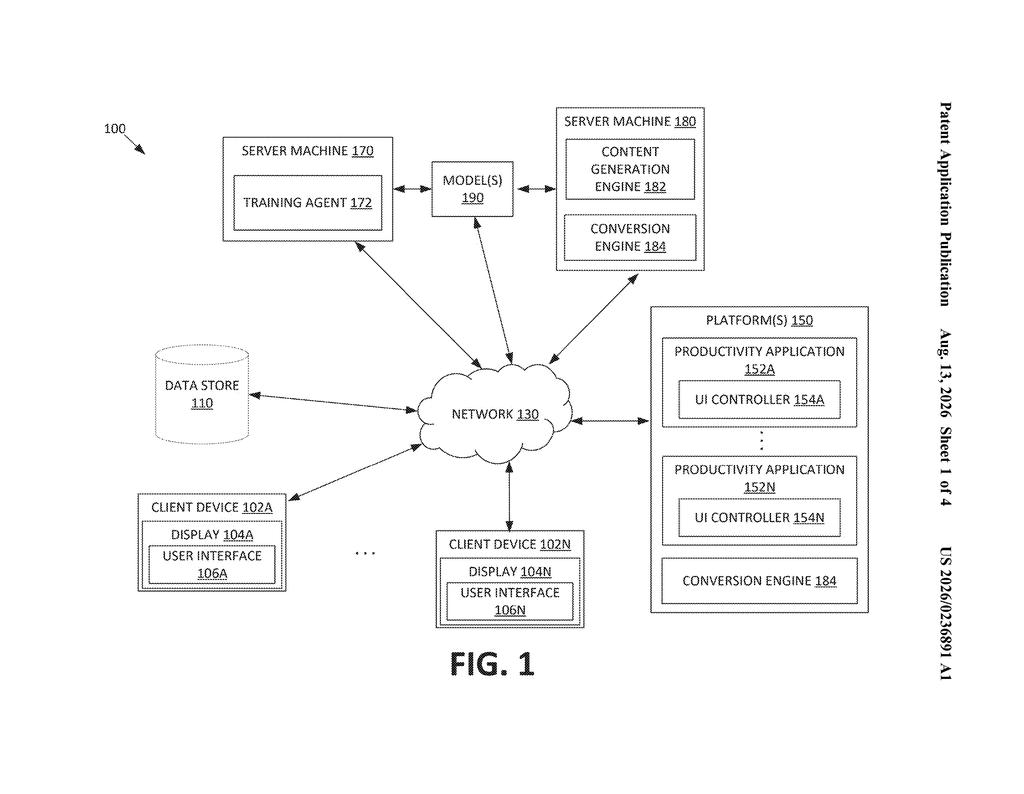
The patent describes a three-layer system built around a coordinating AI model (the "first AI model" in Google's language) that acts as a project manager.
When you submit a text prompt, that coordinator does four things:
- Decides what kinds of content the finished output needs (text, images, data visualizations, or others)
- Routes your prompt to the appropriate specialist AI models, one per content type
- Collects each specialist's output in a shared abstract format (a neutral internal representation that isn't tied to any specific app yet)
- Combines all the pieces into one unified result, then converts that into the file format your productivity app actually uses
The abstract format is a key design choice. By keeping everything in a common internal structure during assembly, the system can mix content types freely before committing to any specific output format, like a Google Doc or Slides deck. That conversion step happens only at the end.
The patent covers this as a server-side pipeline, meaning the heavy AI work happens in Google's cloud and the finished, app-compatible document is pushed to your device through the app's existing interface.
Methods for generating high fidelity multi-modal content using a unified AI architecture are provided. A textual prompt including a request to generate content is received via a user interface (UI) of a productivity application.
Translation: Google is building a way for office software to create complex documents containing text and images from a single command.
What this means for Google Workspace users
For everyday Google Workspace users, this could mean the difference between spending an hour assembling a presentation and getting a draft in seconds. The patent targets productivity apps specifically, so Docs, Slides, and similar tools are the obvious candidates for this kind of one-prompt generation.
The broader picture here is that Google is trying to own the coordination layer, the AI that decides which other AIs to call, not just the individual generation tools. That architectural bet shows up clearly in Big Tech patent news covering the AI-productivity space, where the race is increasingly about who controls the orchestration, not just who has the best text or image model.
Claim 1 is written broadly enough to cover any system where a single AI model routes a prompt to multiple specialist models and assembles their outputs in a shared format before converting to an app-specific format. That scope would potentially block a competitor from building a similar "one prompt, many AI specialists" pipeline inside a productivity app, even if the underlying models are completely different. The claim doesn't require any specific AI architecture, any particular content types, or even any specific app, just the orchestration pattern itself. If granted, that's a wide perimeter around what is rapidly becoming the standard approach to AI-assisted document creation.
There are more where this came from
We read every patent application Big Tech publishes and send you the ones worth knowing. Plain English, free, every week.
The drawings
4 drawing sheets from US 2026/0236891 A1 · click any drawing to enlarge


Want this weekly breakdown for a company we don't cover? Patentlyze Pro →
Be the first to weigh in