
Google Patents AI That Recommends Products Through Natural Conversational Dialogue
Google has patented a system where a large language model tracks the flow of a conversation in real time and uses that understanding to decide what to recommend to you, not just answer your question.
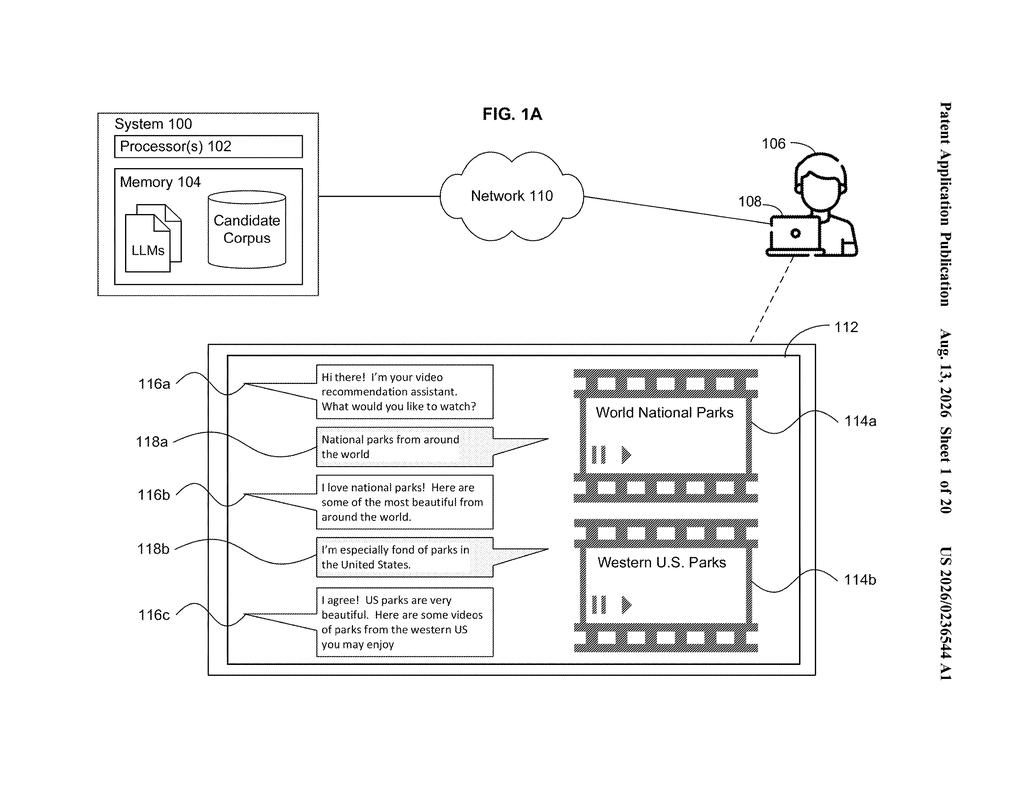
What Google's conversational recommendation system actually does
A shopper types into a chat window: "I want something comfortable for a long flight, not too expensive, and I hate overhead bins." A search box has no idea what to do with that. This is the kind of problem Google's new patent is designed to solve.
The system uses an AI language model to follow the conversation like a human assistant would. As you add details, change your mind, or ask follow-up questions, the model tracks what you want, picks relevant items from a database, and shows them to you alongside a plain-language explanation of why they were chosen.
The result is a recommender that behaves less like a search engine and more like a knowledgeable store clerk who actually listened to what you said.
… the dialogue manager is further configured to present the recommendation slate and an explanation about the recommendation slate to a user of the client device along with the response to the received user input.
Translation: The system provides product suggestions and explains why it chose them during your chat.
How the dialogue manager and recommendation engine work together
At the center of the system is a dialogue manager, a software layer that uses a trained large language model to interpret incoming messages. Rather than just parsing keywords, the model predicts what the patent calls a dialogue state, essentially a running summary of what the user wants, what constraints they've expressed, and where the conversation currently stands.
That dialogue state is handed to a separate recommendation engine, which queries a candidate corpus (a large pool of items, products, or content). The engine filters that pool down to a ranked set of relevant results called a recommendation slate.
The dialogue manager then takes that slate and wraps it in a natural-language response, including an explanation of why those items were surfaced. The key steps in order are:
- User sends a message during a live chat session
- LLM predicts the current dialogue state from that message
- Recommendation engine queries the item database based on that state
- A ranked slate of items is assembled
- The dialogue manager returns the slate plus a response and an explanation to the user
The architecture keeps the language model and the recommendation engine as distinct but connected components, which means each can be updated or swapped independently.
The technology relates to conversational recommender systems ( 100 ) that employ a large language model ( 402 ) which can function as part of a dialogue manager ( 326 ).
Translation: This patent describes using a large language model to manage how a computer talks to you while suggesting products.
What this means for Google's AI-powered shopping and search tools
For Google, this sits squarely at the intersection of two things the company is already pushing hard: conversational AI through Gemini and product discovery through Google Shopping. A system that can sustain a multi-turn conversation while simultaneously surfacing ranked results would be a meaningful step up from the current experience, where chat and search still feel like separate tools bolted together.
For you as a user, the pitch is that you stop having to translate what you actually want into search-box language. The dialogue state tracking means the system remembers that you said "not too formal" two messages ago, even when you've since moved on to asking about colors. Google's work in this area is part of a broader push across AI-powered search and discovery tools covered in the latest Big Tech patents, where conversational recommendation is emerging as one of the more contested spaces.
The architecture here is largely software, which means the shortest path to shipping is straightforward: Google already operates the LLMs, the item corpora, and the chat surfaces. What the patent adds is a formal structure for wiring them together, with an explicit dialogue-state layer sitting between conversation and retrieval, the sort of system design work that typically reaches products within a few cycles. The explanation feature, where the system tells you why it picked what it picked, is the detail most likely to differentiate this from a basic RAG setup in a production rollout.
There are more where this came from
We read every patent application Big Tech publishes and send you the ones worth knowing. Plain English, free, every week.
The drawings
20 drawing sheets from US 2026/0236544 A1 · click any drawing to enlarge


Want this weekly breakdown for a company we don't cover? Patentlyze Pro →
Be the first to weigh in