Google
Google · AI / ML · Filed Nov 10, 2025 · USPTO published Jul 2, 2026 · Jul 2 release
Google Files Patent for Software That Anticipates Your Search Before You Type
Google is patenting a system that watches what you're doing on your device and then guesses which search you're about to run, before you type a single letter.
- Publication number
- US 2026/0187054 A1(US20260187054A1)
- Applicant
- GOOGLE LLC
- Filed · Published
- Nov 10, 2025 · Jul 2, 2026
- Inventors
- Jakob D. Uszkoreit
- Status when we published
- Waiting for an examiner
- Document
- 21 claims
- US classification
- 707/706
- Parent application
- Continuation of 18/743,958 (filed Jun 14, 2024)(18743958)
What Google's context-aware query prediction actually does
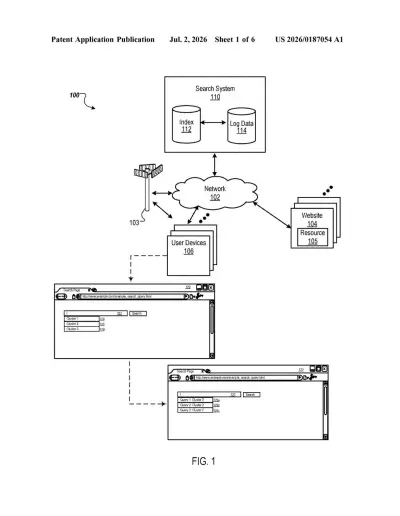
Imagine you just opened a maps app and searched for coffee shops nearby. A moment later, you switch to your browser. Instead of a blank search bar, the browser already suggests a query that fits that moment, like 'coffee hours near me,' because it tracked what you were just doing.
That's the idea behind this Google patent. The system bundles past search queries into groups based on what users were doing and what those searches were about. It then assigns a probability score to each group, estimating how likely you, in your current situation, are to want one of those searches right now.
When you tap the search bar, the system picks the group that best matches your context and shows you a ready-made suggestion. You can accept it or ignore it. The goal is to reduce the friction of typing out a search you were going to run anyway.
How the system groups queries and scores their likelihood
The patent describes a pipeline with several moving parts.
First, the system generates context clusters, which are groups of past query inputs organized by two things: the situation the user was in when they made the query (their 'context') and the subject matter of the query itself. Think of a cluster as a bucket that holds searches that tend to happen together under similar circumstances.
Second, each cluster gets a context cluster probability, a score indicating how likely a user in a given context is to want a query from that cluster. This is essentially a prediction engine that weighs your current activity against historical patterns.
Third, when a user event occurs (like opening a search bar or unlocking the phone), the system reads your device's current context and picks the cluster whose probability score best matches your situation.
Finally, the selected cluster is used to display a context cluster selection input on your device, essentially a pre-filled or suggested query that you can tap to accept. The user retains the choice to select or dismiss it.
The patent's first independent claim was canceled, which is common during patent prosecution and does not necessarily reflect the scope of the remaining claims.
What this means for how Google surfaces search suggestions
For everyday users, this is about reducing repetitive typing. If Google can accurately predict that you're about to search for your usual Monday morning commute route, showing that suggestion before you even start typing saves a small but real amount of friction across millions of daily searches.
For Google's business, more accurate search predictions mean users engage with the search bar more often and with less effort, which expands the surface area for ads and results. It also points toward a version of search that feels more like a proactive assistant than a blank box waiting for input, a direction Google has been pushing with its AI-powered features in recent years.
Source: US 2026/0187054 A1 at the USPTO (PDF). Full patent text and figures are in the official publication.
Get our take in your Top Stories
Liked this breakdown? Add Patentlyze as a preferred source on Google, and our plain-English take shows up more often in your Top Stories the next time Google patent news breaks.
Add Patentlyze on Google
One click.
There are more where this came from
We read the new patents from Big Tech, carmakers and more and send you the ones worth knowing. Plain English, free, every week.
More from Google
All 1,127 Google patents →
More in AI / ML
All 2,745 AI / ML patents →
Samsung
A New Patent Predicts Your Phone Needs Before You Ask
IBM
IBM's New Patent Lets You Question a Meeting You Missed
Microsoft
Microsoft Patent Filing Reveals Real-Time AI Research Suggestions for Note-Taking Apps
Microsoft