
Qualcomm Patents a Permission System for Sharing Your AR Avatar in Live Calls
When AR video calls become mainstream, you'll want control over who can see your digital likeness. Qualcomm's new patent builds the plumbing for exactly that.
How Qualcomm's AR avatar access tokens work for you
You're on a video call and the other person is represented by a custom 3D avatar, complete with unique clothes, accessories, and expressions. Right now there's no standard way to handle who gets to load that avatar, or which version of it they see.
Qualcomm's patent describes a system where, when you join an AR call, a kind of digital permission slip (called an access token) gets sent to everyone else on the call. That token tells their device: here's where to fetch this person's avatar, and here's exactly which parts of it you're allowed to see. You might share a full, detailed version of your avatar with close contacts and a stripped-down version with strangers.
The idea is that your avatar lives in one central place, and every call session decides on the fly who gets access to what. It keeps your digital identity under your control rather than scattering copies across every app you use.
… sending an access token to a client device associated with at least one other user involved in the AR communication session, the access token indicating that the at least one other user has access to the base avatar and a selection of the one or more avatar assets.
Translation: The system sends a digital key to other people in your call so they can view your avatar and specific digital accessories.
How the token system controls avatar and asset delivery
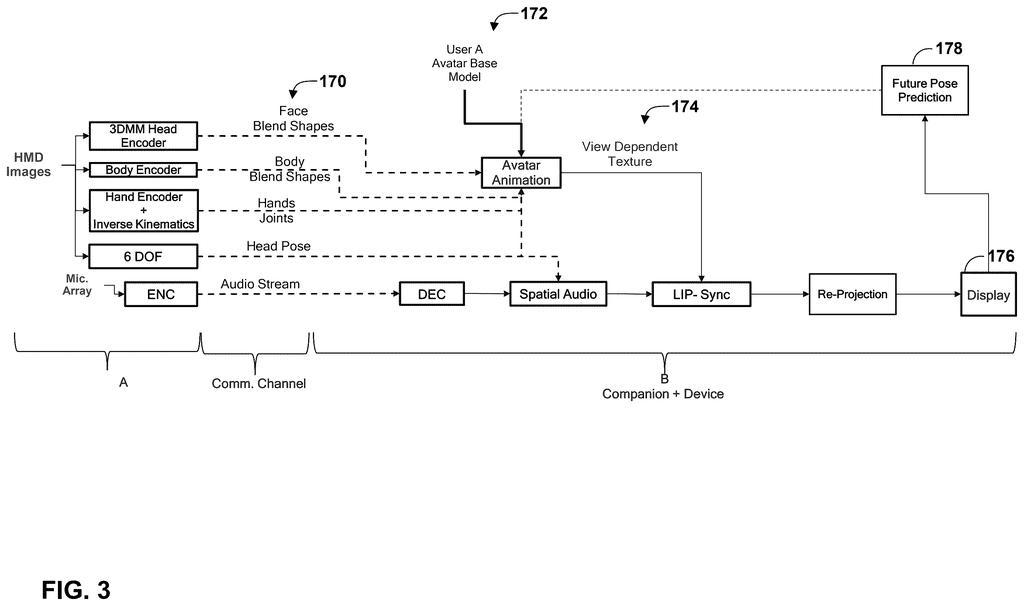
The patent describes a three-part architecture for managing AR avatars in live communication sessions.
- Base avatar repository: Your avatar and all its customizable parts (called avatar assets, things like clothing, hairstyles, or facial expressions) are stored on a dedicated server, not inside each app separately.
- Session initiation: When an AR communication session starts, the system retrieves metadata about your avatar, including which repository server holds it.
- Access token delivery: The coordinating device sends an access token (a credential, similar to a temporary login pass) to every other participant's device. The token specifies both that they can retrieve your base avatar and exactly which subset of your avatar assets they're permitted to load.
The key distinction is that the token controls a selection of assets, not an all-or-nothing grant. A session organizer or the avatar owner can pre-configure which asset bundle different participants receive, so a work call might render a professional avatar variant while a personal call unlocks a fully customized one.
The patent focuses on the authorization and session management layer, meaning it is designed to sit on top of whatever rendering engine or AR platform is actually drawing the avatar on screen.
An example device for communicating augmented reality (AR) media data includes: a memory configured to store media data; and a processing system implemented in circuitry and configured to: obtain data representing a base avatar and one or more avatar assets …
Translation: The patent describes hardware that stores your avatar and the digital items you choose to wear or display.
What this means for AR video calls and digital identity
AR video calls are not yet mainstream, but the platforms building toward them (think spatial computing headsets and next-generation video conferencing) need agreed-on infrastructure before they can scale. Without a standard way to manage avatar access, every app would store its own copy of your digital likeness and make its own rules about who sees what. That creates privacy headaches and a fragmented experience where your avatar looks different, or breaks entirely, depending on the app.
Qualcomm sits at the chip and modem layer of most of the world's mobile devices, so a patent like this signals the company is thinking about owning the protocol layer for AR sessions, not just the hardware underneath them. The AR identity space is active territory for Big Tech patent news, with multiple companies filing around avatar standards, spatial audio, and session management as the groundwork for whatever replaces the flat video call.
The problem this patent attacks is real: AR avatars stored across dozens of siloed apps, with no user control over who loads which version, is a privacy and consistency nightmare waiting to happen. The token-based approach maps cleanly onto how web authentication already works (OAuth-style access grants), which suggests it could actually be adopted rather than reinvented from scratch. The filing is narrow enough to be implementable, and that specificity makes it more credible than broad platform land-grabs.
There are more where this came from
We read every patent application Big Tech publishes and send you the ones worth knowing. Plain English, free, every week.
The drawings
12 drawing sheets from US 2026/0237138 A1 · click any drawing to enlarge


Want this weekly breakdown for a company we don't cover? Patentlyze Pro →
Be the first to weigh in