
Sony Patents a System That Builds Custom Game Trailers from Your Play History
A generic trailer shows everyone the same highlights. Sony is patenting a system that watches what you already play and builds a new trailer around the parts of a game most likely to grab your attention.
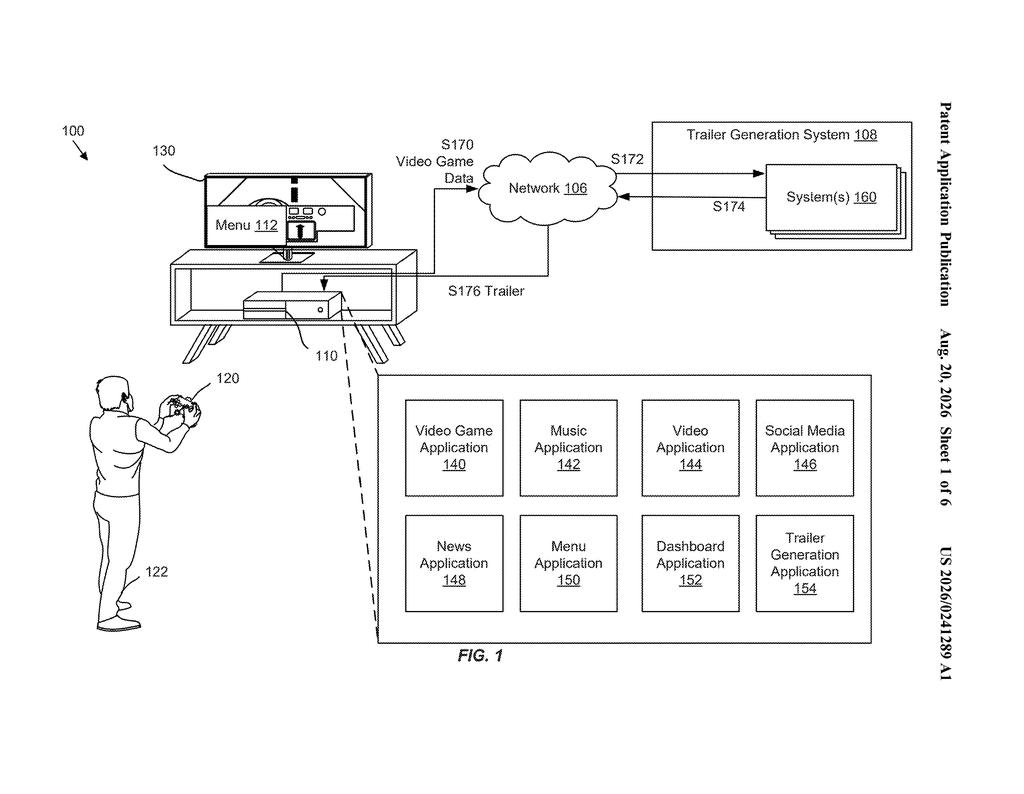
What Sony's personalized game trailer system actually does
Imagine browsing your PlayStation store and seeing a trailer for a game you've never played. Instead of the same cinematic reel every other person sees, the clips are picked specifically for you, based on how you actually use your console.
That's the idea behind this Sony patent. The system looks at your account data, figures out what you're into (racing, open-world exploration, horror, whatever), and then assembles a custom trailer for an unfamiliar game by pulling the sections of its video content that match your interests. The finished trailer plays on your device just like any normal preview would.
The goal is pretty clear: show you the part of a game you would find compelling, not the part a marketing team thought would appeal to the widest possible crowd.
… determining an interest of a user based at least in part on game console data associated with an account of the user; determining, based at least in part on the interest of the user, a set of content sections from video content of a video game …
Translation: The system analyzes your gaming history to identify specific moments or gameplay styles you enjoy most.
How Sony picks and assembles your trailer clips
The patent describes a four-step process powered by data already sitting inside a user's PlayStation account.
- Interest detection: The system reads game console data tied to your account. That likely includes which games you play, which genres you spend the most time in, and how you behave inside games.
- Content selection: It then scans the full video content of a target game and identifies a set of content sections (specific clips or segments) that match your detected interests. If you log heavy hours in stealth games, it might pull the sneaking sequences rather than the combat cutscenes.
- Trailer generation: Those selected sections are assembled into a trailer. The patent doesn't specify a fixed length or format, so the system appears flexible.
- Delivery: The finished trailer is pushed to your device and presented through whatever interface you're using.
The underlying idea is that the same game can tell different stories to different players. A narrative-heavy RPG might be pitched to you as a story-driven experience or as a combat-heavy action game depending on what your account data says you prefer. This is personalization applied to advertising content, not just to recommendation feeds.
… generating a trailer for the video game based at least in part on the set of content sections. Techniques further include causing a presentation of the trailer on a user device associated with the account.
Translation: The software automatically edits these highlights into a custom video preview and sends it to your console or phone.
What this means for how games get marketed to you
For you as a player, this could mean trailers that actually feel relevant instead of ones clearly aimed at some imagined average gamer. If you only play multiplayer modes, you'd theoretically stop seeing trailers packed with single-player story beats that do nothing for you.
For the games industry, this sits at the intersection of ad personalization and streaming video assembly, two areas that have been reshaping how media gets sold. Sony controls both the platform and the account data, which puts it in an unusually strong position to run this kind of targeting. Among the interesting tech patents covering AI-driven media personalization, this one is notable because it targets the moment of discovery rather than post-purchase engagement. The value proposition is straightforward: a better-matched trailer probably converts more game sales, which benefits Sony regardless of whether it benefits you.
Sony's third filing we've tracked since July in our AI assistants that remember you watch builds on one on nursing care robots and one on reducing repetitive questions.
Personalized trailers give up the shared reference point that lets two friends compare notes and decide together whether a game looks worth buying, which is a quiet but real cost to the social layer of how people evaluate marketing. Sony likely gains higher individual conversion rates in the trade, but players who already feel watched by their platforms will now encounter advertising invisibly shaped around their behavior, with no easy way to know it happened. That asymmetry of awareness is where this design could erode trust faster than it builds engagement.
There are more where this came from
We read every patent application Big Tech publishes and send you the ones worth knowing. Plain English, free, every week.
The drawings
6 drawing sheets from US 2026/0241289 A1 · click any drawing to enlarge


Want this weekly breakdown for a company we don't cover? Patentlyze Pro →
Be the first to weigh in