
Sony
Sony · AI / ML · Filed Aug 27, 2025 · USPTO published Aug 27, 2026 · Aug 27 release
Sony Patent Generates Personalized Store Ads From Your In-Store Movement
Sony is building the machine-learning infrastructure to turn your in-store movements into custom advertising. A new patent from Sony Semiconductor Solutions describes a system that watches how shoppers behave in a physical space and generates ads tailored specifically to each person.
- Publication number
- US 2026/0253102 A1(US20260253102A1)
- Applicant
- Sony Semiconductor Solutions Corporation
- Filed · Published
- Aug 27, 2025 · Aug 27, 2026
- Inventors
- Shuichi URABE, Akito KUWABARA
- Status when we published
- Examiner raised objections; the company can respond
- Document
- 19 claims
- US classification
- 705/14.43
- Examiner
- SNIDER, SCOTT (Art Unit 3621)
- Parent application
- National Stage Entry of PCT/JP2024/007966 (filed Mar 4, 2024)(PCTJP2024007966)
How Sony's in-store ad system reads your behavior
You're walking through a store, pausing near the coffee display, then doubling back to the snack aisle. To most retailers, that's invisible data. To Sony's patented system, it's a signal.
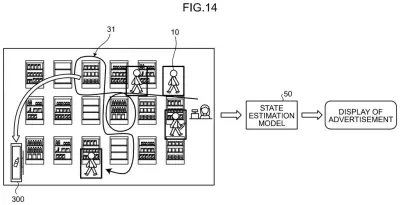
The idea is to use a trained AI model to connect the dots between how a shopper moves and what kind of ad content tends to work on that person. Instead of showing everyone the same digital sign, the system would generate new content specifically matched to your observed behavior in real time. If you lingered near protein bars, the screen nearby might show a relevant offer rather than a generic promotion.
Sony Semiconductor Solutions, the division behind many of the camera sensors in your smartphone, is the applicant here. The patent covers both the data-gathering side (watching behavior in a defined space) and the content-generation side (producing ads optimized for that observed user). It is an end-to-end pipeline from foot traffic to targeted message.
… an acquisition unit that acquires behavior information of a customer in a predetermined space, and a generation unit that generates optimized content, which is content newly generated for a user to be estimated, from behavior information of the user …
Translation: It tracks how you move through a store and uses that to instantly create custom advertisements just for you.
How the model links behavior data to ad performance
The system has two main pieces: an acquisition unit and a generation unit.
The acquisition unit collects behavior information from customers in a defined physical space, a store, a mall corridor, an airport lounge. The patent does not specify exactly how behavior is captured (cameras, sensors, tracking beacons are all plausible given Sony Semiconductor's sensor expertise), but the input is behavioral: where people go, what they stop near, how long they linger.
The generation unit takes that behavior data and feeds it through a trained model. That model has already learned the relationship between certain behaviors and the advertising effect (meaning, did a given type of content actually work?) of content previously shown in that space. Using those learned patterns, the system generates new ad content optimized for the specific user being estimated, rather than selecting from a fixed library of pre-made ads.
The key distinction is generation, not selection. Most targeted ad systems pick from existing creative. This patent describes producing content freshly tailored to the individual, which implies a generative AI component sitting at the output end of the pipeline.
What this means for retail advertising and shopper privacy
For retailers, the appeal is obvious: ads that match what a shopper is actually doing in the moment have a better shot at landing than a static poster. The system Sony describes would make physical stores behave more like websites, where every piece of content is already personalized based on your history and current session. If this works as described, it could push in-store advertising closer to the conversion rates that online retargeting already achieves.
For shoppers, the picture is more complicated. The system infers things about you from your physical movements, in a space where most people do not expect to be profiled. There is no mention of consent mechanisms, opt-out signals, or data retention limits in the claims as published. Sony's filing sits in a growing category of latest Big Tech patents targeting the ad-tech space with behavioral AI, and the privacy questions those filings raise are still largely unanswered by regulators.
That makes this Sony's third AI recommendation filing we've tracked since May, joining one on trailers built from play history and one on a configurable motion content generator.
Source: US 2026/0253102 A1 at the USPTO (PDF). Full patent text and figures are in the official publication.
Get our take in your Top Stories
Liked this breakdown? Add Patentlyze as a preferred source on Google, and our plain-English take shows up more often in your Top Stories the next time Sony patent news breaks.
Add Patentlyze on Google
One click.
There are more where this came from
We read the new patents from Big Tech, carmakers and more and send you the ones worth knowing. Plain English, free, every week.
The drawings · 39 sheets
39 drawing sheets from US 2026/0253102 A1 · click any drawing to enlarge


Show the other 31 sheets


More from Sony
All 722 Sony patents →
More in AI recommendation
All 91 AI recommendation patents →
Nvidia
Nvidia Patents Technology That Customizes AI Responses in the Cloud, Not on Your Device
Qualcomm
Qualcomm Patents a Way to Ask an On-Device AI About Multiple Parts of a Photo at Once
Google
Google Patents an Ad-Targeting System That Never Sees Your Full Profile
Adobe