
Microsoft Patent Targets Hackers Who Trick AI Into Revealing Forbidden Information
People have figured out that if you phrase a question to an AI in just the right way, you can trick it into spilling secrets it was never supposed to share. Microsoft is patenting a system that recognizes those tricks before the AI ever sees them.
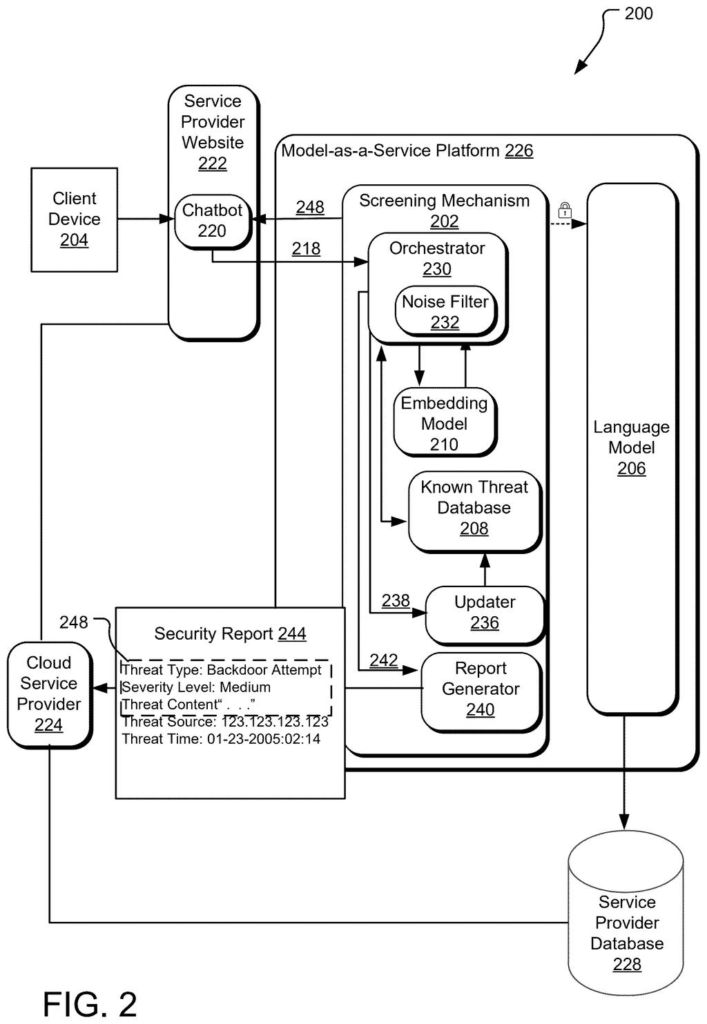
How Microsoft's AI prompt-screening system actually works
A security camera stares at an empty hallway all night, comparing every shadow to a library of known intruder silhouettes. If something matches, the alarm trips before anyone gets through the door. Microsoft's new patent works on the same principle, but for AI chatbots.
When someone types a message to an AI, this system converts that message into a kind of numerical fingerprint. It then checks that fingerprint against a stored collection of fingerprints from known attack prompts, the sneaky phrasings people have used to trick AI into revealing private data or bypassing its rules. If your message looks too much like a previous attack, it never reaches the AI at all.
The practical payoff: companies running AI assistants on sensitive data get a filter that learns from past attacks, not just from the programmer's best guess about what bad actors might try. It's closer to how antivirus software works than how traditional content filters do.
… determining values of a similarity metric computed between the first embedding and a plurality of embeddings stored in a known threat database, the plurality of embeddings corresponding to malicious inputs that exemplify attempts to extract unauthorized information from the language model or other artificial intelligence tool …
Translation: The system compares incoming user prompts against a library of known hacking attempts to see if they match.
How the embedding comparison catches attack patterns
The patent describes a detection pipeline built around embedding models (software that converts text into a list of numbers, called a vector, that captures the meaning and structure of the words). Every incoming prompt gets run through this model to produce a first embedding.
That embedding is then compared to a known threat database, a curated collection of embeddings generated from previously identified malicious prompts. Those include attempts to extract confidential system instructions, bypass safety guardrails, or impersonate an admin. The comparison uses a similarity metric (a mathematical score measuring how close two vectors are in meaning-space, similar to how a search engine ranks results by relevance).
If the incoming prompt's embedding lands close enough to any entry in the threat database, meaning it clears a predefined similarity threshold, the system flags the message as malicious and blocks it before the language model ever processes it. The language model itself sees nothing.
Key components of the system include:
- An embedding model that converts raw text into numerical vectors
- A known threat database of embeddings from catalogued attack prompts
- A similarity scoring engine that measures how close two embeddings are
- A blocking layer that intercepts flagged inputs before they hit the AI
… analyzing the values of the similarity metric to identify a select similar embedding within the known threat database that satisfies predefined similarity criteria with the first embedding and, in response to identifying the select similar embedding, identifying the first input as malicious and preventing the first input from being processed by the language model.
Translation: If the system finds a close enough match to a known attack, it labels the prompt as dangerous and blocks it from the AI.
What this means for AI security at the enterprise level
AI assistants are being plugged into corporate systems, customer databases, and internal document stores at speed, which means the surface area for abuse is growing just as fast. Classic content filters look for specific banned words or phrases, but attackers constantly rephrase their prompts to slip past them. A similarity-based approach catches intent rather than exact wording, which is a more durable defense against the kind of creative rephrasing that prompt injection attacks rely on.
For everyday users, this would operate invisibly: you'd never know it was running unless your message was blocked. The real audience is the IT departments and AI platform teams who carry the risk when an AI leaks something it shouldn't. Microsoft already runs AI products across enterprise, cloud, and productivity software, so a patented screening layer fits that stack directly. Security-minded interesting tech patents in the AI space have been piling up fast as companies race to harden their models against the same class of attacks this filing targets.
This is the 15th Microsoft filing we've tracked since July in our AI guardrails race watchlist, following one on attack bots for security testing and one on a physics-based deepfake detector.
Claim 1 protects any system that takes a user's message, converts it into a numerical fingerprint, and checks that fingerprint against a stored library of known harmful messages to decide whether to block it. The claim names none of the underlying choices: not how the fingerprint is made, not which math is used for comparison, not how the library was built. That breadth matters in practice.
Any AI safety tool following this basic screen-then-compare pattern could fall within the claim's reach, regardless of how differently it was engineered, because the claim covers the pattern itself rather than any specific way of executing it. Patent examiners will ask whether maintaining a library of bad examples and flagging new messages that look similar is a new idea or simply a familiar technique applied to a new setting.
If they push back, Microsoft will need to narrow the claim, and a narrower claim would cover far less ground.
Get our take in your Top Stories
Liked this breakdown? Add Patentlyze as a preferred source on Google, and our plain-English take shows up more often in your Top Stories the next time Microsoft patent news breaks.
There are more where this came from
We read every patent application Big Tech publishes and send you the ones worth knowing. Plain English, free, every week.
The drawings
4 drawing sheets from US 2026/0252694 A1 · click any drawing to enlarge


Want this weekly breakdown for a company we don't cover? Patentlyze Pro →
Be the first to weigh in