
Google Patents a System That Catches Privacy Attacks by Spotting Repeated Database Queries
If someone keeps asking a database slightly different questions to piece together private records, Google's new patent describes a way to catch them in the act before they assemble the full picture.
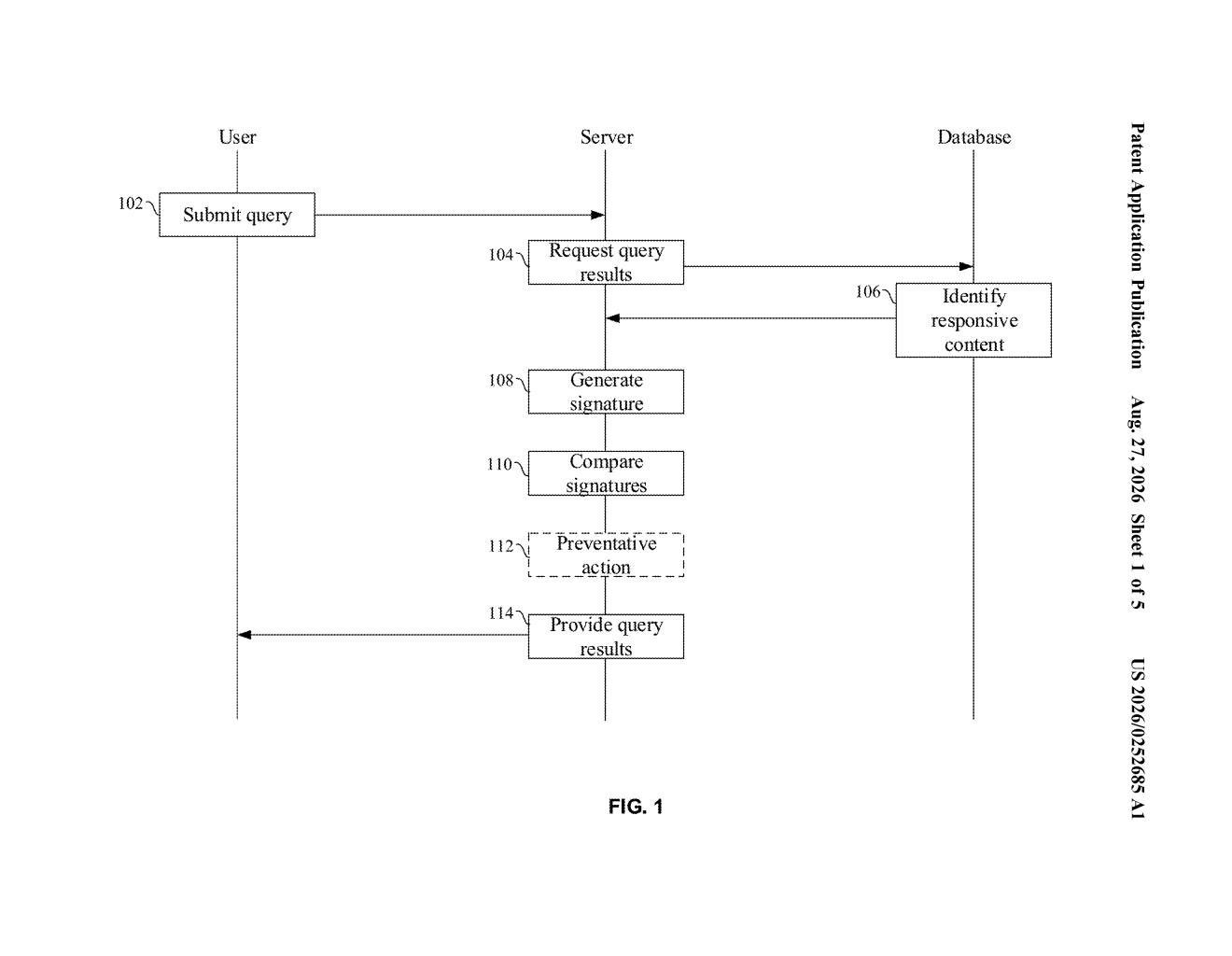
How Google's query fingerprinting spots data thieves
A security camera stares at an empty hallway all night, logging every event, so a single unusual motion at 3 a.m. triggers an alarm. Your data works differently: most databases just answer questions, logging little, which means a determined attacker can sneak in the back door by asking dozens of overlapping queries and stitching the answers together.
Google's patent describes a system that gives each query result a kind of fingerprint. Run a query, and the system hashes the rows of data it returns into a compact signature. That signature gets stored alongside a history of past signatures for similar queries.
If a new query's signature looks too much like a previous one, the system treats it as a red flag: someone may be running the same probe in disguise, trying to extract private records one slice at a time. At that point, the system can block the query, alert an administrator, or take other protective steps.
… identifying, by the one or more processors, the query as an attack when the signature corresponds to at least one historical query signature or the other signature associated with the responsive data.
Translation: The system flags a search as a privacy threat if it produces data patterns that match previous searches.
How the signature comparison flags an attack
The patent covers a method for detecting a specific type of database attack called a repeated-result attack (where an outsider submits many queries that, individually, look harmless but collectively expose private rows of data).
Here is the core flow:
- Query arrives: The system receives a database query and runs it normally, pulling back the matching rows.
- Aggregation and hashing: The responsive rows are aggregated using a function (think: summing or grouping values), and then a hash or other mathematical signature is computed over those aggregated values. A hash is just a short fingerprint derived from data: change one row and the fingerprint changes.
- Signature comparison: The new signature is compared against stored signatures from previous queries, as well as any other signatures associated with the same current result set. If the similarity score exceeds a configurable threshold, the system flags the query.
- Protective action: A flagged query is labeled a privacy attack, and the system can block results, raise an alert, or throttle the requester.
The patent notes that the similarity check is not just exact-match: it can catch queries that are close to a previous one, not only identical copies. This matters because attackers routinely tweak queries slightly to evade simple replay detection.
If the similarity of the signature associated with the current query result is above a threshold similarity to another signature, the query and its associated results are identified as a privacy attack. Preventative actions may be enabled in response to determining that the query is a privacy attack.
Translation: When a search is too similar to past activity, the system labels it as an attack and can automatically block it.
What this means for databases holding sensitive data
Databases that power healthcare records, financial services, or advertising platforms face a real class of threat called inference attacks: an outsider never hacks in directly but instead queries the system repeatedly, each time learning a little more, until enough pieces snap together to reconstruct a private record. Standard access controls do not stop this because each individual query is technically allowed.
This patent puts a cheap, automated watchdog inside the query layer itself. Because it works at the software level, requiring no new hardware, the shortest path from this filing to a deployed feature is relatively direct: it would slot into Google's existing cloud database products (like BigQuery or Cloud SQL) as a configurable monitoring rule. Data-privacy rules around the world are also getting stricter, so tools like this are becoming table stakes for enterprise cloud customers, and new Big Tech patents in the database privacy space reflect how seriously cloud providers are treating regulatory pressure on data protection.
That makes this Google's 20th filing we've tracked on their AI guardrails efforts since May, a group that also includes their applications on a security gate for AI tools and cross-checking AI generated code.
This is a tidy piece of defensive software engineering. The core idea, hashing query results and comparing those hashes to a history of prior results, is not a radical new concept in security research, but packaging it as a patent-protected, automated system inside a cloud database engine is the kind of incremental product hardening that enterprise buyers actually ask for.
From a ship-path perspective, this is about as close to deployable as a patent filing gets. There is no custom hardware required, no new model to train, and no dependency on features that do not already exist in Google's database stack. A small engineering team could wire this into BigQuery's query planner in a reasonably short cycle.
The main open question is threshold tuning: decide too aggressively and you block legitimate analysts running similar reports; decide too loosely and you miss patient attackers who space out their queries over days. That calibration problem is harder than the detection logic itself, and the patent does not fully solve it.
Get our take in your Top Stories
Liked this breakdown? Add Patentlyze as a preferred source on Google, and our plain-English take shows up more often in your Top Stories the next time Google patent news breaks.
There are more where this came from
We read every patent application Big Tech publishes and send you the ones worth knowing. Plain English, free, every week.
The drawings
5 drawing sheets from US 2026/0252685 A1 · click any drawing to enlarge


Want this weekly breakdown for a company we don't cover? Patentlyze Pro →
Be the first to weigh in