
Google Patents a System That Gives Its AI Assistant an Emotionally Expressive Voice
Most AI assistants read your words back at you in a flat, newsreader monotone regardless of what they're actually saying. Google is filing a patent to fix that, by having the AI figure out the emotional tone of its own response before it opens its mouth.
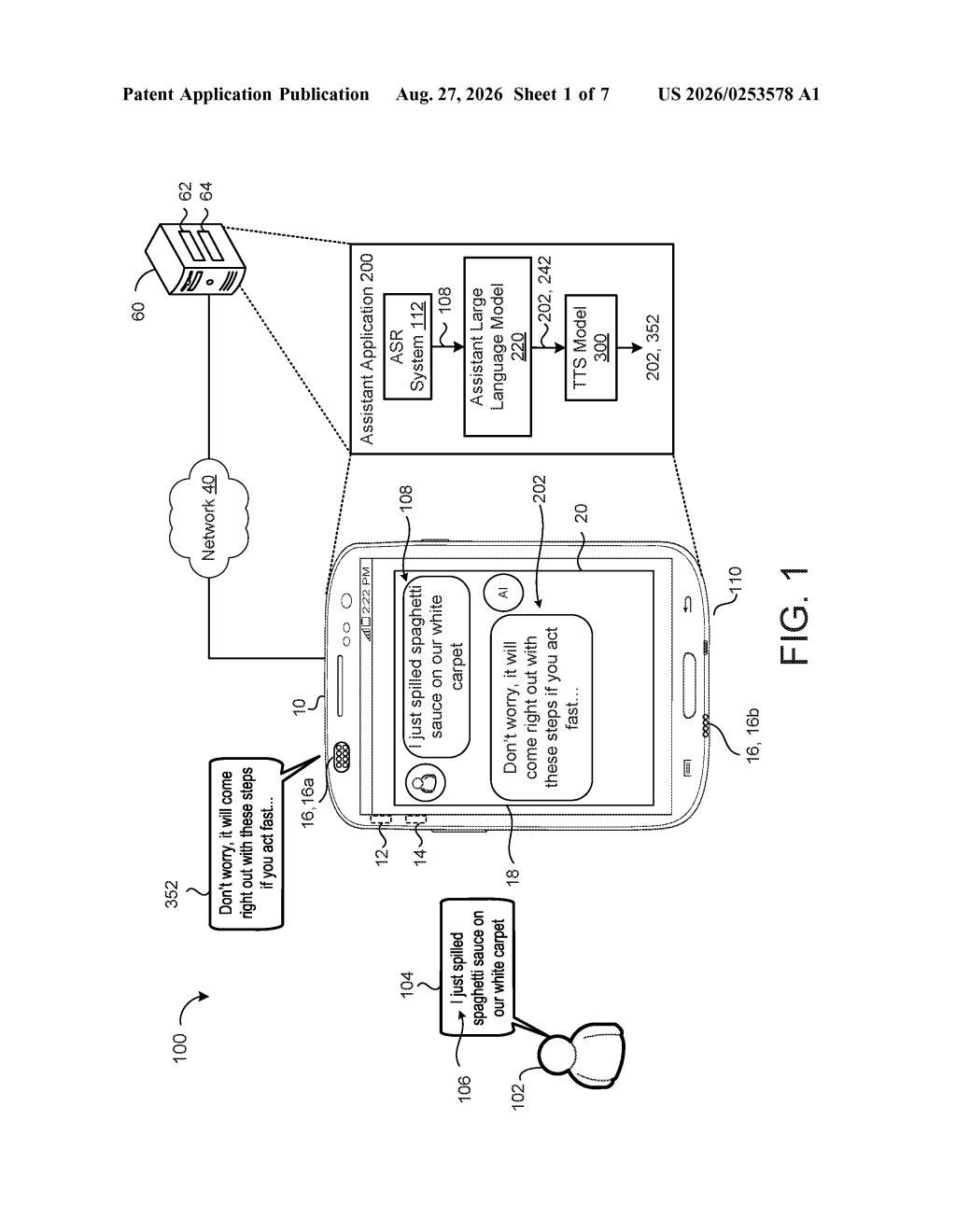
How Google's AI detects tone before it speaks
Today's AI voices are largely one-note. An assistant might tell you great news or deliver a genuine apology, but the voice sounds the same either way, because nothing in the system actually looks at whether the words are cheerful, concerned, or apologetic before they get handed off to the speech engine.
Google wants to change that by adding an extra step in the middle. Before the AI speaks, it reads its own response and asks: what emotion does this text carry? The answer, whether that's enthusiasm, sympathy, or something more neutral, gets attached to the text as a kind of label. The voice model then uses that label to shape how the words are actually delivered.
The result, if this works as described, is an AI assistant whose voice rises a little when it has good news and softens when the topic is difficult. For you, the listener, that could make conversations with an AI feel less like interacting with a talking search bar.
… generating marked-up text that includes the natural language input text annotated with an emotional embedding that specifies the emotional state of the natural language input text …
Translation: The system tags the text with data that defines the intended emotion.
How the LLM tags emotion before the voice model speaks
The system works in two distinct stages that hand off information between two separate AI models.
In the first stage, the same large language model (LLM) that generated the response in the first place is used a second time, this time with a special instruction called an emotion detection task prompt. That prompt tells the LLM to look at its own output text and classify the emotional state it carries. Think of it like asking a writer to label their own paragraph with a mood tag before it goes to print.
In the second stage, the detected emotional state is converted into an emotional embedding, which is a set of numerical values that represents the emotion in a form the voice model can consume. The text is then "marked up" with this embedding, bundled together, and sent to the text-to-speech (TTS) model.
The TTS model reads both the words and the emotional tag at the same time, then generates spoken audio that reflects the specified tone. Key components the patent covers:
- Reusing the existing LLM for emotion detection (no separate classifier needed)
- Converting that detection into an embedding the voice model can act on
- Annotating the input text so the TTS model gets both content and emotional instruction at once
… instructing a TTS model to process the input text and the emotional embedding to generate a synthesized speech representation of the natural language response conveying the emotional state of the natural language response as specified by the emotional embedding …
Translation: The voice generator uses the emotional tags to speak the words with feeling.
What emotionally aware AI voices mean for Google products
For anyone who uses a Google assistant on a phone, smart speaker, or Nest display, this is a direct quality-of-life change. Conversations that touch on scheduling a doctor's visit, getting directions during a stressful commute, or hearing a reminder about a missed birthday could all land differently if the voice actually matches the moment.
From a competitive standpoint, Google is trying to close a gap that voice assistants have had since the beginning. The patent's claim is broad: it covers any system that uses a trained machine learning model to detect emotional state and pass that state to a TTS engine, which is a description wide enough to apply across nearly every Google voice product. Voice AI is one of the more active areas among interesting tech patents right now, and this filing makes clear that tone and expressiveness are where Google sees real room to improve.
That makes this Google's 38th filing in voice and speech AI we've tracked since May, a topic that already covers separating nearby voices by distance and calling businesses back for you.
Claim 1 of this patent is written at a high level of generality. It does not lock in a specific emotion taxonomy, a particular LLM architecture, or even the number of emotional states the system must recognize. Any trained machine learning model that classifies emotional state and produces an embedding for a TTS engine would fall within its scope as written. That breadth matters in practice. If granted, it could give Google a wide perimeter around the core idea of routing emotional metadata from a language model to a speech model.
A competitor building a voice assistant that skips the auto-detection step entirely, or routes emotion through a rule-based classifier, would likely land outside the claim, but the space in between is large. The underlying problem the patent solves is real and obvious to anyone who has talked to a voice assistant for more than a few minutes.
Whether the claim survives examination at that breadth is a separate question, but the engineering direction is sensible and the scope of the filing suggests Google intends this to cover a lot of ground.
Get our take in your Top Stories
Liked this breakdown? Add Patentlyze as a preferred source on Google, and our plain-English take shows up more often in your Top Stories the next time Google patent news breaks.
There are more where this came from
We read every patent application Big Tech publishes and send you the ones worth knowing. Plain English, free, every week.
The drawings
7 drawing sheets from US 2026/0253578 A1 · click any drawing to enlarge


Want this weekly breakdown for a company we don't cover? Patentlyze Pro →
Be the first to weigh in