
Google Patents Remote Control of Conference Room Devices From Meet's UI
Ever been the remote participant on a call while someone in the conference room fumbles with the camera angle for five minutes? Google's new patent is aimed squarely at that problem.
What Google's remote room-hardware control actually does
Imagine you're dialing into a meeting from home while your colleagues sit in a conference room. The camera is pointed at the wrong wall, but nobody in the room notices — and you have zero control over it. That's exactly the frustration Google is trying to fix.
This patent describes a system where remote participants can see and control conference room hardware — cameras, microphones, displays, and similar devices — directly from inside the Google Meet interface. Instead of texting someone in the room to "please tilt the camera left," you'd just click a button in Meet yourself.
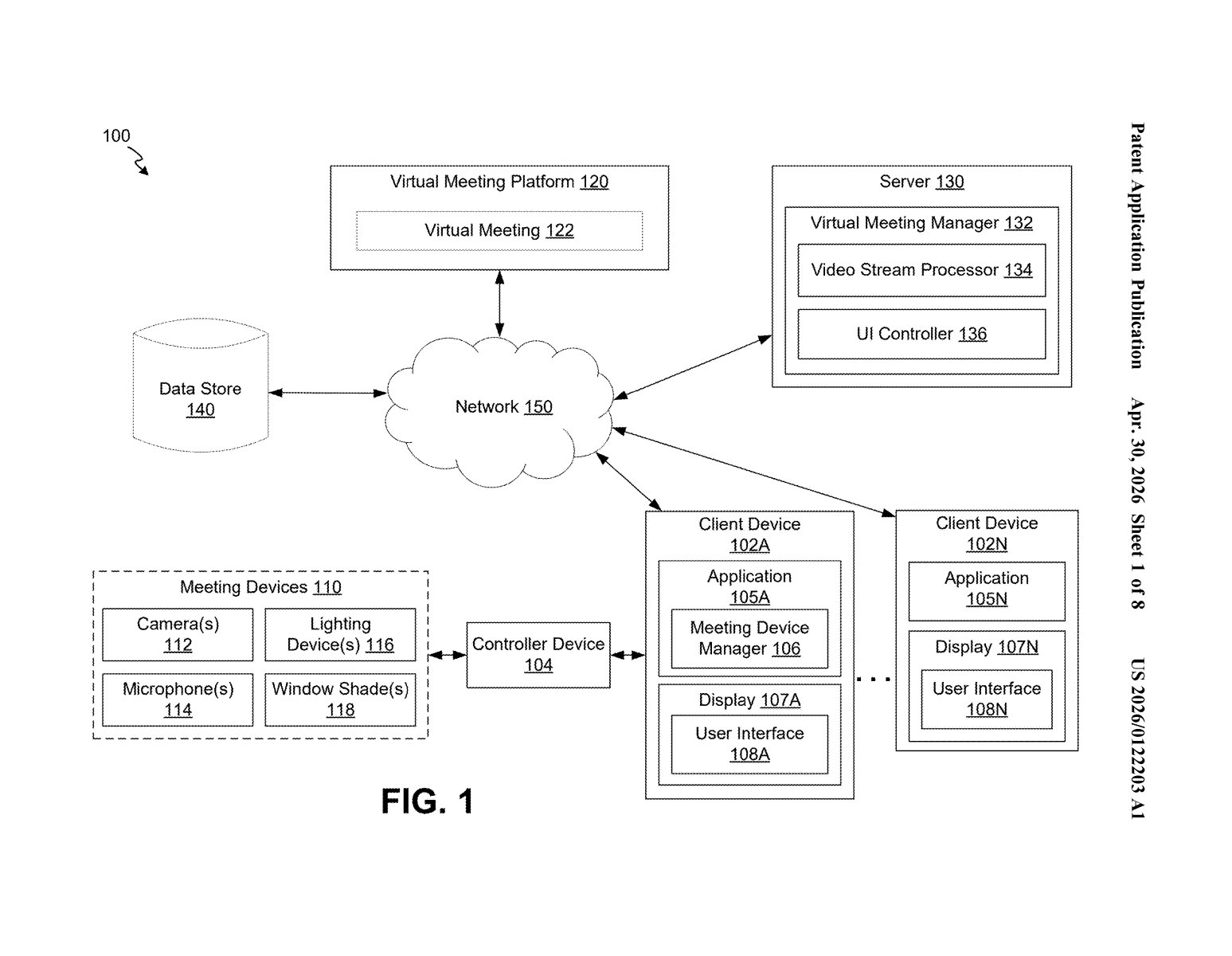
The way it works: a controller device sitting in the conference room acts as a hub, advertising what hardware is available and what each device can do. Your Meet client fetches that list, shows you the options, and lets you send commands back to the room. The hardware responds as if someone in the room had pressed the button.
How Meet bridges remote users to in-room controller devices
The patent describes a three-part architecture built into Google Meet's client software.
First, a controller device in the conference room — think a dedicated Meet hardware pod or a room PC — inventories all the connected meeting devices (cameras, mics, speaker bars, displays) and broadcasts meeting device data describing each one and its available features (pan, tilt, zoom, mute, volume level, and so on).
Second, a remote client device — your laptop at home — connects to that controller and pulls down this device manifest. The virtual meeting UI (the Meet window) is then updated to display those devices and their controls alongside the usual call interface. You see something like a panel listing "Room Camera" with tilt/zoom options, or "Ceiling Mic" with a mute toggle.
Third, when you interact with those controls, your client sends meeting device control data back to the room's controller, which translates it into actual hardware commands:
- Adjust camera pan/tilt/zoom
- Mute or unmute room microphones
- Switch display inputs or adjust volume
- Trigger any other feature the device exposes
The claim is deliberately broad — "one or more features" of "one or more meeting devices" — meaning it could apply to nearly any controllable AV hardware in the room.
What this means for hybrid meetings and Google Workspace
Hybrid meetings are still a second-class experience for remote participants, and the root cause is almost always that in-room hardware is only controllable by people physically present. Google building this into Meet's UI would give remote workers genuine parity — you could adjust the room camera yourself instead of interrupting the meeting to ask for help.
For Google's Workspace and Meet Hardware business, this also creates a stickier ecosystem. If your conference room runs Google's controller hardware and your colleagues use Meet, this kind of seamless integration becomes a real differentiator over Zoom Rooms or Microsoft Teams Rooms — especially as enterprises push workers back into hybrid schedules.
This is a genuinely useful idea that addresses one of the most persistent, low-grade annoyances in modern work life. It's not flashy AI, but getting remote-control of conference room cameras into the Meet UI is exactly the kind of practical quality-of-life improvement that makes enterprise software worth paying for. If Google ships this cleanly, it matters.
There are more where this came from
We read every patent application Big Tech publishes and send you the ones worth knowing. Plain English, free, every week.
Want this weekly breakdown for a company we don't cover? Patentlyze Pro →