
Microsoft Patents an Atom-Traffic Planner for Its Quantum Computer Architecture
Microsoft has filed a patent for software that acts like an air-traffic controller for individual atoms inside a quantum computer, deciding which atoms move where and when to keep calculation errors as low as possible.
What Microsoft's atom-scheduling system actually does
A quantum computer sits in a lab, chilling near absolute zero, trying to run calculations on atoms floating in place with laser beams. The problem: moving those atoms around during a computation is unavoidably messy, and every wrong move adds errors that can trash the result.
Microsoft's patent covers a scheduling system that figures out the best possible plan for shuffling atoms between two regions: a "storage zone" where atoms wait, and an "interaction zone" where they actually do computational work. Think of it like a chess clock crossed with a seating chart, where the software has to satisfy dozens of rules at once.
The scheduler weighs constraints like the physical shape of each zone, how far atoms can travel in one move, and which groups of atoms need to interact at the same time. Its whole goal is to minimize the total error rate across a computation, before a single atom has actually moved.
… a scheduling optimizer for receiving a plurality of constraints and determining an optimized atom schedule that optimizes a value of an objective function that correlates to minimizing a logical error rate while performing the quantum computation …
Translation: A smart planner figures out the best moves to keep quantum errors as low as possible.
How the optimizer moves atoms between zones
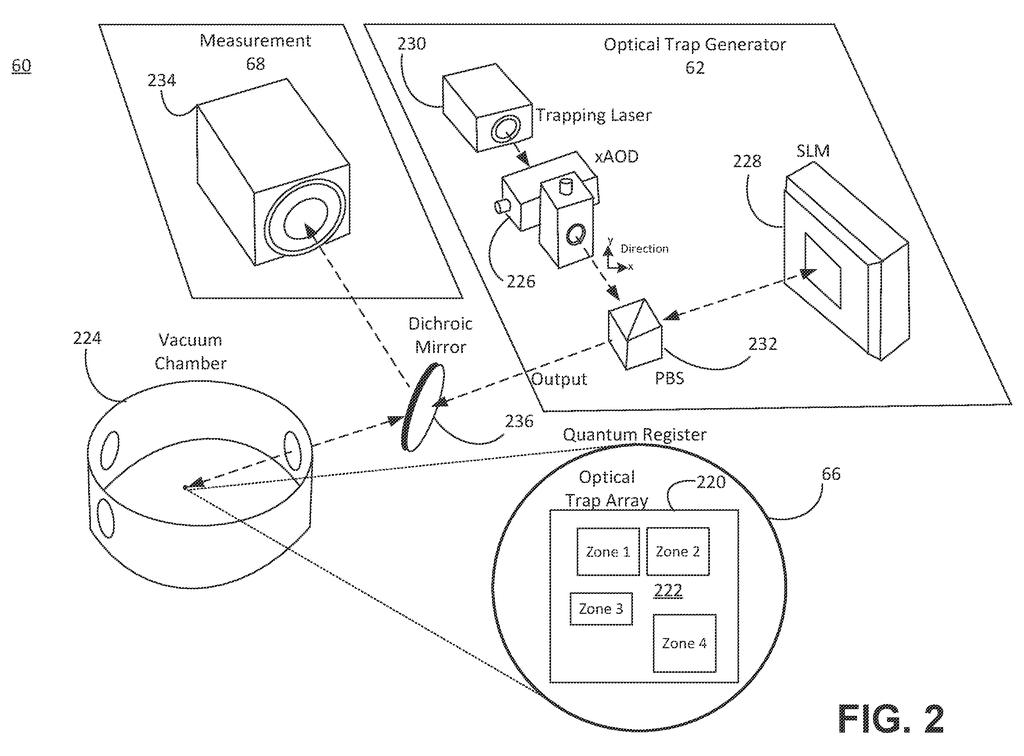
The system is built around what Microsoft calls a zoned neutral-atom quantum computer. Rather than locking every atom in a fixed grid, this design splits the atom array into two distinct areas:
- Storage zone, where atoms park while they are not actively computing
- Interaction zone, where pairs or small groups of atoms are brought together to perform quantum gate operations (the basic steps of a quantum calculation)
Atoms are physically picked up and repositioned by optical tweezers, which are tightly focused laser beams that can grab and steer individual atoms. The optical trap generator deflects a trapping laser in two directions to build the full atom array.
The scheduling optimizer is the core of the patent. It takes in an objective function (a mathematical formula that scores how good any given atom arrangement is) and a list of constraints, then runs algorithms to find the arrangement that minimizes logical errors. The constraints it must respect include:
- The physical geometry of each zone, including "doublons" (paired atom slots in the interaction zone where gate operations happen)
- Where each qubit (each atom acting as a unit of quantum information) starts out in the array
- Which gate operations can be grouped and run at the same time
- Movement limits, such as how many atoms can be relocated in one step
The optimizer can use either an annealing solver (an algorithm that searches for good solutions by gradually narrowing possibilities, similar to how metal cools and settles into a stable structure) or a mathematical optimization engine (a more direct solver that applies formal math techniques to find the best answer).
The invention relates to neutral atom quantum computers having a zoned architecture that includes a storage zone and an interaction zone as part of an array of atoms that form the quantum register in an optical lattice.
Translation: These computers use laser traps to shuffle atoms between holding areas and processing zones.
What this means for practical quantum computing
Quantum computers are currently fragile enough that small inefficiencies in atom placement compound into cascading errors. Microsoft's push into neutral-atom quantum hardware is part of its bet that this architecture can reach practical scale before competing approaches. A scheduler that pre-plans atom movements to keep error rates low is not a glamorous fix, but it is the kind of problem that determines whether a quantum computation produces a trustworthy answer or noise.
For anyone hoping to eventually use quantum computing via cloud services, better scheduling translates directly into results you can trust. You would not see the scheduler at work, but you would notice if it were absent: calculations that should take minutes would require many repeated runs to filter out errors, driving up time and cost.
Microsoft's fourth quantum computing patents filing we've tracked since June adds to earlier applications, one on picking the best physics solver and one on shrinking quantum simulation math.
Quantum computers fail constantly, and most of that failure is invisible. It shows up later as wrong answers, or as answers that took so long to verify they defeated the purpose of using quantum hardware at all.
This patent addresses that by planning the most efficient possible sequence of atom movements before a calculation even begins, keeping error rates as low as the machine physically allows. The person running a workload notices nothing different on their end, but they get a more reliable result because the machine was better organized from the start.
The honest caveat is that a scheduler only matters if the underlying hardware eventually reaches the scale where real work gets done, and that scale does not exist commercially yet. This is careful preparation for a machine that still needs to prove itself.
There are more where this came from
We read every patent application Big Tech publishes and send you the ones worth knowing. Plain English, free, every week.
The drawings
7 drawing sheets from US 2026/0260776 A1 · click any drawing to enlarge


Want this weekly breakdown for a company we don't cover? Patentlyze Pro →