
Intel Patents a System That Picks the Right Voice in a Noisy Meeting
Most microphone systems boost whoever is loudest. Intel's new patent describes a system that listens for whoever is most important, based on what's actually being said and who's saying it.
What Intel's speaker-prioritization system actually does
Imagine you're on a video call and a colleague starts talking at the same moment a truck rumbles past outside. Today's audio systems almost always boost the loudest sound, which is often the wrong one. Intel's patent describes a different approach: a system that figures out who should be the focus of your attention, not just who is making the most noise.
The system listens to speech, identifies each person talking, and reads the meaning of what they're saying in real time. It considers things like who is asking a question, whose turn it logically is, or which speaker's words are most relevant to the topic at hand. Then it amplifies that person's voice while dialing back the others.
Along the way, it also produces a live transcript. And it keeps an eye on its own performance, automatically fine-tuning itself when audio conditions change, like when someone joins from a loud café or moves to a different room.
The system uses a single-pass architecture and integrates comprehensive semantic analysis with acoustic speaker identification so that speaker focus is directed based on contextual importance rather than acoustic prominence.
Translation: It figures out who matters based on what they are saying instead of simply picking whoever is speaking the loudest.
How the context fusion engine picks and boosts one voice
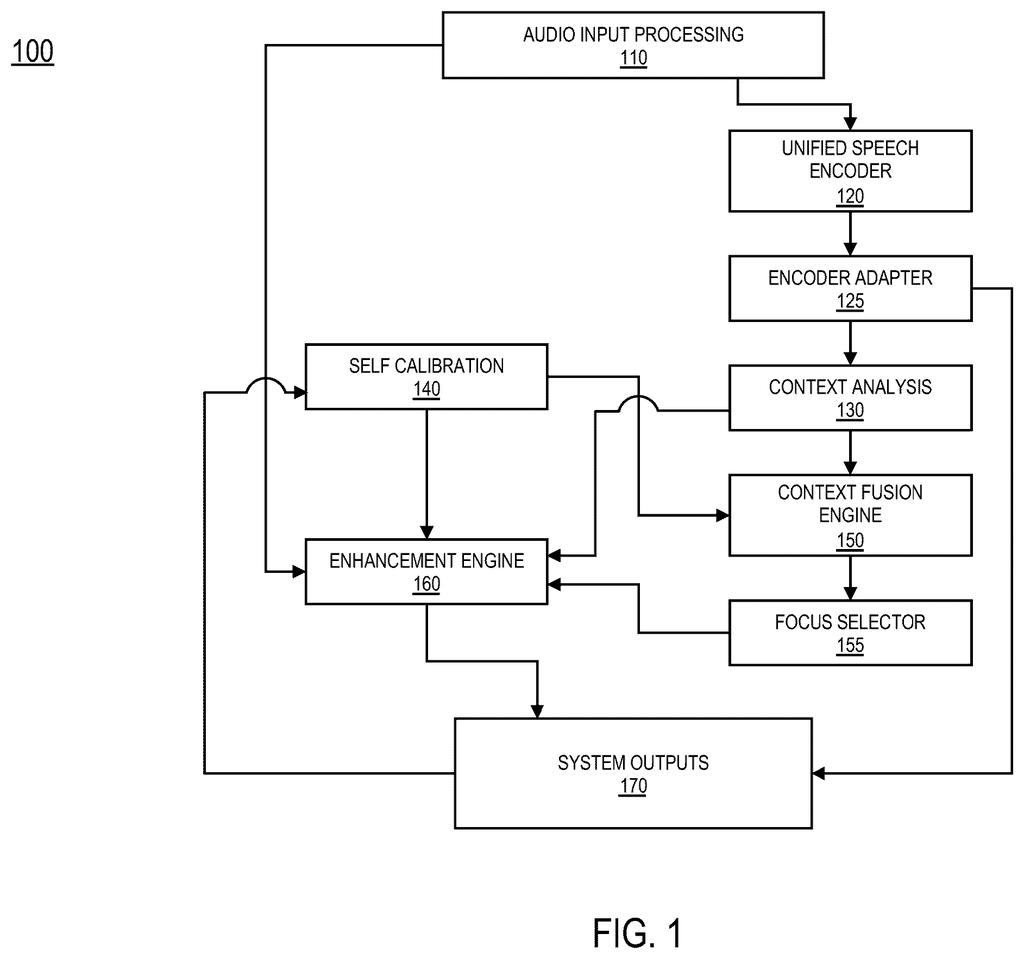
The system processes incoming audio through a speech-to-text encoder in a single pass. That encoder does two jobs at once: it converts speech into text tokens (the building blocks of language) and simultaneously builds acoustic speaker embeddings, which are compact mathematical fingerprints that identify who is speaking based on voice characteristics.
Those speaker fingerprints feed into a context fusion engine, which assigns a priority score to each speaker. The scoring pulls from multiple sources:
- Content relevance: is this speaker saying something on-topic?
- Vocabulary domain: are they using field-specific language (medical, legal, technical) that signals expertise?
- Speaker role: are they a teacher, a presenter, a questioner?
- Dialogue flow: whose turn is it based on conversational patterns?
A focus selector picks the top-priority speaker, and an enhancement engine generates a spectral emphasis mask (essentially a per-frequency filter) that boosts that person's voice frequencies while reducing others. The result is enhanced audio that emphasizes the chosen speaker in real time.
A self-calibration loop monitors the quality of the enhanced audio and the transcript, then automatically adjusts the system's internal weights over time. This means performance stays consistent even as room acoustics, background noise, or conversation style shifts.
What this means for meetings, classrooms, and hearing aid users
For anyone who has ever struggled to follow a meeting because a loud background voice kept drowning out the actual presenter, this addresses a real and daily frustration. The system's ability to prioritize by context rather than volume is particularly relevant for accessibility tools like hearing aids and assistive listening devices, where the whole point is directing attention to the right voice, not the nearest one.
Intel's steady investment in on-device audio intelligence is visible here: the single-pass, low-latency design suggests this is aimed at running inside a chip rather than in a cloud server. That means the benefit could live inside a laptop or a pair of earbuds, not just in an enterprise conferencing platform.
This is the third Intel filing in voice and speech AI we've tracked since July, following one on blocking self-triggered wake words and one on voice-controlled robots.
Three people talk over each other in a meeting, and right now your recording picks up whoever is loudest. Intel's patent describes a system that would instead follow whoever is most relevant, based on what they're saying and what role they're playing in the conversation.
The person with the actual answer gets heard, not just the person closest to the microphone. The system also transcribes as it listens, so the prioritization leaves a written record rather than a momentary volume adjustment that disappears.
The real question is whether it works accurately enough to be invisible. If it does, people will simply notice that their recordings feel easier to follow. If it doesn't, it becomes a setting nobody touches.
There are more where this came from
We read every patent application Big Tech publishes and send you the ones worth knowing. Plain English, free, every week.
The drawings
11 drawing sheets from US 2026/0268919 A1 · click any drawing to enlarge


Want this weekly breakdown for a company we don't cover? Patentlyze Pro →