
Intel Patents a System That Connects Similar Browsing Sessions to Sharpen Recommendations
Intel has filed a patent for a recommendation system that doesn't just look at what you clicked, it looks at how your current browsing session compares to thousands of similar sessions from other users, then uses that pattern to predict what you'll want next.
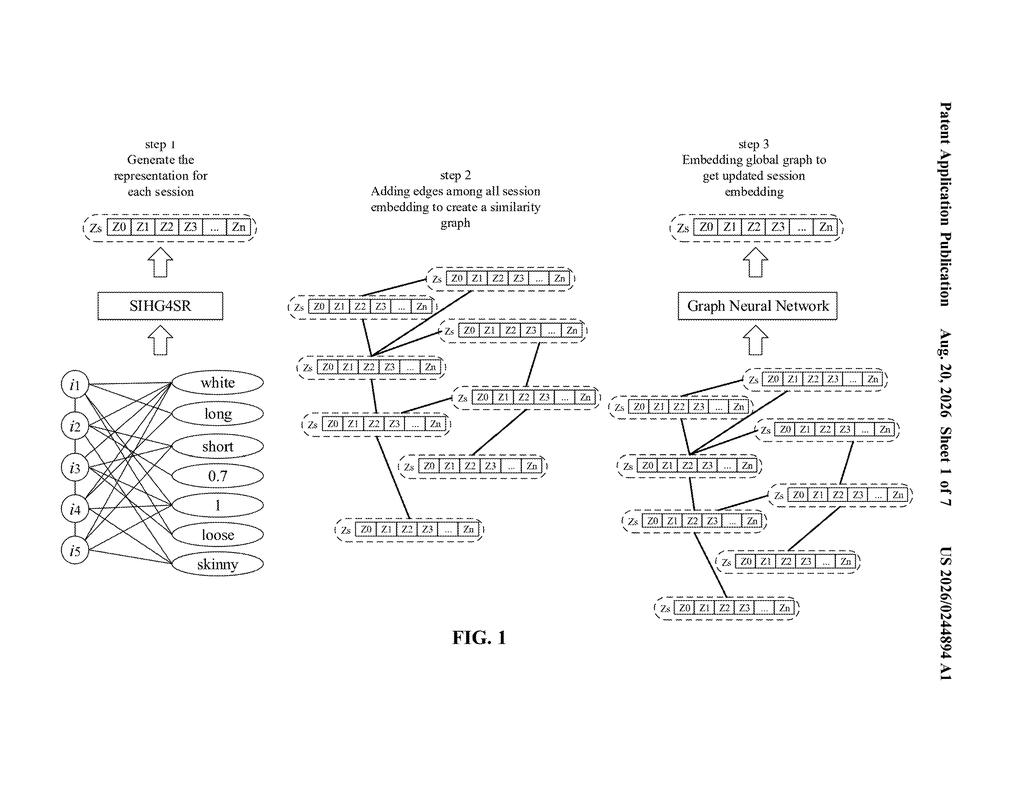
How Intel's session-similarity graph shapes what you see next
You're browsing a retailer's website, clicking through laptops, then chargers, then laptop bags. The site's recommendation engine is trying to figure out what to show you next, and it only has a few clicks to go on, because you've never logged in or bought anything there before.
That's the problem Intel's patent is designed to solve. Instead of relying on your long purchase history (which doesn't exist in this case), the system compares your current browsing session to a large pool of other sessions that looked similar, then groups them into a kind of relationship map called a similarity graph. Sessions that look alike get connected; ones that look very different don't.
That graph then gets fed into a type of AI called a Graph Neural Network, which uses the connections between sessions to make better guesses about what you'll want to see next. The result is a recommendation engine that can work even when it barely knows who you are.
generating a similarity graph comprising a plurality of nodes and one or more edges, each node corresponding to an individual session and an edge being generated to connect two nodes in the similarity graph, wherein a similarity score of a pair of sessions corresponding to the two nodes exceeds a preset similarity threshold …
Translation: The system maps out how different users browse the web and links them together if their activity looks similar enough.
How the GNN reads the similarity graph to rank items
The patent describes a two-stage process for making product or content recommendations based on a user's current browsing session rather than their full history.
Stage one: building the similarity graph. The system takes a collection of past user sessions and computes a similarity score for every pair of sessions. If two sessions clear a preset similarity threshold (meaning they looked meaningfully alike in terms of items viewed, order, or duration), the system draws an edge, a connection, between them in a graph structure. Each session becomes a node, and the edges form a web of relationships.
Stage two: running the Graph Neural Network (GNN). A GNN is a type of neural network designed to learn from graph-shaped data rather than flat lists or tables. It can propagate information across connected nodes, so a session node effectively borrows context from its neighbors. The system loads the similarity graph into the GNN to generate recommendations for whatever the current user is doing right now.
Key components the patent covers:
- A graph construction step with a tunable similarity threshold
- Node representations for individual sessions
- Edge generation based on pairwise session similarity
- GNN inference over the resulting graph structure
The approach is specifically aimed at session-based recommendation, a subfield that matters most when users are anonymous or new, and there's no rich historical profile to draw from.
What this means for real-time shopping recommendations
Session-based recommendation is one of the harder problems in e-commerce and streaming, because most people who land on a site don't have an account or a purchase history. A system that can make good guesses from just a few clicks has real value for platforms that live on engagement.
Intel's patent positions the company in AI infrastructure work that sits closer to software and data systems than to chip design, which is the business most people associate with Intel. For readers following Big Tech patent news in the AI recommendation space, this filing reflects Intel's continuing push to own parts of the AI stack beyond silicon, though whether this particular approach moves from patent to product is a separate question entirely.
Intel's 125th filing among the patents we've tracked in our Intel coverage since May joins earlier work like a graphics-chip scheduling fix and an AI computation skipper.
All the claims in this patent were canceled before it was published. That means, right now, it protects nothing. Intel would need to file new claims just to get back to square one.
Even if new claims are approved, the underlying idea is not fresh ground. Academics have been building and publishing similar recommendation systems for years. Any protection Intel wins will almost certainly be narrow, covering one specific way of doing things rather than the broad concept itself.
Get our take in your Top Stories
Liked this breakdown? Add Patentlyze as a preferred source on Google, and our plain-English take shows up more often in your Top Stories the next time Intel patent news breaks.
There are more where this came from
We read every patent application Big Tech publishes and send you the ones worth knowing. Plain English, free, every week.
The drawings
7 drawing sheets from US 2026/0244894 A1 · click any drawing to enlarge


Want this weekly breakdown for a company we don't cover? Patentlyze Pro →
Be the first to weigh in