
Microsoft Patents an AI Decoding System That Preps Voice Calls for Speech Recognition
Microsoft has filed a patent for a way to decode voice audio using AI by temporarily converting it into a form that separates a sound's shape from its pitch, then handing the cleaned-up result straight to a speech recognition system.
What Microsoft's modulation-domain voice codec actually does
A person speaks into a phone. That voice travels across a network, gets compressed, and arrives at the other end as encoded audio. Whatever clarity was lost in that journey, a speech recognition system still has to make sense of it.
Microsoft's patent describes a decoding process designed to handle exactly that situation. Instead of treating the incoming audio as a single wave to be unpacked the usual way, it breaks the signal into two parts: one capturing how the sound changes over time (the "modulator") and one carrying its underlying structure (the "carrier"). An AI model works on those two parts separately, then recombines them into a clean audio signal.
The decoded audio is then handed directly to an automated speech recognition (ASR) system, the kind that transcribes calls, powers voice assistants, or drives call-center automation. The whole pipeline is built to make the AI's transcription job easier by giving it better-quality audio to work from.
converting the encoded voice audio signal into the modulation domain to obtain a modulation-domain representation of the encoded voice audio signal; decoding the modulation-domain representation of the encoded voice audio signal; …
Translation: The system transforms the audio into a special math format and decodes it there.
How the ML model decodes audio through the modulation domain
The patent covers the decoding side of a voice codec (a system that compresses and decompresses audio for transmission). When a voice call arrives encoded over a telecommunications network, this system unpacks it using a machine learning model.
The key step is converting the encoded audio into the modulation domain. Think of ordinary audio as a single waveform. The modulation domain separates that waveform into two layers: carrier signals (the underlying tones) and modulator signals (the slower-changing "envelope" that shapes how loud or soft those tones are at any moment). Human speech has natural structure in both layers, and working in this decomposed form can make it easier to reconstruct a clean signal from a degraded one.
The ML model decodes the modulation-domain representation, then converts it back to the time domain (ordinary audio that plays in real time). That reconstructed audio is then processed further before being sent to an automated speech recognition (ASR) system, which converts the audio into text or commands.
The claim covers the full receive-and-decode pipeline:
- Receive encoded voice audio from a transmitter over a network
- Convert to modulation domain using an ML model
- Decode the modulation-domain representation
- Convert back to the time domain
- Output the result to an ASR system
The modulation domain audio signal is encoded with a plurality of carrier signals and a plurality of modulator signals derived from the modulation domain audio signal.
Translation: It bundles the audio data using multiple carrier and modulator signals.
What this means for AI assistants that listen to phone calls
Speech recognition systems that power call transcription, virtual assistants, and contact-center automation are only as good as the audio they receive. Phone calls, especially over mobile or compressed-voice networks, often arrive with artifacts that trip up AI transcription. A codec specifically designed to hand cleaner audio to a downstream ASR system could improve accuracy in exactly those conditions.
The patent sits at an intersection Microsoft clearly cares about: Teams, Azure AI Speech, and Copilot-style meeting transcription all depend on decoding voice audio well before any language model sees it. A better decoding stage means fewer transcription errors at the foundation, which matters more than any downstream model improvement if the input audio is the real bottleneck.
That makes this Microsoft's 13th filing we've tracked in Voice & speech AI since May, a topic that already includes applications on phone and internet speech and cloning voices across languages.
Claim 1 describes a decoding method, meaning it applies only after audio has already been encoded in a specific way, processed through a particular pipeline, and handed to a speech recognition system. That sequence is narrow by design, and someone building their own encoding approach or handling audio differently at any step along the way would fall outside what this claim covers.
That narrowness has real consequences. This patent, if granted, would protect one specific path through the pipeline rather than putting a fence around AI voice processing broadly.
The claim is specific enough to be defensible without being sweeping enough to reshape how the industry works. That is a reasonable outcome for a patent to achieve.
There are more where this came from
We read every patent application Big Tech publishes and send you the ones worth knowing. Plain English, free, every week.
The drawings
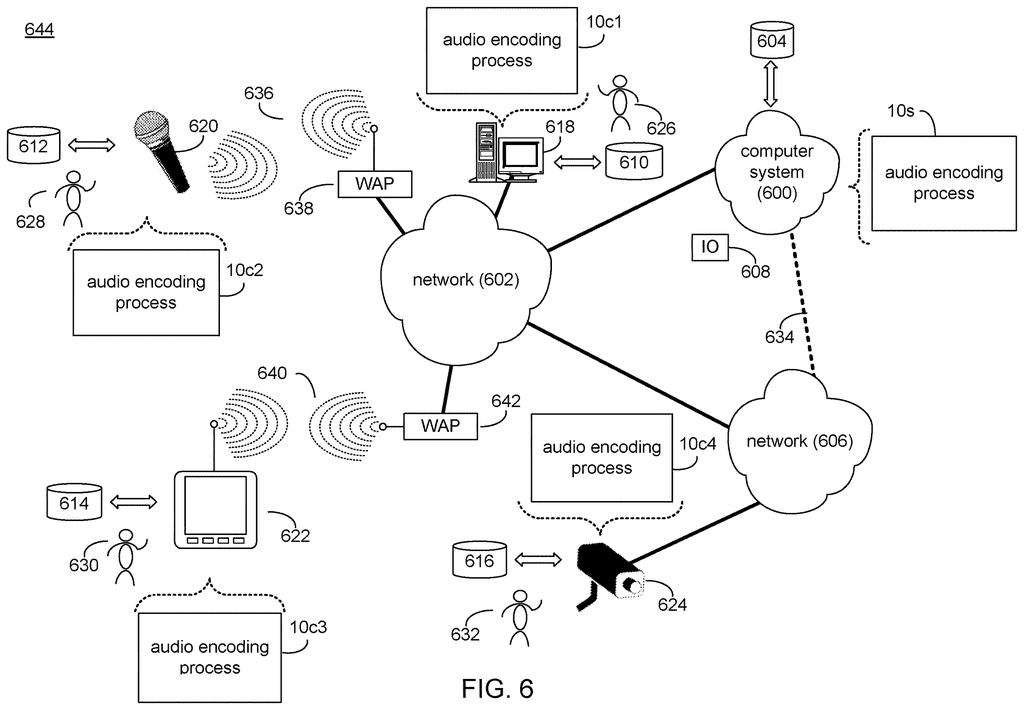
6 drawing sheets from US 2026/0279380 A1 · click any drawing to enlarge


Want this weekly breakdown for a company we don't cover? Patentlyze Pro →