
Disney Patents a Way to Train AI on Simulated Equipment Failures Before They Happen
Disney has filed a patent for a system that teaches an AI to recognize equipment failures by feeding it fake sensor readings from a simulated version of the equipment first. The idea is to get the AI fully trained before anything actually breaks.
How Disney's fault-simulation AI would protect rides
Imagine a roller coaster that starts behaving oddly at 2 a.m., and the system catches it before the first guest ever boards. That is the kind of outcome Disney is building toward with this patent.
Right now, the challenge with teaching an AI to spot mechanical problems is that you need real examples of those problems to learn from. But waiting for actual failures to happen is costly, and in a theme park setting, it could be dangerous. Disney's idea is to skip the waiting by running a detailed computer simulation of the physical equipment, deliberately breaking it in various ways inside that simulation, and recording what the fake sensors report when each fault occurs.
That simulated failure data gets fed to a test version of the control system, and the AI watches how the system responds. Every data point gets labeled with the specific fault that caused it, building a rich library the AI can learn from. The goal is an AI that can watch live sensor readings during real operation and flag problems early, before they become shutdowns or safety incidents.
introducing, by a processor, a simulated fault into a software simulation of a physical system, the simulated fault comprising a plurality of fault instances distributed over a simulation time …
Translation: The system injects digital breakdowns into a computer model of machinery over a set period.
How the simulation loop creates labeled training data
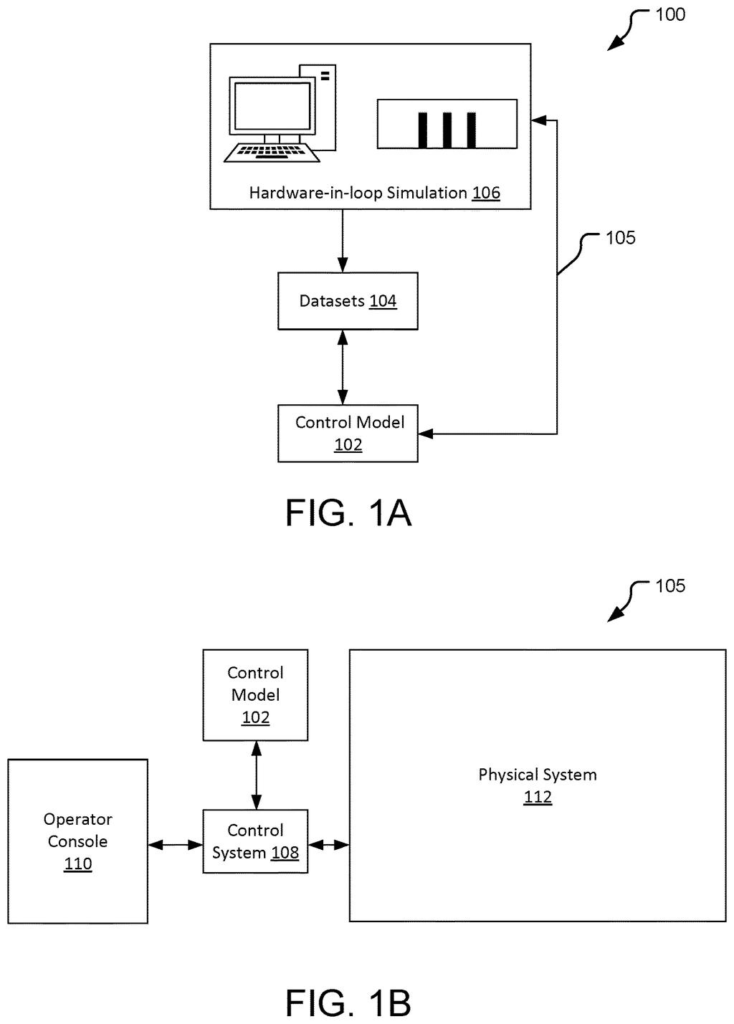
The patent describes a training pipeline that relies on what engineers call hardware-in-the-loop simulation, meaning a software model of a physical system is wired up to a real (or emulated) control system so both sides exchange data as if the system were actually running.
Here is how each step works:
- Fault injection: The processor introduces a simulated fault into the software model of the physical system. A fault is not a single event but a series of instances spread across a simulated time window, so the AI learns to recognize faults as they develop, not just at their peak.
- Emulated sensor data: The simulation generates sensor readings that mimic what real sensors on the physical equipment would report under those fault conditions. These are fake readings, but they are grounded in the physics of the simulation.
- Test control system: Those fake readings are sent to a test control system, which operates exactly as the real control system would. The test system produces output signals in response.
- Labeled training data: The output signals are tagged with the specific fault instances that produced them, creating a labeled dataset.
- Model training: A machine learning model is trained on that dataset. Once trained, the model runs alongside the real control system during live operation and watches for the same patterns it learned to recognize in simulation.
The key advantage is that the system can generate training examples for rare or dangerous faults that would be impractical or unsafe to trigger in the real world.
… tagging the output data with the simulated fault to create training data. The method further includes utilizing the training data to train the control system model …
Translation: The software labels the results of these artificial failures to teach an AI how to spot real problems.
What this means for theme park safety and uptime
Physical equipment failures at theme parks, factories, or any complex facility are expensive to diagnose and sometimes dangerous. The traditional approach to AI-based fault detection requires collecting historical failure data, which means waiting for real problems to occur and hoping you logged enough of the right sensor readings when they did. This patent describes a way to sidestep that bottleneck entirely.
For guests and operators, a well-trained fault-detection model could mean fewer unexpected shutdowns and earlier warnings on developing problems. For Disney specifically, which operates large-scale attractions with continuous uptime pressure, catching a mechanical issue in the early stages rather than mid-operation is a meaningful operational and safety improvement. Disney's track record in simulation and physical-system patents suggests this is part of a broader engineering push rather than a one-off filing.
That makes this Disney's fourth filing in AI simulation we've tracked since June, joining one on 3D light ray routing and one on AI standing in for slow simulations.
The problem this patent attacks is real and underappreciated. Getting an AI to recognize equipment faults requires examples of those faults, but serious mechanical failures are rare by design, which means the training data is almost always thin. Simulation-based training is a sensible answer to that gap.
What makes this approach credible is the specificity of the fault modeling. Distributing fault instances across a simulation time window, rather than treating a fault as a single moment, forces the AI to learn gradual signatures rather than just alarms. That is a more honest representation of how real failures actually develop.
The honest caveat is that this approach is only as good as the simulation. If the software model of the physical system is an imperfect replica of the real thing, the AI learns patterns that may not fully transfer to live conditions. Disney would need extremely accurate simulation models for this to deliver on its promise, and that is a significant engineering challenge that the patent does not address.
There are more where this came from
We read every patent application Big Tech publishes and send you the ones worth knowing. Plain English, free, every week.
The drawings
5 drawing sheets from US 2026/0278473 A1 · click any drawing to enlarge


Want this weekly breakdown for a company we don't cover? Patentlyze Pro →
Be the first to weigh in