
New Disney Patent Teaches 3D Image Software Where to Send Light Rays
Rendering a single frame of a Pixar-style scene can take hours because software has to simulate millions of light rays bouncing around a virtual room. Disney just filed a patent for a system that uses a trained neural network to make those guesses far more efficiently.
How Disney's renderer figures out where light should travel
Imagine trying to light a real room by testing every possible angle a flashlight could point before deciding which one actually illuminates the corner you care about. That's roughly what a 3D rendering engine does for every surface a virtual light ray touches. It's exhaustive, expensive, and slow.
Disney's patent describes a system that uses a neural network, one that has already learned how light behaves in a scene from earlier samples, to intelligently predict which directions are worth chasing. Instead of blindly testing thousands of directions, the system picks a smarter, smaller set. It also adds a safety fallback so it doesn't become overconfident and miss important light sources entirely.
On top of that, the system dynamically adjusts how many candidate directions it tests at each surface point. If testing more directions at a particular spot wouldn't actually improve the final image much, it tests fewer and spends that computing power somewhere it counts more. The goal is a higher-quality image in less time.
Inside the neural radiance cache and candidate-count math
The patent describes a path guiding system for 3D rendering. Path guiding is the technique of steering light-ray simulations toward directions that are actually likely to carry useful light, rather than sampling directions at random.
At each point where a simulated light ray hits a surface, the system uses a module called a neural radiance cache (a compact neural network that stores learned estimates of how bright each direction looks from that surface) to propose candidate bounce directions. Those candidates are then ranked using a method called resampled importance sampling (essentially a weighted lottery: more weight to directions the network thinks are brighter, but with a random element to avoid blind spots).
A key safety feature is what the patent calls defensive target construction. The neural network's brightness estimates are blended with a simpler, physics-based fallback estimate. This means that even if the neural network is wrong about a particular surface, the renderer doesn't completely miss a major light source.
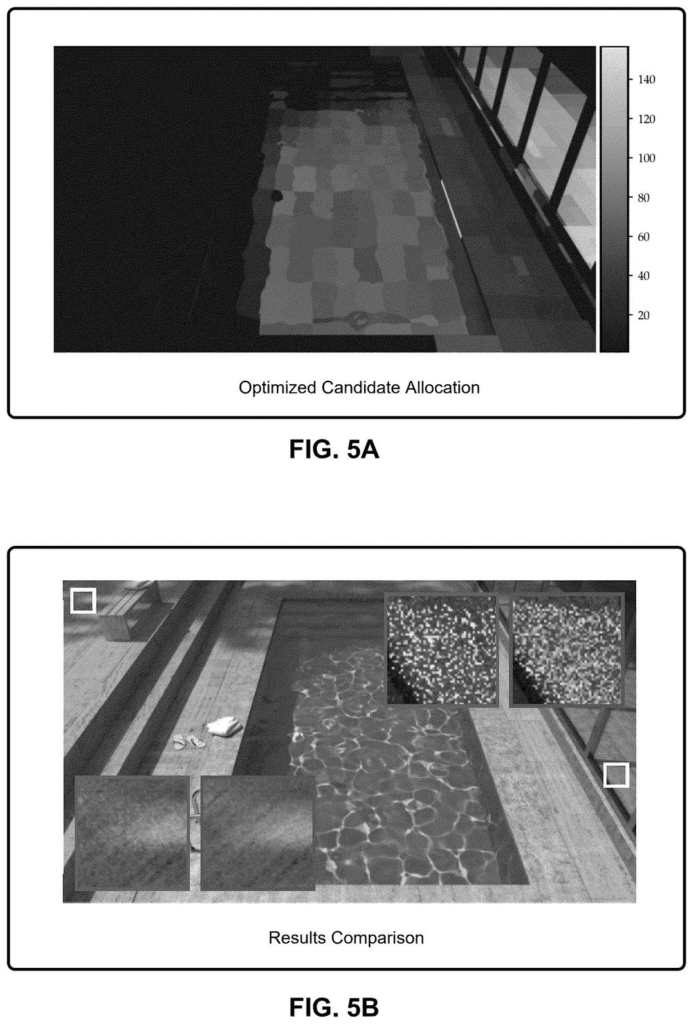
Finally, a sub-module called ORCA (Optimized Resampling Candidate Allocation) decides, per surface point, exactly how many candidate directions to test. It does this by estimating whether adding more candidates would reduce image noise enough to justify the extra compute time. The result is a renderer that spends its computing budget where it actually helps.
What this means for animated film and real-time rendering
For studios like Disney, rendering time directly translates to cost and creative flexibility. A system that produces the same image quality with fewer wasted calculations means faster turnarounds, cheaper cloud computing bills, or the ability to render at higher quality within the same budget. The adaptive candidate-count idea is particularly practical: it's the kind of per-frame optimization that compounds across thousands of shots in a feature film.
The techniques here are also relevant beyond animation. Real-time path tracing, the technology pushing photorealistic graphics into video games and interactive design tools, faces the same computational pressure. Any method that makes light-ray sampling more efficient without sacrificing quality has a wide potential audience.
This is genuinely interesting foundational rendering research from Disney, not a product feature or a UI tweak. The combination of neural guidance with a physics-based defensive fallback is a thoughtful answer to a real failure mode (overconfident neural networks that miss light). Whether it ships in a commercial tool or stays an internal research asset, it represents real intellectual investment in making photorealistic rendering faster.
There are more where this came from
We read every patent application Big Tech publishes and send you the ones worth knowing. Plain English, free, every week.
The drawings
6 drawing sheets from US 2026/0212593 A1 · click any drawing to enlarge


Want this weekly breakdown for a company we don't cover? Patentlyze Pro →