
Nvidia's New Patent Lets Long Videos Automatically Label Everything in Them, Faster
Tagging every person, car, or object that appears across hours of video is slow work, even for powerful computers. Nvidia's new patent describes a way to chop that job into pieces, run them all at once, and then stitch the results back together as if the video were never split.
What Nvidia's video-chunking tagging system actually does
A security camera stares at an empty parking lot for eight hours straight. When something finally happens, someone needs to find it fast, and that means the whole recording has to be analyzed, object by object, frame by frame. That takes a lot of computing power and a lot of time.
Nvidia's approach is to cut the video into segments and process those segments simultaneously, the way a team of workers each handles a different box on an assembly line. Each segment gets its own set of tags: which objects appear, where they are in the frame, and when. The tricky part is that a car or a person might stroll out of one segment and into the next. The system then does a second pass to reconnect those objects across the seams, so the final record treats them as one continuous thing rather than two separate sightings.
The end result is a single, fused metadata file for the whole video, structured so that any downstream system, like a search tool or an alert engine, can query it quickly.
determining, using at least one of image data representative of a video or available processing capacity of one or more processing components for processing the image data, a partitioning of the video that includes at least a first segment of the video and a second segment of the video; …
Translation: The system splits up a long video based on how heavy the footage is and how much computer power is currently available.
How the system splits, tags, and stitches video data
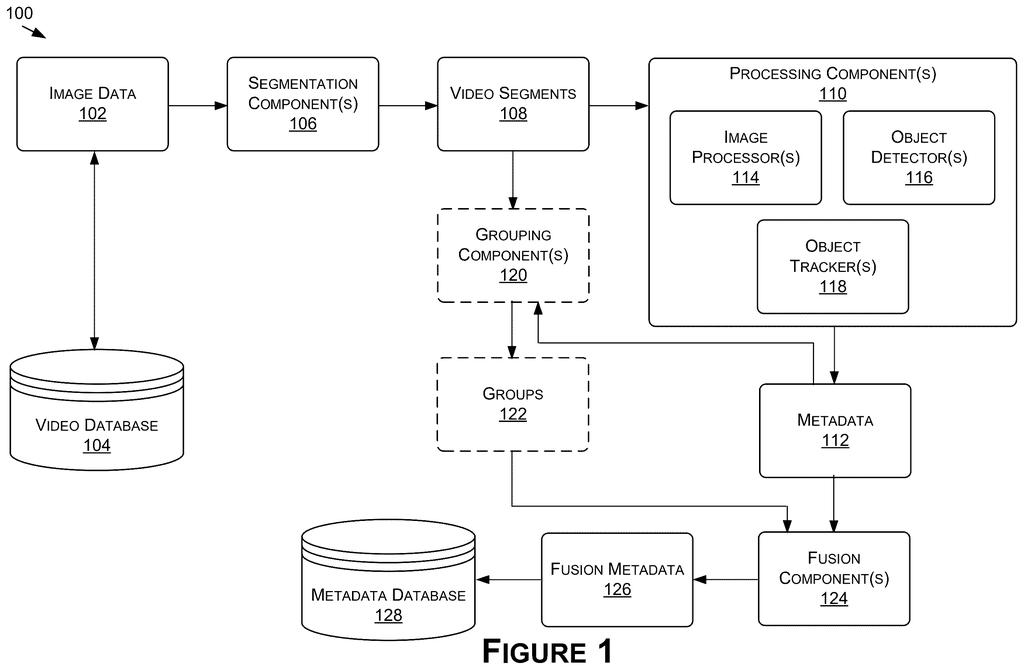
The patent describes a pipeline with three main stages: segmentation, parallel tagging, and fusion.
Segmentation is the first decision. The system looks at two things when deciding where to cut: the content of the video itself (for example, a scene change or a gap in activity) and how much processing capacity is available at the moment. More servers free? Smaller chunks. Fewer resources? Bigger ones. That flexibility is built in so the approach scales to different hardware setups.
Parallel tagging is where the real speed comes from. Each segment is handed to one or more processing components, which can run at the same time rather than waiting in line. For each segment, the system produces a metadata instance that records object identifiers (a unique ID for each detected thing), spatio-temporal information (where in the frame and at what timestamp), and visual descriptors (what it looks like).
Fusion and reassociation is the final and most complex step. Because objects can cross from one segment into the next, the system compares the metadata from adjacent segments to figure out which entries refer to the same real-world object. This is called object reassociation, essentially connecting the dots across the cuts. Once that cross-referencing is done, the system writes a single, unified metadata record covering the whole video to a database.
… an instance of metadata may represent at least identifiers, spatio-temporal information, and/or visual information associated with objects as represented by a video segment.
Translation: Each piece of data describes what an object looks like, what it is called, and where it appears across space and time.
What this means for AI-powered video search and surveillance
For anyone building AI tools that search, monitor, or analyze video, the bottleneck has always been how long it takes to process long recordings. A system that can distribute that work across many processors and still produce a coherent, cross-referenced result makes large-scale video analysis much more practical, whether that's for a retail chain reviewing hundreds of store cameras or a film studio cataloging footage.
For you as an end user, the downstream effect would show up as faster results when searching recorded video, more accurate tracking of events across time, and the ability for AI assistants to answer questions like 'when did the blue car arrive?' without waiting for a full re-analysis every time. a growing pile of Nvidia video-AI filings suggests the company is building out the infrastructure layer that its GPU customers would run these pipelines on.
This is the 58th Nvidia filing in our AI vision coverage we've tracked since May, building on work like one on fixing corrupted frames and one on predicting eye movement.
From a shipping standpoint, this patent describes software logic, not new chips or hardware, which means the main barriers are integration and accuracy rather than years of physical engineering.
The critical piece that has to work before this becomes a real product is reliable object labeling within each video chunk, good enough that the system can stitch identities together across chunks without losing track of who or what it was following. That is a genuine engineering challenge, but one Nvidia's existing customers running large server farms are already positioned to tackle.
What this most plausibly becomes is a background layer inside enterprise video platforms, powering search, alerts, and automated review without any single feature a consumer would point to by name. That anonymity is actually a sign of durability: infrastructure that works tends to stick around.
There are more where this came from
We read every patent application Big Tech publishes and send you the ones worth knowing. Plain English, free, every week.
The drawings
17 drawing sheets from US 2026/0279055 A1 · click any drawing to enlarge


Want this weekly breakdown for a company we don't cover? Patentlyze Pro →
Be the first to weigh in