
Apple Patents a New Way to Seal and Mount Rear Cameras Inside a Glass Bump
Apple is rethinking how cameras attach to the glass back of a phone, using a molded plastic seal and a metal trim ring to lock each lens into its own slot in a raised glass plateau. It's a small detail, but camera bumps are one of the most failure-prone parts of modern smartphones.
What Apple's glass camera plateau actually does
A camera bump sits on the back of nearly every modern smartphone, and most people have watched one crack, fog up, or slowly work loose over time. That raised glass island has to survive drops, temperature swings, and years of pressure, while keeping dust and moisture away from sensitive lenses.
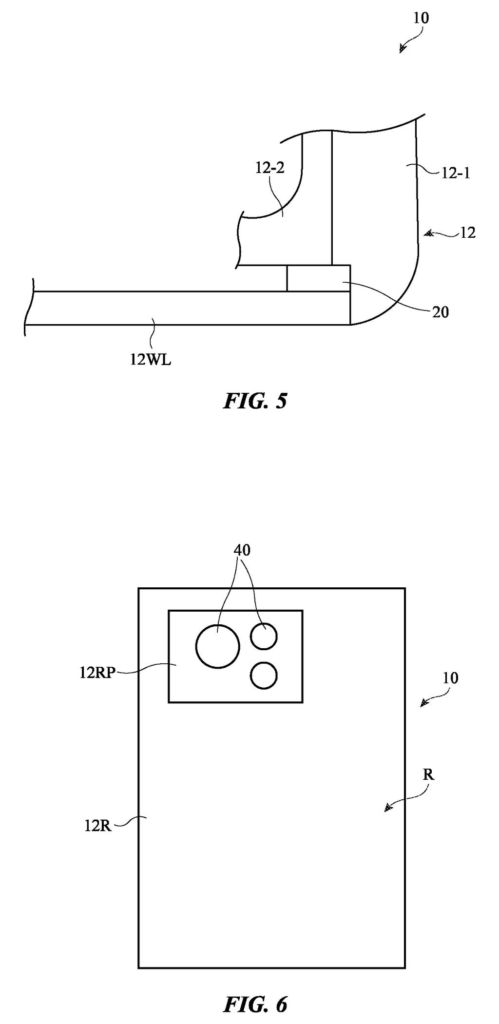
Apple's newly filed patent describes a system where the glass that forms the back of the phone rises into a plateau with individual openings cut into it. Each camera lens protrudes into its own opening, and a metal trim ring sits in that opening around the lens. A molded polymer, think of it as precisely shaped plastic, holds the trim ring in place and seals the gap between the inside of the phone and the outside world.
Separately, the patent also describes how the display's bent edge is embedded in epoxy and supported by a metal bracket that is chemically bonded and welded to other internal structures. Together, these details sketch a phone chassis that tries to make every joint more durable and more precise.
a housing including a housing wall with a protruding portion forming a plateau with an opening; a camera configured to operate through the opening; a camera trim in the opening, wherein a portion of the camera protrudes into the camera trim; and a molded polymer that attaches the camera trim to the plateau, wherein the molded polymer separates the interior from the exterior.
Translation: The camera fits into a raised glass bump and is sealed in place by molded plastic.
How the trim ring, molded polymer, and plateau connect
The core of the patent is a mechanical system for attaching camera hardware to a raised glass section on the back of a phone.
Here is how the pieces fit together:
- Glass plateau: Instead of a flat glass back with a separate camera module sitting on top, the glass itself is shaped to rise into a plateau with openings through it, one per camera.
- Camera trim: A metal ring (the trim) sits inside each opening. The camera lens protrudes into the trim, which helps center and protect the glass-to-metal joint.
- Molded polymer: A shaped plastic piece fills the gap between the trim and the plateau. It is the structural glue of the whole assembly, sealing the interior from outside air and debris while holding the trim in position.
- Display mounting: On the display side, the bent edge of the screen is embedded in epoxy (hardened resin), and a metal support is chemically bonded to that epoxy. That metal support is then welded to camera brackets and other internal structures, tying the display and camera systems into a unified frame.
The air gap between the display's epoxy and the housing sidewall is a deliberate design choice, likely to absorb stress without cracking the glass or separating the adhesive.
What this means for iPhone camera bump design
Camera bumps are a structural weak point. The joint between glass, metal, and camera optics has to be tight enough to keep out water and grit but flexible enough to survive drops without shattering. A molded polymer seal that is formed to the exact shape of the opening is a more controlled solution than a layer of adhesive tape, which can dry out, shift, or leave gaps.
For everyday users, the promise is a camera module that stays sealed longer and a back glass that is less likely to crack at the bump's edges. For Apple, tighter tolerances at the camera opening also mean better optical alignment, which directly affects photo quality. Apple's run of display-and-camera-integration filings suggests the company is treating the physical chassis as a precision instrument, not just an enclosure.
This is the 43rd Apple filing we've tracked in our cell phone coverage since May, adding to work like one on inactive component updates and one on antenna frequency switching.
Water finding its way past a camera lens is one of those failures that feels minor until it ruins your phone. A gap between the camera glass and its surrounding trim ring is all it takes, and over months of drops, temperature swings, and pocket pressure, even a well-built seal can lose its grip.
Forming a plastic ring to the exact shape of each camera opening gives engineers a tighter, more predictable seal than adhesive tape alone. Whether that holds up over three or four years depends on materials and assembly precision, and a patent describes neither.
A phone camera that fogs, corrodes, or floods is a repair bill most people did not budget for. A solution worth filing around, and worth manufacturing correctly.
There are more where this came from
We read every patent application Big Tech publishes and send you the ones worth knowing. Plain English, free, every week.
The drawings
5 drawing sheets from US 2026/0281220 A1 · click any drawing to enlarge


Want this weekly breakdown for a company we don't cover? Patentlyze Pro →