
IBM Patents a System Where Software Builds Its Own Reference Database to Answer Questions
IBM has patented a system where teams of AI agents read your organization's documents, build a structured knowledge map from scratch, and then answer plain-English questions from it directly, complete with a built-in feedback loop so the AI catches its own blind spots before you ever ask a question.
How IBM's AI turns company documents into a question-answering map
Ever tried to get a straight answer from a pile of company manuals, contracts, and policy documents? You end up reading ten PDFs to find one fact, and half the time the answer was buried in a footnote you almost skipped.
IBM's patent describes a system that automates that whole process. A team of AI agents reads through your organization's unstructured documents and builds a kind of knowledge map, a structured database that captures all the important facts and how they connect. Crucially, one AI agent plays the role of critic, testing whether the map can actually answer the questions your team might ask. If it can't, it sends feedback to a second agent to fill in the gaps.
Once the map is built, you can type a plain-English question and the system figures out whether the map can answer it, translates your question into a formal database query, and returns a precise answer. No more wading through stacks of documents yourself.
… providing, by the second AI agent to the first AI agent, feedback to identify one or more missing entities or relationships for inclusion in the domain schema …
Translation: One AI tells another when important information is missing so the database can improve.
How the AI agents check and fix each other's knowledge map
The patent describes an information retrieval system built around a knowledge graph, a structured database where facts are stored not just as text but as a web of named entities (people, products, regulations, processes) and the relationships between them.
Building that graph is handled by multiple cooperating AI agents:
- A first AI agent identifies what entities and relationships the graph should contain for a given subject area (a domain schema, essentially the blueprint).
- A second AI agent tests that blueprint by asking whether sample questions from the domain are actually answerable using what's been captured. If they're not, it flags the missing pieces and sends the blueprint back for revision.
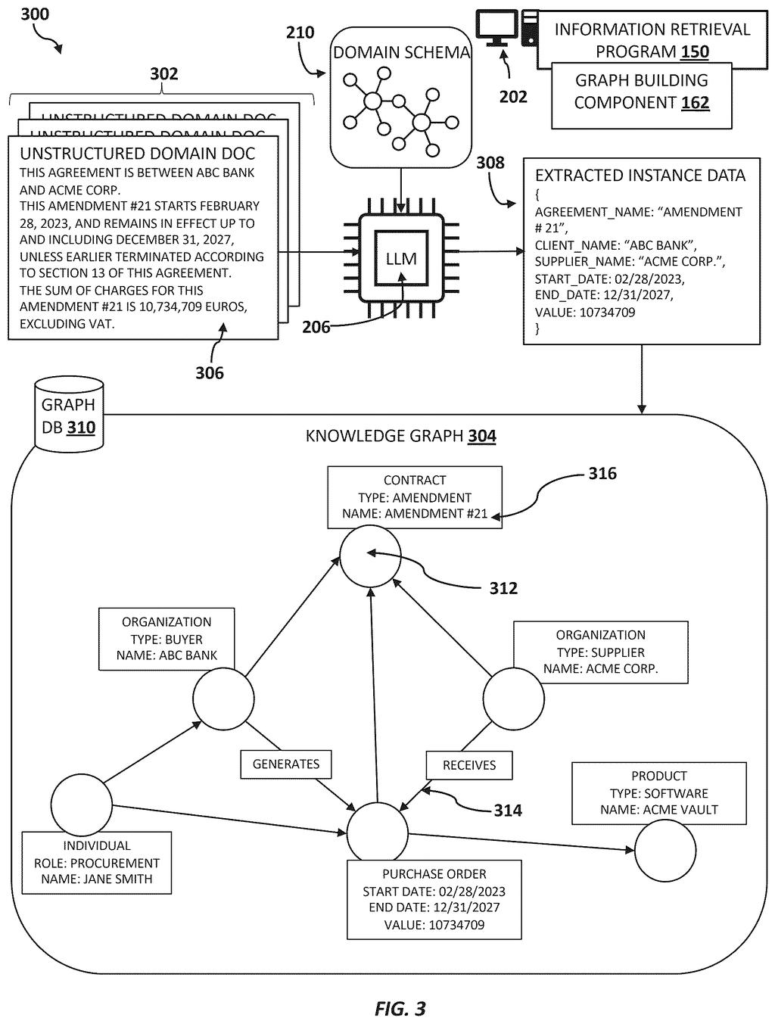
- Once the schema passes that check, the system pulls instance data (specific real-world facts) out of unstructured documents, think PDFs, reports, memos, and slots them into the schema to complete the graph.
At query time, the system first classifies whether an incoming plain-English question can be answered by the graph at all (by checking whether the entities and relationships the question refers to actually exist in the database). If yes, it translates the natural language question into a formal graph language query (a structured command that a graph database can execute, analogous to SQL for relational databases) and runs it to produce a precise answer.
… constructing the knowledge graph by integrating the domain schema and the plurality of instance data extracted from the plurality of domain documents …
Translation: The system builds a connected reference network by combining its structural plan with real facts pulled from documents.
What this means for workers drowning in company documents
For anyone whose job involves pulling facts out of large document collections, compliance officers, analysts, customer-support teams, HR departments, this kind of system could cut out a substantial chunk of manual research. Instead of searching and reading, you ask a question and get an answer tied directly to the source material.
The self-correcting design of the AI agents is the detail worth paying attention to. Most AI question-answering tools fail: they give you a confident but wrong answer because the underlying knowledge was incomplete. IBM's approach builds the error-checking into the construction phase, so gaps in the knowledge map get caught before a user ever runs into them. IBM's track record in knowledge-graph patents suggests this is part of a longer effort to move enterprise AI from general-purpose chat toward domain-specific, auditable answers.
IBM's 16th application we've tracked since May on our AI models working together list follows earlier work on picking the best model automatically and AI that fixes its own errors.
When someone asks a question about a supplier contract or a compliance rule, this system pulls the answer from a verified map of the organization's own documents. That means the answer reflects what the company actually agreed to, not a confident-sounding approximation.
The system includes a step where one AI agent deliberately tries to poke holes in another agent's work before any of it reaches users. That pressure-testing exists because the questions that matter most are usually the ones edge-case enough to expose a tool's weaknesses.
The limiting factor will be document quality. Anyone working from inconsistent records or poorly formatted files will hit that wall before they experience any of the benefits, and the patent describes the approach to this problem without promising a clean solution.
There are more where this came from
We read every patent application Big Tech publishes and send you the ones worth knowing. Plain English, free, every week.
The drawings
5 drawing sheets from US 2026/0277950 A1 · click any drawing to enlarge


Want this weekly breakdown for a company we don't cover? Patentlyze Pro →
Be the first to weigh in