
Samsung · Filed May 8, 2026 · Published Sep 17, 2026

Samsung Patents a Self-Testing Video Decoder That Picks Its Own Fill Direction

Every time your TV or phone decodes a video, it has to guess how to fill in each tiny block of the image from the pixels around it. Samsung has filed a patent for a decoder that auditions every possible fill direction and picks the one that fits best, without needing a separate instruction from the encoder.
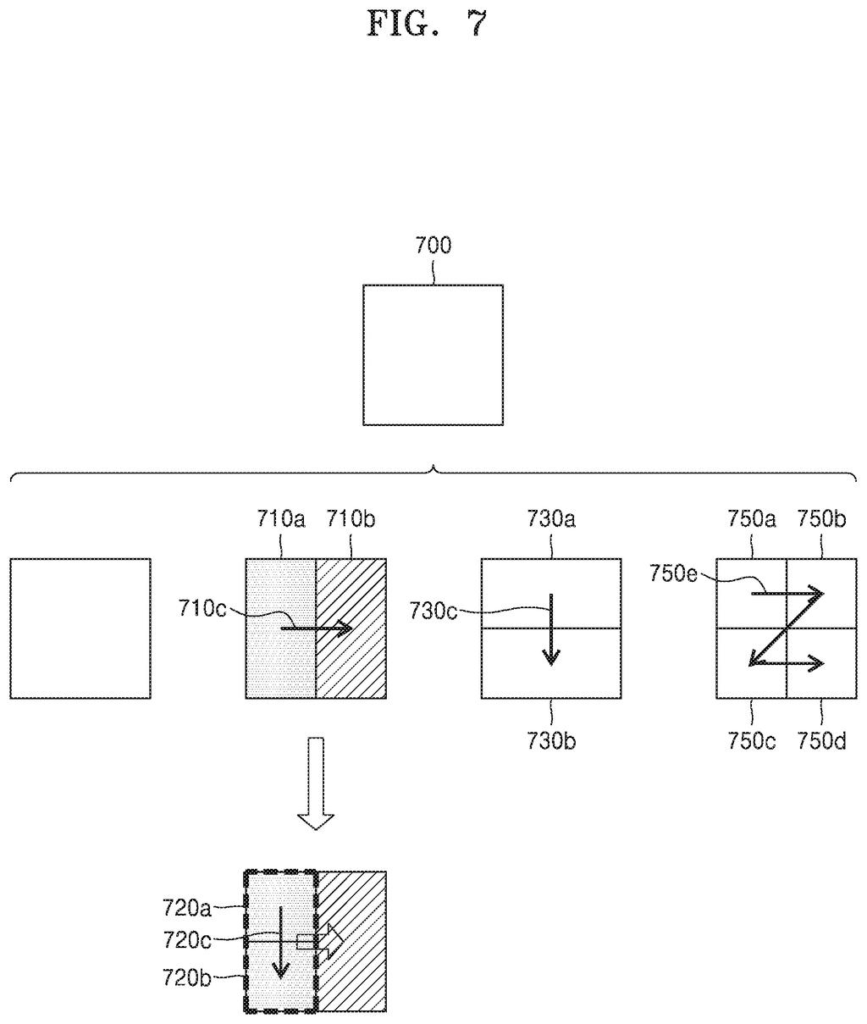
A video block is divided and filled in different directions, with one method showing a horizontal fill direction influencing a subsequent block. Drawing from patent filing US 2026/0281330 A1.
A video block is divided and filled in different directions, with one method showing a horizontal fill direction influencing a subsequent block.
See all 49 drawings from this filing ↓
Publication number US 2026/0281330 A1 US20260281330A1
Applicant SAMSUNG ELECTRONICS CO., LTD.
Filing date May 8, 2026
Publication date Sep 17, 2026
Inventors Jeeyoon PARK, Minsoo PARK, Minwoo PARK, Kwangpyo CHOI
US classification 375/240.02
Status when we published Waiting for an examiner (Jun 24, 2026)
Parent application is a Continuation of PCTKR2024015454 (filed 2024-10-14)
Document 15 claims

What Samsung's auto-direction video trick actually does

Imagine you're putting together a jigsaw puzzle, but instead of seeing the box art, you have to figure out the shape of each missing piece by looking at the pieces already placed around it. That's roughly what a video decoder does dozens of times per frame.

When your phone or TV decodes a video, it breaks each frame into tiny blocks and reconstructs them one by one. For each block, it needs to know which direction the surrounding pixels flow (horizontal stripes, diagonal lines, and so on) so it can make a plausible guess about what belongs inside. Normally, that direction is sent along with the video file itself, which costs extra data.

Samsung's new approach lets the decoder figure out the best direction on its own. It uses two strips of already-decoded pixels: one to generate predictions, and the other to check how good those predictions are. The direction with the lowest error score wins, and that's what gets used to reconstruct the block. No extra instruction needed.

From the filing · CLAIM 1
… determining a directional mode for the current block, from among the plurality of directional modes, based on cost values corresponding to comparison results between each prediction sample set of the plurality of prediction sample sets and the other one of the first sample set and the second sample set …

Translation: The decoder tests different fill directions to see which one matches the surrounding pixels best.

How the decoder tests and scores each fill direction

The patent describes a decoding method built around intra prediction (the process of reconstructing a video block using only neighboring pixels already decoded in the same frame, rather than referencing other frames).

The decoder identifies two sets of neighboring pixels around the current block:

  • First sample set: one strip of already-decoded pixels, used as the reference to generate candidate predictions.
  • Second sample set: a separate strip of already-decoded pixels, used as the ground truth to score those candidates.

For each of several directional modes (think: horizontal, vertical, diagonal at various angles), the decoder runs intra prediction using the first sample set and generates a predicted version of the second sample set. It then compares each predicted version against the actual second sample set and assigns a cost value (a numerical error score, where lower means better). The direction with the lowest cost wins.

Once the best direction is selected, the decoder applies full intra prediction to reconstruct the actual current block. The key insight is that this approach uses already-available decoded data to make the direction decision locally, which means the encoder does not need to transmit the mode explicitly, saving bitrate.

From the filing · THE ABSTRACT
… performing intra prediction by using one of the first sample set or the second sample set as a reference sample set according to each directional mode of a plurality of directional modes to obtain a plurality of prediction sample sets corresponding to the other one of the first sample set or the second sample set …

Translation: It generates multiple test predictions by using neighboring pixels as a reference guide for different angles.

What this means for video quality on Samsung devices

If this approach holds up in practice, it could let video encoders send slightly smaller files without sacrificing image quality, because the direction information does not need to be packaged and transmitted alongside the video data. For you, that could translate to sharper video at the same bandwidth, or the same quality at a lower data cost, which matters most on mobile connections where every kilobit counts.

the pattern in Samsung's video-codec filings points toward investing heavily in decoder-side intelligence, shifting work away from the encoder and the file itself. Whether this specific technique makes it into a shipping codec standard like VVC or a future successor depends on how well it performs in formal testing, but the direction is clear.

Samsung's 123rd filing we've tracked since May adds to earlier work like faster duplicate region spotting and two-stage image storage, all part of our camera sensor push coverage.

Editorial take

You would never notice this working. The improvement, if it ships, arrives invisibly: a video stream that holds its picture quality a little better when your connection gets spotty, or uses slightly less data to look the same.

Codec efficiency is where real-world video quality actually comes from. Dozens of small tricks like this one, accumulated, separate a TV that looks sharp at modest internet speeds from one that needs a much faster connection to reach the same result. Samsung makes both the chips and the TVs, so a niche technical filing like this has a plausible path into hardware you can actually buy.

This is a narrow, incremental improvement in a crowded field. If it gets folded into a future video standard, streaming on your next Samsung TV becomes imperceptibly better. That is a real payoff, even if you never know it happened.

Get our take in your Top Stories

Liked this breakdown? Add Patentlyze as a preferred source on Google, and our plain-English take shows up more often in your Top Stories the next time Samsung patent news breaks.

There are more where this came from

We read every patent application Big Tech publishes and send you the ones worth knowing. Plain English, free, every week.

The drawings

49 drawing sheets from US 2026/0281330 A1 · click any drawing to enlarge

Video decoder system components., drawing sheet 1 from US 2026/0281330 A1
Sheet 1 Video decoder system components.
Video encoder system components., drawing sheet 2 from US 2026/0281330 A1
Sheet 2 Video encoder system components.
Video block division examples., drawing sheet 3 from US 2026/0281330 A1
Sheet 3 Video block division examples.
Vertical and horizontal block divisions., drawing sheet 4 from US 2026/0281330 A1
Sheet 4 Vertical and horizontal block divisions.
Hierarchical video block partitioning., drawing sheet 5 from US 2026/0281330 A1
Sheet 5 Hierarchical video block partitioning.
Video block partitioning examples., drawing sheet 6 from US 2026/0281330 A1
Sheet 6 Video block partitioning examples.
Video block fill directions., drawing sheet 7 from US 2026/0281330 A1
Sheet 7 Video block fill directions.
Video block fill direction prediction., drawing sheet 8 from US 2026/0281330 A1
Sheet 8 Video block fill direction prediction.
Show the other 41 sheets
Samsung Patents a Self-Testing Video Decoder That Picks Its Own Fill Direction patent drawing, sheet 9
Sheet 9
Samsung Patents a Self-Testing Video Decoder That Picks Its Own Fill Direction patent drawing, sheet 10
Sheet 10
Samsung Patents a Self-Testing Video Decoder That Picks Its Own Fill Direction patent drawing, sheet 11
Sheet 11
Samsung Patents a Self-Testing Video Decoder That Picks Its Own Fill Direction patent drawing, sheet 12
Sheet 12
Samsung Patents a Self-Testing Video Decoder That Picks Its Own Fill Direction patent drawing, sheet 13
Sheet 13
Samsung Patents a Self-Testing Video Decoder That Picks Its Own Fill Direction patent drawing, sheet 14
Sheet 14
Samsung Patents a Self-Testing Video Decoder That Picks Its Own Fill Direction patent drawing, sheet 15
Sheet 15
Samsung Patents a Self-Testing Video Decoder That Picks Its Own Fill Direction patent drawing, sheet 16
Sheet 16
Samsung Patents a Self-Testing Video Decoder That Picks Its Own Fill Direction patent drawing, sheet 17
Sheet 17
Samsung Patents a Self-Testing Video Decoder That Picks Its Own Fill Direction patent drawing, sheet 18
Sheet 18
Samsung Patents a Self-Testing Video Decoder That Picks Its Own Fill Direction patent drawing, sheet 19
Sheet 19
Samsung Patents a Self-Testing Video Decoder That Picks Its Own Fill Direction patent drawing, sheet 20
Sheet 20
Samsung Patents a Self-Testing Video Decoder That Picks Its Own Fill Direction patent drawing, sheet 21
Sheet 21
Samsung Patents a Self-Testing Video Decoder That Picks Its Own Fill Direction patent drawing, sheet 22
Sheet 22
Samsung Patents a Self-Testing Video Decoder That Picks Its Own Fill Direction patent drawing, sheet 23
Sheet 23
Samsung Patents a Self-Testing Video Decoder That Picks Its Own Fill Direction patent drawing, sheet 24
Sheet 24
Samsung Patents a Self-Testing Video Decoder That Picks Its Own Fill Direction patent drawing, sheet 25
Sheet 25
Samsung Patents a Self-Testing Video Decoder That Picks Its Own Fill Direction patent drawing, sheet 26
Sheet 26
Samsung Patents a Self-Testing Video Decoder That Picks Its Own Fill Direction patent drawing, sheet 27
Sheet 27
Samsung Patents a Self-Testing Video Decoder That Picks Its Own Fill Direction patent drawing, sheet 28
Sheet 28
Samsung Patents a Self-Testing Video Decoder That Picks Its Own Fill Direction patent drawing, sheet 29
Sheet 29
Samsung Patents a Self-Testing Video Decoder That Picks Its Own Fill Direction patent drawing, sheet 30
Sheet 30
Samsung Patents a Self-Testing Video Decoder That Picks Its Own Fill Direction patent drawing, sheet 31
Sheet 31
Samsung Patents a Self-Testing Video Decoder That Picks Its Own Fill Direction patent drawing, sheet 32
Sheet 32
Samsung Patents a Self-Testing Video Decoder That Picks Its Own Fill Direction patent drawing, sheet 33
Sheet 33
Samsung Patents a Self-Testing Video Decoder That Picks Its Own Fill Direction patent drawing, sheet 34
Sheet 34
Samsung Patents a Self-Testing Video Decoder That Picks Its Own Fill Direction patent drawing, sheet 35
Sheet 35
Samsung Patents a Self-Testing Video Decoder That Picks Its Own Fill Direction patent drawing, sheet 36
Sheet 36
Samsung Patents a Self-Testing Video Decoder That Picks Its Own Fill Direction patent drawing, sheet 37
Sheet 37
Samsung Patents a Self-Testing Video Decoder That Picks Its Own Fill Direction patent drawing, sheet 38
Sheet 38
Samsung Patents a Self-Testing Video Decoder That Picks Its Own Fill Direction patent drawing, sheet 39
Sheet 39
Samsung Patents a Self-Testing Video Decoder That Picks Its Own Fill Direction patent drawing, sheet 40
Sheet 40
Samsung Patents a Self-Testing Video Decoder That Picks Its Own Fill Direction patent drawing, sheet 41
Sheet 41
Samsung Patents a Self-Testing Video Decoder That Picks Its Own Fill Direction patent drawing, sheet 42
Sheet 42
Samsung Patents a Self-Testing Video Decoder That Picks Its Own Fill Direction patent drawing, sheet 43
Sheet 43
Samsung Patents a Self-Testing Video Decoder That Picks Its Own Fill Direction patent drawing, sheet 44
Sheet 44
Samsung Patents a Self-Testing Video Decoder That Picks Its Own Fill Direction patent drawing, sheet 45
Sheet 45
Samsung Patents a Self-Testing Video Decoder That Picks Its Own Fill Direction patent drawing, sheet 46
Sheet 46
Samsung Patents a Self-Testing Video Decoder That Picks Its Own Fill Direction patent drawing, sheet 47
Sheet 47
Samsung Patents a Self-Testing Video Decoder That Picks Its Own Fill Direction patent drawing, sheet 48
Sheet 48
Samsung Patents a Self-Testing Video Decoder That Picks Its Own Fill Direction patent drawing, sheet 49
Sheet 49
Browse all the drawings 49 drawing sheets
Patent filing page

Source. Full patent text and figures from the official USPTO publication PDF.
Reader comments

Be the first to weigh in

Start the discussion

Real name or a handle, either is fine. Comments are read by a person before they appear, so allow a little time. Keep it about the filing.