
Samsung Patents an AI That Writes Its Own Training Videos to Caption the Unexpected
Most video captioning tools fall apart the moment they see something unusual. Samsung's new patent describes a system that solves that by having AI generate its own practice videos before it ever encounters a tricky real one.
How Samsung teaches its AI to describe videos it has never seen
Ever tried to get an automatic caption on a home video of a niche sport or a regional festival, only to get something vague or completely wrong? That happens because most captioning tools are only as good as the examples they were trained on, and rare situations rarely make it into training data.
Samsung's patent describes a system that patches that gap by building its own practice material. Instead of waiting for humans to supply labeled examples of unusual situations, the AI writes descriptive captions from scratch, then uses a separate AI to generate matching videos for those captions. The captioning model then trains itself on those pairs.
The result is a model that can handle out-of-distribution scenarios, meaning situations it would never have seen in a conventional training dataset. For you, that could mean more accurate automatic captions on videos that cover anything from regional cooking techniques to obscure hobbies.
… a large language model that receives a prompt related to a content category and generates a plurality of captions based on the prompt …
Translation: An AI text generator writes diverse descriptions based on specific topics.
How captions become synthetic videos for self-training
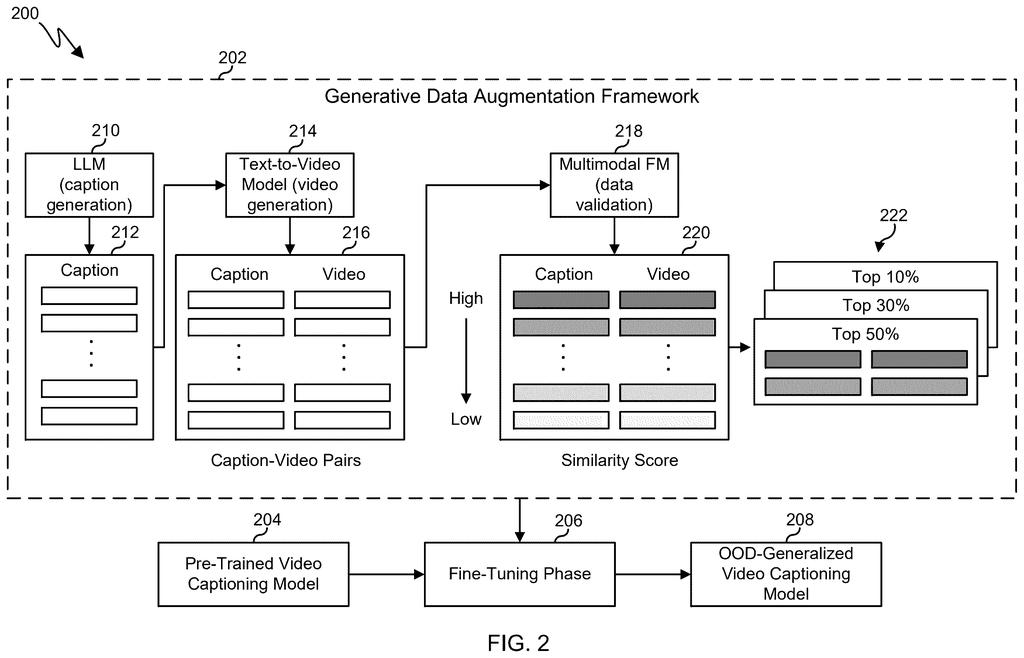
The patent describes a three-stage pipeline that lets a video captioning model train itself on situations it has never encountered.
- Stage 1 (Caption generation): A large language model (essentially a text AI, the kind that powers chatbots) receives a prompt describing a content category. It produces a large batch of varied, realistic captions that describe hypothetical scenes in that category.
- Stage 2 (Video synthesis): Those captions are fed into a text-to-video model, which generates short video clips visually matching each caption. The video-caption pairs now form a synthetic training dataset.
- Stage 3 (Fine-tuning): The video captioning model is fine-tuned (adjusted, using those new pairs) so it gets better at describing the kinds of scenes represented in that category.
The key insight is that the model never needs humans to film and label examples of rare events. It can bootstrap its own training data for any content category by generating text first and video second.
Out-of-distribution is the technical term for inputs that look nothing like what a model was originally trained on. This system is specifically designed to handle those edge cases.
… a text-to-video model that generates video counterparts each associated with a caption of the plurality of captions to finetune the video captioning model …
Translation: Another AI turns those generated descriptions into custom training videos.
What this means for auto-captioning on Samsung devices
Auto-captioning is increasingly baked into phones, TVs, and cameras, but it tends to perform well only on mainstream content: sports highlights, news clips, cooking shows. Anything unusual, regional, or niche often gets a generic or inaccurate caption. A system that can self-train on synthetic data for any content category could shrink that gap without requiring Samsung to collect and label massive new real-world datasets.
For accessibility, that matters directly. Captions are not a nice-to-have for the millions of people who are deaf or hard of hearing. If your video shows something off the beaten path and the caption is wrong, the failure is not abstract. Samsung has been filing around on-device AI and media understanding since 2023, and this patent fits that pattern by pushing more of the intelligence into the model itself rather than relying on ever-larger human-curated datasets.
Samsung's 32nd filing we've tracked in AI image and video since May follows a two-stage image compression idea and a body-double workout video patent.
Automatic captions fail people most precisely when the moment feels personal: a wedding ceremony with unfamiliar traditions, a street festival, a family gathering built around rituals that never made it into mainstream training footage. Samsung's approach teaches its captioning model to handle those gaps by having one system write descriptive captions for unusual scenarios and another generate matching video clips, giving the model practice on situations it would rarely see otherwise.
For someone using a Samsung camera or TV, this improvement would arrive without announcement. The payoff is a caption that is accurate where it used to be garbled or missing, in exactly the moments that matter most.
That quiet reliability is what the filing is building toward, and it is a meaningful one. The tool becoming useless at a personal moment is not a minor glitch; it is a failure people remember.
There are more where this came from
We read every patent application Big Tech publishes and send you the ones worth knowing. Plain English, free, every week.
The drawings
6 drawing sheets from US 2026/0279018 A1 · click any drawing to enlarge


Want this weekly breakdown for a company we don't cover? Patentlyze Pro →
Be the first to weigh in