
Samsung Patents a Way for Sound Systems to Figure Out Where Their Speakers Are
Setting up a surround-sound system usually means telling it exactly where each speaker sits. Samsung is patenting a method that lets the system figure that out on its own by listening.
What Samsung's speaker-height detection actually does
A home theater system sits silent in the living room, waiting to be told where its speakers are. Normally, that means you pulling out a tape measure or answering a setup wizard's questions about ceiling height and speaker placement.
Samsung's patent describes a system that skips all of that. Each speaker plays a short test tone, and a set of microphones in the room listens carefully. By measuring how long the sound takes to travel from each speaker to each microphone, the system can calculate exactly how far away each speaker is. Once it has those distances, it works out the angle: is that speaker at ear level, or mounted high on the wall, or tucked into a ceiling corner?
The result is a receiver or sound bar that knows its own physical layout without you lifting a finger. That information is important because a system that knows where its speakers actually are can apply the right audio processing to each one, rather than guessing.
emitting, by each of a plurality of discrete loudspeakers, an excitation stimulus; measuring, by each of a plurality of microphones, a response at that microphone due to the emitted excitation stimuli …
Translation: The speakers play test sounds that the microphones pick up to analyze how sound travels.
How the system measures distance and calculates elevation
The patent describes a calibration process built around test tones and microphones. Each discrete loudspeaker in the system emits what the patent calls an excitation stimulus (a short burst of sound designed to be easy to measure). A set of microphones records how that burst sounds when it arrives at each listening point.
From those recordings, the system performs a mathematical operation called deconvolution (essentially stripping away the room's own acoustic character to isolate the direct sound path). This produces what engineers call a loudspeaker room impulse response for every speaker-microphone pair: a precise fingerprint of how sound traveled from that speaker to that microphone.
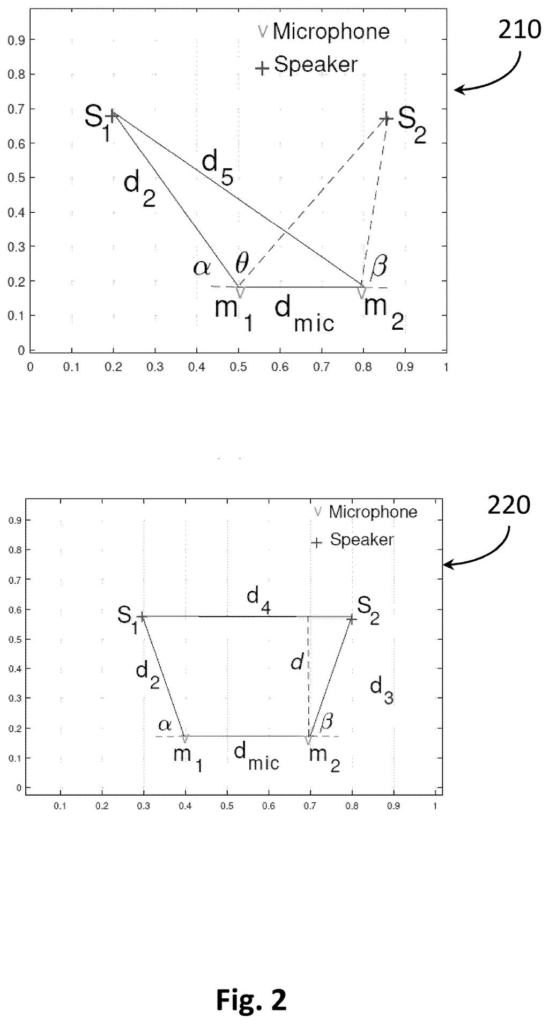
The travel time buried inside each impulse response translates directly into a distance. The patent requires at least two microphones placed a known distance apart, which gives the geometry enough reference points to triangulate. Once the system has distances from multiple microphones to a single speaker, basic trigonometry converts those distances into an elevation angle, telling the system how high above the listening plane that speaker sits.
The patent notes each speaker must be physically close to at least one microphone, which keeps the measurement reliable in typical living-room setups where a sound bar or receiver might sit near some speakers but not others.
… determining, from the set of loudspeaker room impulse responses, a distance between each discrete loudspeaker and each microphone; and estimating, based on the determined distances, an elevation angle of each of the discrete loudspeakers.
Translation: The system figures out how far away each speaker is and what height it is placed at.
What this means for home theater audio setup
For most people buying a multi-speaker home audio system today, setup is the frustrating part. Getting Dolby Atmos or spatial audio to sound right depends on the receiver knowing whether those overhead or wall-mounted speakers are actually overhead or at ear level. If the system guesses wrong, dialogue sounds off, effects land in the wrong place, and the whole expensive setup underperforms.
A method that measures speaker position automatically removes that friction and also catches real-world problems: a speaker someone meant to mount high but ended up placing on a shelf, or a soundbar moved to a different room. Samsung's run of audio-calibration filings suggests the company is investing in making premium sound accessible without the manual configuration work that currently discourages buyers.
Samsung's 26th filing in the audio patents we cover since May adds to a run that includes one on coil placement and one that reads audio structure.
Setting up surround sound almost always ends the same way: everything works, technically, but the overhead effects feel slightly off, like rain that sounds like it's coming from the wall instead of the ceiling.
This patent solves that by having the speakers and microphones measure each other automatically, timing how long sound takes to travel between them and using those measurements to figure out exactly where each speaker sits in the room. No manual calibration, no guessing.
The person who feels this is someone watching a movie where a plane passes overhead and it actually passes overhead. That's the whole payoff, and it's a real one.
There are more where this came from
We read every patent application Big Tech publishes and send you the ones worth knowing. Plain English, free, every week.
The drawings
3 drawing sheets from US 2026/0276771 A1 · click any drawing to enlarge


Want this weekly breakdown for a company we don't cover? Patentlyze Pro →
Be the first to weigh in