
Google Patents a Privacy-Preserving System for Teaching Smart Speakers Your Sounds
Your smart speaker already listens for its wake word — but what if it could learn to recognize the specific sounds that matter in your home, like your dog's bark or a particular door chime, without ever sending a raw recording to Google's servers?
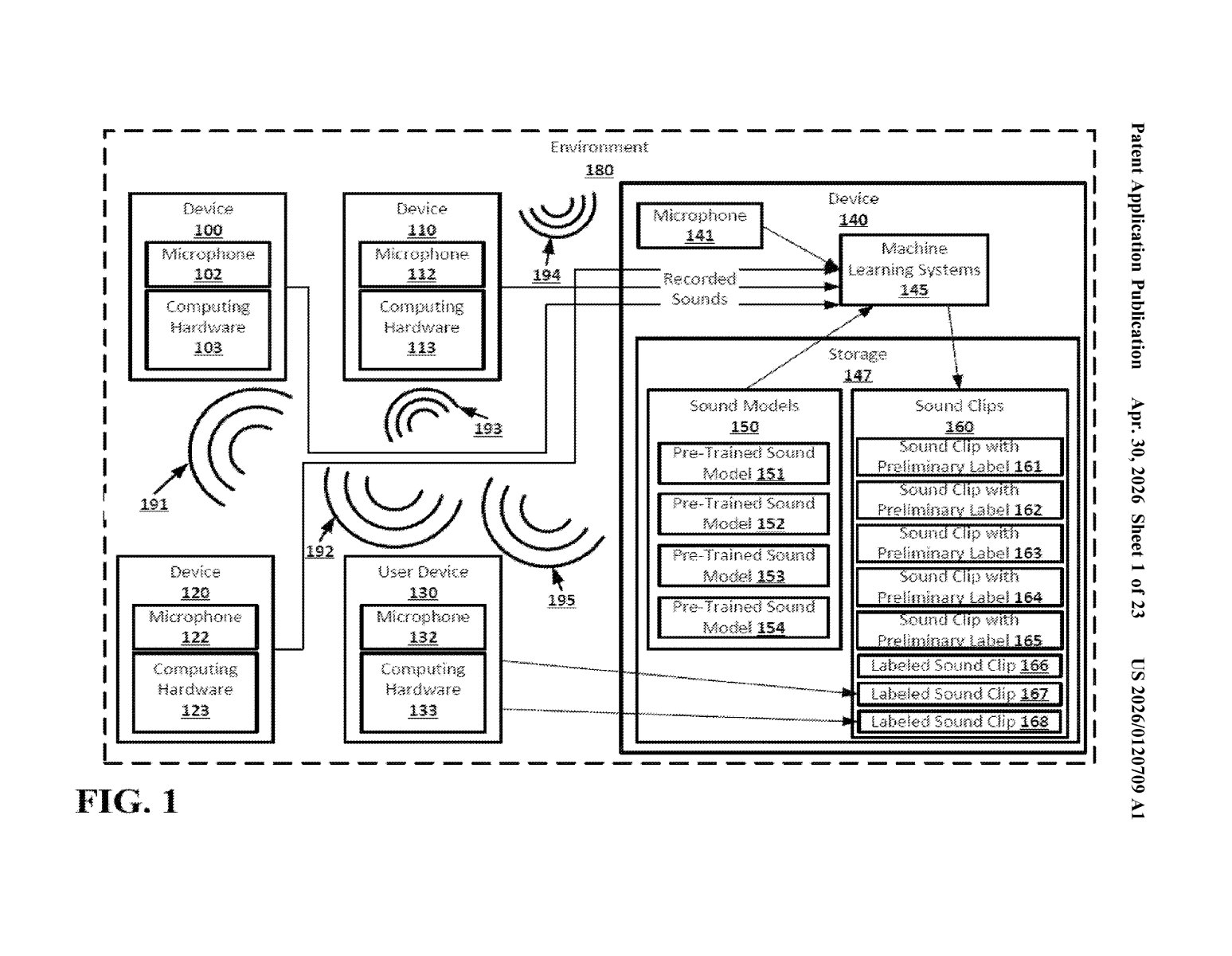
What Google's on-device sound personalization actually does
Imagine your Google Nest hears a sound and sends you a phone notification: "Hey, I caught something — is this worth remembering?" You tap yes or no, and the device quietly updates its own understanding of what sounds matter to you. That's the core loop this patent describes.
What makes it interesting is where the learning happens. Instead of uploading your audio to Google's cloud and training a model there, the heavy lifting stays on the device (or close to it). The system uses a pre-trained model as a starting point, then fine-tunes it based on the labels you give it — keeping your personal sound library private by design.
This is sometimes called on-device personalization, and it's a direct response to one of the thorniest problems with smart home devices: people don't trust them with their audio. By letting the model adapt to your environment without shipping your sounds off to a server, Google is trying to offer customization without the creep factor.
How the personalization module learns from your feedback
The system works in a four-step loop. First, a listening device — think a Nest Hub or smart speaker — captures a sound clip from the environment. A built-in personalization module then runs two things in parallel: it generates an embedding (a compact mathematical fingerprint of the audio) and makes a best guess at a predicted sound class (e.g., "dog bark," "alarm," "glass breaking").
Next, the device fires off a notification to your phone. The notification essentially asks: "I heard something — do you want me to learn this sound?" You respond with a label — yes, no, or maybe a custom name — and that label gets fed back into the system.
Finally, the pre-trained models update themselves based on three inputs:
- Your label (the ground truth)
- The embedding (what the sound actually sounded like)
- The predicted class (what the model already thought it was)
The update is incremental — it nudges the existing model rather than retraining from scratch. This is the key privacy-preserving trick: the raw audio doesn't need to leave the device, only the abstract numerical representations do (if anything leaves at all). The patent describes storing confirmed clips as "positive" training examples and rejected ones as "negative" clips, building a personalized dataset over time.
What this means for Google Nest and smart home privacy
For users, this is about trust and utility at the same time. Smart speakers have stalled partly because people are uneasy about ambient microphones. A system that visibly asks for your consent before learning a sound — and that keeps the actual audio local — is a meaningful step toward making that bargain feel fairer. If you've ever wished your Nest could reliably detect your specific smoke alarm tone and not your neighbor's TV, this is the technical path to that.
For Google's product strategy, this slots neatly into the broader push toward on-device AI across the Pixel and Nest lines. It also puts competitive pressure on Amazon's Alexa ecosystem, which has offered some sound detection features but with less transparent privacy controls. Whether this capability ships as a Nest feature or stays in the lab depends on execution, but the underlying architecture is clearly production-minded.
This is a genuinely thoughtful patent — it solves a real user problem (my smart speaker doesn't know my sounds) with a mechanism that takes the privacy objection seriously rather than papering over it. The human-in-the-loop labeling step is clever because it turns the user into a collaborator instead of a data source. Worth watching for a Nest firmware update.
There are more where this came from
We read every patent application Big Tech publishes and send you the ones worth knowing. Plain English, free, every week.
Want this weekly breakdown for a company we don't cover? Patentlyze Pro →