
Disney Patents a Display System That Floats Real 3D Images in Open Air for Crowds
Disney has filed a patent for a display system that projects a three-dimensional image into empty space, visible from multiple angles simultaneously, with no headset required. The goal is a real image that a group of people can walk around and interact with, like a physical object.
What Disney's floating real-image display actually does
A crowd gathers around a glowing figure hovering in midair at a theme park. Nobody is wearing glasses. Nobody is holding a phone. The image just floats there, and people walk around it from all sides.
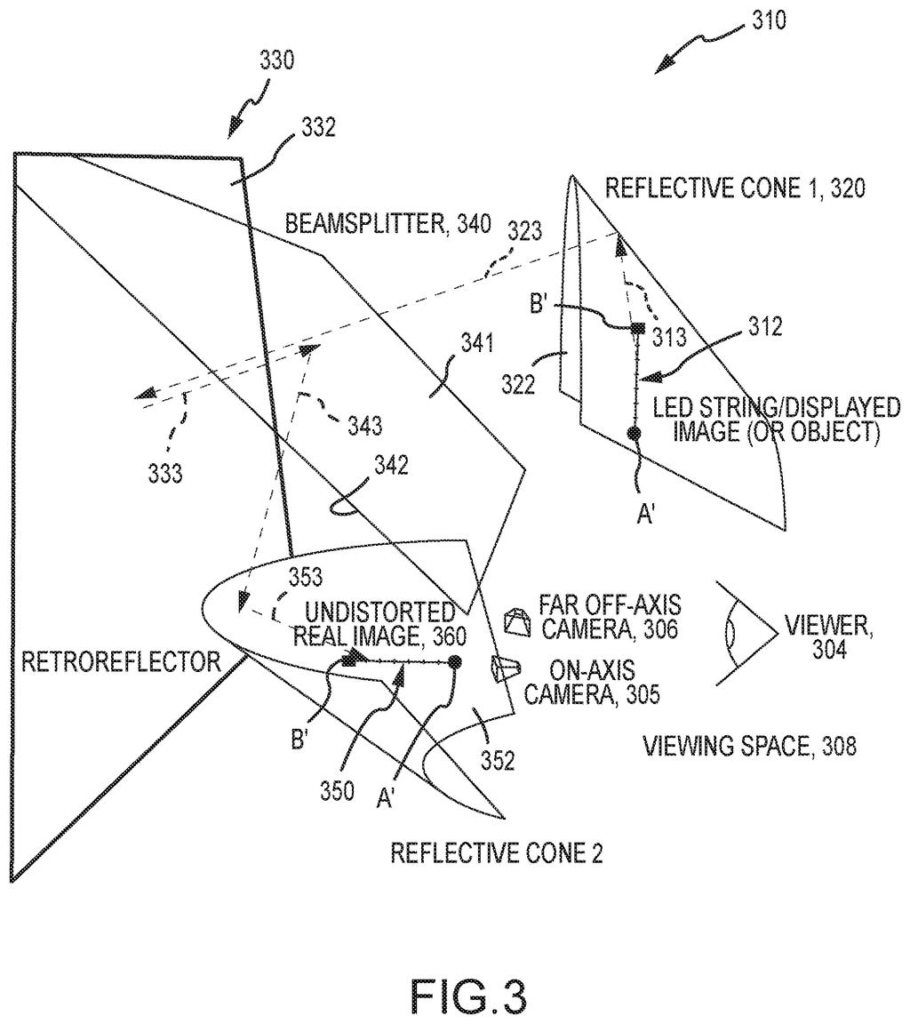
That is what Disney's patent is trying to make possible. The system uses a set of optical stations, each one containing a light source, a half-mirror (called a beamsplitter), and a special reflective surface. Each station bounces light in a precise way so the image appears to hang in the air in front of it. By arranging multiple stations in a ring and tilting them slightly relative to each other, the overlapping light from all of them builds up a single image you can see from almost any direction.
The key word here is real image. Unlike a hologram or a screen illusion, a real image forms where actual light rays physically converge in space. You can't touch it, but it exists at a real point in the room, not just on a flat surface.
A wide-angle, retroreflective real image display system that produces real images that can be viewed and interacted with by a group of people who can move about a space to view the real image.
Translation: Multiple people can walk around the floating picture and see it from different angles without special glasses.
How the beamsplitters and retroreflectors build the image
The system works around a specific optical trick. A retroreflector is a surface that sends light straight back in the direction it came from, the same principle that makes road signs glow in your headlights. When you place a retroreflector behind a beamsplitter (a half-mirror that lets some light through and bounces some back), you can create a real image, meaning a point in space where light rays actually cross, forming a visible object that appears to float in front of the device.
A single station like this produces a real image, but only visible from a narrow range of angles. Disney's patent solves the narrow-viewing problem by using multiple display stations, each slightly rotated relative to the others. Each station contributes a cone of light to the viewing area, and those cones overlap. A person standing anywhere within that shared zone sees the image.
The patent also describes a second, more compact version using two additional reflectors (mirrors) to fold the optical path into a smaller physical footprint. In that version:
- Light from a source hits a first reflector.
- It passes through a beamsplitter toward the retroreflector.
- The retroreflector sends it back through the beamsplitter at a different angle.
- A second reflector directs that returned light into the viewing zone.
Both versions aim for the same result: a wide-angle, glasses-free, interactive real image that a group of people can move around and observe from different positions.
What this could mean for theme park and public displays
For theme parks and public venues, the ability to show a three-dimensional image to a group, without screens, headsets, or fixed viewing positions, has been a long-standing design problem. Most existing real-image displays work only if you stand in exactly the right spot, which limits them to single-viewer demonstrations. Disney's approach, stacking multiple stations to widen the viewing angle, is a direct attack on that constraint.
If the system works at scale, it opens the door to interactive displays where guests could approach an image from any direction, see it shift with perspective, and potentially interact with it. That is a meaningful difference from a flat screen or a projection surface, and it fits neatly into Disney's long bet on physical-digital storytelling at its parks. The practical challenges of brightness, image quality, and physical size at attractions scale remain real, but the optical concept is sound.
Disney's seventh filing we've tracked in our Display coverage since June builds on earlier work like projecting onto moving surfaces and locking images to a robot's skin.
Floating, three-dimensional images that only look correct from one specific spot are essentially useless in a museum, a theme park, or any public venue where people wander freely. That is not a minor inconvenience. It is the reason this category of display technology has stayed mostly off the table for anyone designing experiences around crowds.
Disney's patent describes a system where multiple display units work together, their light overlapping across a wider area so that many people standing in different positions can all see the image at the same time. The problem that targets is specific and expensive: if only one person in a group can see the effect properly, you cannot build a reliable experience around it.
Whether the hardware survives the daily abuse of a public environment remains an open question. But the problem here is real, the cost of leaving it unsolved is high, and the approach is proportionate to both.
There are more where this came from
We read every patent application Big Tech publishes and send you the ones worth knowing. Plain English, free, every week.
The drawings
7 drawing sheets from US 2026/0287803 A1 · click any drawing to enlarge


Want this weekly breakdown for a company we don't cover? Patentlyze Pro →
Be the first to weigh in