
Disney Patents a Motorized 3D Projection Surface That Pops Out on Cue
Disney is patenting a projection surface that physically unfurls on command — and then displays 3D visuals synced to a show, or that react to where you're standing.
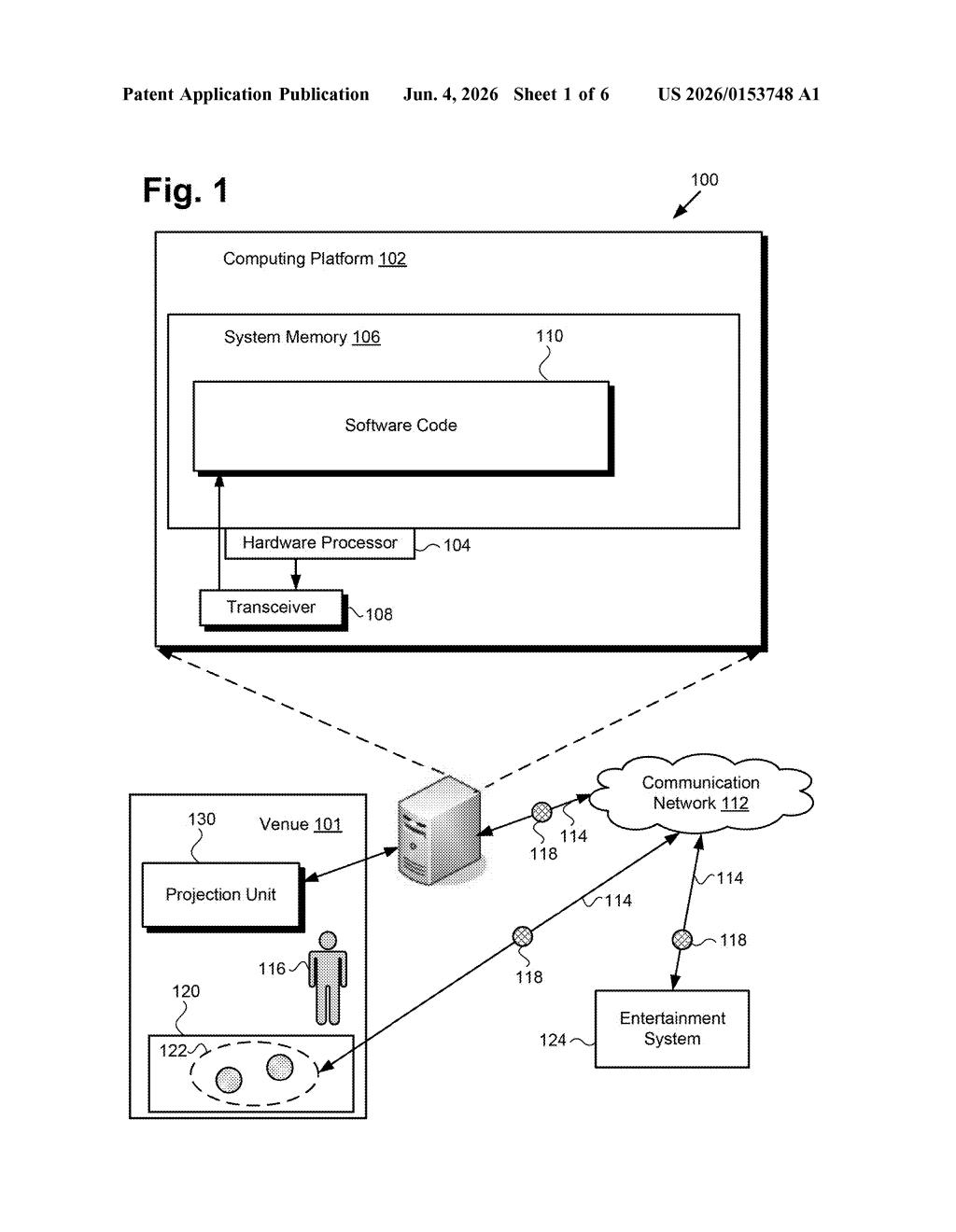
What Disney's extending projection surface actually does
Imagine you're walking through a Disney theme park attraction and a panel on the wall suddenly extends outward toward you — then lights up with a 3D image that seems to pop right off the surface. That's the core idea here.
Disney's patent describes a physical surface that can mechanically stretch or unfold at one end while the other end stays fixed. Once extended, a projector illuminates it and produces a 3D visual effect. The effect can be timed to sync with a ride or show, it can react to something you do, or it can change based on where you are in the venue.
Think of it as a prop and a display system combined into one. The surface isn't just a static screen — it moves, it knows where you are, and it puts on a show tailored to the moment. It's the kind of seamless theatrical trick that makes a theme park feel like another world.
How the system extends, lights, and reacts in real time
The system has two main components: a computing platform (processor + software) and a projection unit built around a 3D extendable surface.
The surface has a fixed end (the non-extending end, anchored to a wall, floor, or fixture) and a free end (the extending end) that physically moves outward when triggered. The system receives an activation signal — think a ride vehicle crossing a sensor threshold, a show timestamp firing, or a guest interaction — and responds by physically extending the surface and switching on the projection.
Once illuminated, the patent describes three modes of operation:
- Synchronized mode: the 3D effect plays back in sync with a pre-programmed show or ride sequence
- Interactive mode: the visuals respond to a specific action taken by a guest (a gesture, a button press, a prop interaction)
- Location-aware mode: the displayed content shifts based on where the guest is standing within the venue space
The 3D visual effect is produced by projecting onto the now-physical three-dimensional shape of the extended surface — the geometry of the surface itself contributes to the illusion, rather than relying purely on optical tricks from the projector.
What this means for Disney's next generation of park experiences
Theme park projection mapping is already impressive, but it typically works on static surfaces. By making the surface itself move, Disney can add a physical dimension to the illusion — a surface that reaches toward you feels fundamentally different from a flat wall lighting up. The tactile surprise of something physically extending is a trick even the best flat-panel display can't replicate.
The location-awareness and interactivity clauses are the quietly ambitious part. If the system knows where you are in a room and adjusts what it shows accordingly, Disney could create personalized moments inside shared spaces — something that's increasingly central to their next-generation park design philosophy.
This is a genuinely clever piece of theatrical engineering. Combining a mechanically articulating surface with projection mapping and guest-location tracking closes a gap that pure digital displays can't — the physical surprise of something moving toward you. It's niche by design, purpose-built for high-budget immersive venues, but in that context it solves a real problem.
There are more where this came from
We read every patent application Big Tech publishes and send you the ones worth knowing. Plain English, free, every week.
Want this weekly breakdown for a company we don't cover? Patentlyze Pro →