
Nvidia Patents a Fix That Keeps AR Objects Locked in Place Without Altering the Headset's Display System
One of the most frustrating things about augmented reality is watching a virtual object slowly drift away from where it's supposed to be. Nvidia's new patent describes a system that locks AR visuals in place using depth data and a clever hand-off between a remote server and the headset's own display pipeline.
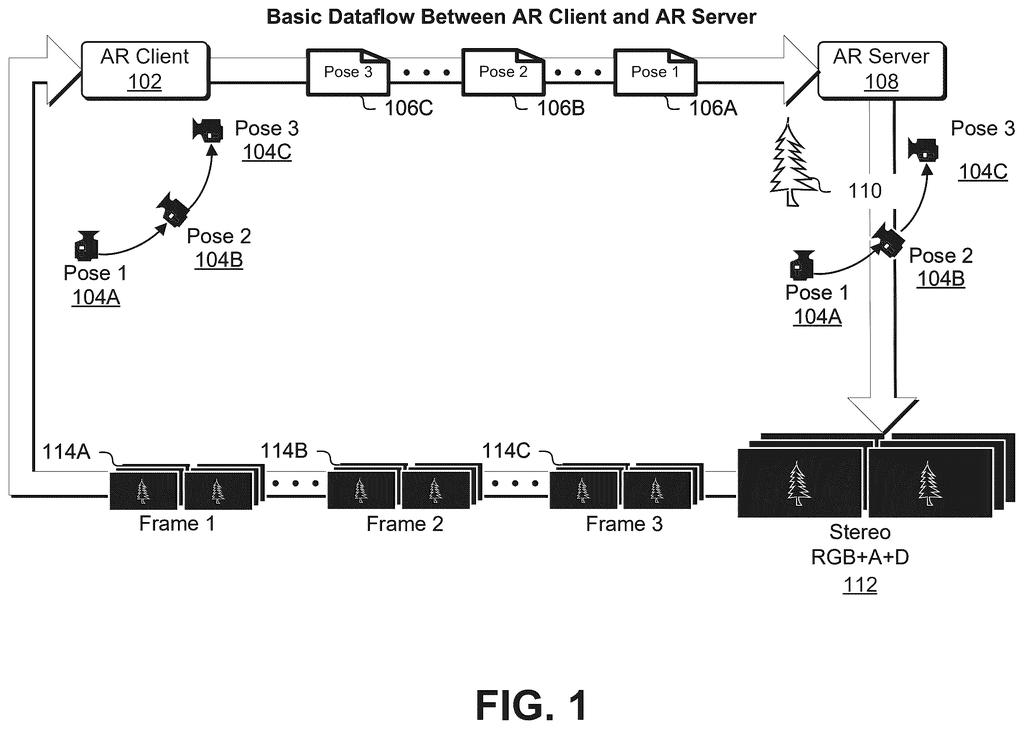
What Nvidia's AR stabilization system actually does
A surgeon's AR headset shows a 3D model hovering over a patient. Then the model starts to slip, drifting a few centimeters as the headset updates its view of the room. That small error can ruin the whole experience, and in some cases, it matters a lot.
Nvidia's patent describes a system designed to eliminate that drift. The idea is to build a 3D mesh (think of it as a wire-frame skeleton of the virtual object) on a remote server, then hand that mesh off to the headset at the last moment so the headset can pin it precisely to the real world using its own up-to-the-millisecond position data.
The clever part: the remote software never has to reach inside the headset's own graphics engine. It passes the mesh through a standard software handshake, and the headset handles the final rendering. That separation keeps the system stable even when the server and the headset are slightly out of sync.
receive, via an incoming application interface (API) call, one or more predicted poses and a coordinate system used by an augmented reality (AR) client device; …
Translation: It takes movement predictions and spatial data from the headset through an API.
How the mesh and pose data flow between server and headset
The patent describes a server-side process that generates a mesh (a mathematical surface describing a virtual object's shape) based on predicted pose data (the headset's best guess about where it will be pointing a few milliseconds in the future). That predicted pose comes from the AR client device via an API call (a structured request one piece of software sends to another, like a waiter taking your order to the kitchen).
The server builds both the mesh and the associated color data without ever touching the headset's internal rendering pipeline (the graphics engine that actually draws pixels on screen). Instead, it sends the finished mesh back through another API call. The headset then renders it using a fresh, real-time actual pose rather than the predicted one. That last-second substitution is what prevents drift.
The system also relies on depth information to understand the geometry of the real scene, which helps the virtual object sit correctly in 3D space rather than floating awkwardly in front of or behind real surfaces.
Key components described in the patent:
- Incoming API call carrying predicted poses and the headset's coordinate system
- Server-side mesh generation independent of the headset's graphics engine
- Outgoing API call delivering the mesh and color data back to the device
- Final render using the actual, current pose for pixel-accurate placement
A mesh that includes a virtual object to be rendered for display by a client device is generated by execution of software that lacks access to a rendering pipeline of the client device …
Translation: The system builds the 3D virtual object using software that bypasses the headset's main display pipeline.
What this means for cloud-rendered AR experiences
For AR to be useful in demanding settings (medical visualization, industrial inspection, precision training), virtual objects have to stay exactly where they are placed. Even small amounts of drift erode trust and make the technology feel unreliable. The problem compounds when rendering is done remotely on a powerful server rather than on the headset itself, because network delays create a gap between what the server calculated and where the headset actually is.
This patent attacks that gap directly by splitting the work: heavy mesh generation stays on the server, but the final placement decision stays on the headset. the pattern in Nvidia's AR and robotics filings suggests the company is building infrastructure for experiences that rely on cloud compute rather than cramming all the processing into a wearable device. If this approach works at scale, it could make server-rendered AR far more practical than it is today.
Nvidia's sixth filing we've tracked since July in the AR glasses race builds on earlier applications covering eye movement prediction and gaze-based device controls.
The problem this patent addresses is real and not trivial. AR drift is the reason many professional AR deployments still use tethered, high-powered local hardware rather than lightweight headsets connected to remote servers. The cost of drift is measured in frustrated users and, in high-stakes applications, in errors that have consequences.
The solution here is architecturally sensible. By keeping the final render decision on the headset (where timing is tightest) and offloading the heavy geometric work to a server, Nvidia is threading a needle that has tripped up other approaches. The API-based hand-off also means this could, in principle, work across different headset hardware without requiring deep integration into each device's proprietary graphics stack.
That said, the patent describes a mechanism, not a finished product. Whether the latency budget for the round-trip API call is actually tight enough to prevent perceptible drift in practice is an engineering question the document does not fully answer. The approach is credible, but the hard work of proving it at real-world frame rates is still ahead.
There are more where this came from
We read every patent application Big Tech publishes and send you the ones worth knowing. Plain English, free, every week.
The drawings
29 drawing sheets from US 2026/0289911 A1 · click any drawing to enlarge


Want this weekly breakdown for a company we don't cover? Patentlyze Pro →
Be the first to weigh in