
Nvidia Patents a System That Lets Remote Users Step Inside Your Real-World Room in VR
Nvidia has filed a patent for a system it calls 'teleportation': a way to scan a real room, swap its physical objects for polished 3D virtual versions, and then let a remote person walk through that reconstructed space as if they were actually there.
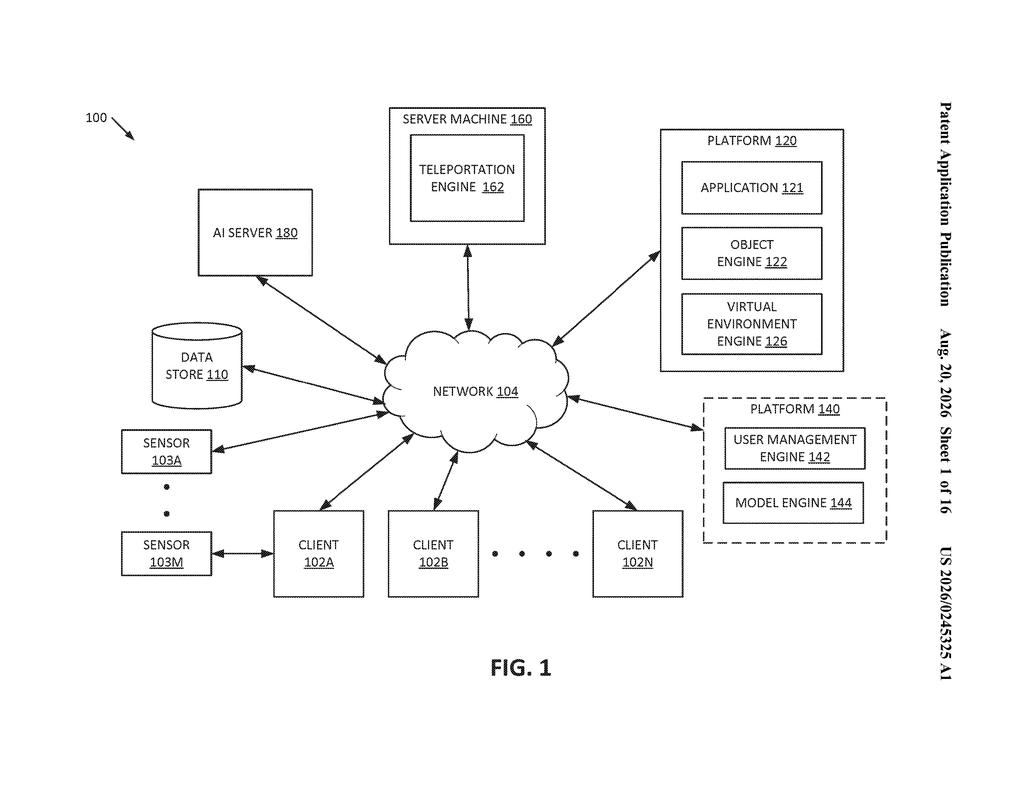
What Nvidia's virtual room-sharing system actually does
Right now, video calls show you a flat rectangle of someone else's world. Even the fanciest virtual-meeting apps either put both people in a made-up digital room or leave the remote person staring at a 2D screen. Neither feels like sharing the same space.
Nvidia's patent describes a different approach. A person wearing sensor-equipped gear moves around their real room. The system scans everything in that room, finds the closest-matching 3D virtual objects (so a wooden chair becomes a clean, rendered virtual chair), and builds a live virtual copy of the space. A remote guest, wearing their own VR headset, is then dropped into that copy. Both people appear as avatars, and the guest can see the host's room around them in real time.
The result is less like a video call and more like physically visiting someone. You'd see their actual furniture arranged the way it really is, but rendered as crisp virtual graphics rather than blurry video pixels.
… identifying, based on the first set of data, a virtual object candidate corresponding to an object in the real-world environment positioned at a first location, wherein identifying the virtual object candidate comprises: generating a vector embedding of the object …
Translation: The system scans physical items in your room and turns them into digital 3D models that can be placed in a virtual space.
How Nvidia matches real objects to virtual 3D stand-ins
The system works in two parallel streams. The host wears sensors (the patent describes wearable devices) that continuously capture data about the physical environment around them, including the positions of objects and the host's own location in the room.
When the system spots a real object, it doesn't just pass along raw camera data. Instead it generates a vector embedding (a numerical fingerprint that captures the object's shape and appearance) and searches a database of pre-made 3D assets for the closest visual match. The best-matching virtual object is then placed at the exact real-world position of the physical one.
Meanwhile, the remote guest sends their own avatar data. The system stitches everything together into a single virtual representation:
- The real room, rebuilt from sensor data
- Real objects replaced by matched 3D virtual versions at their true positions
- An avatar of the host standing where the host actually stands
- The guest's avatar placed inside that same reconstructed space
That combined scene is streamed to the guest's computing device in real time, so they experience a shared virtual space that mirrors a real physical one.
Apparatuses, systems, and techniques providing a teleportation system combining virtual reality and augment reality are provided. A first set of data associated with a real-world environment is received.
Translation: Nvidia is developing a way to blend real-world surroundings with virtual reality to create a teleportation experience.
What this means for remote collaboration and AR headsets
For anyone building enterprise VR meeting tools, remote training platforms, or social AR apps, this patent describes a missing piece: a way to bring the physical context of one person's environment into a shared virtual space without requiring the other person to own a camera rig or pre-scan a room. If this approach works at scale, remote collaborators could review a real factory floor, a real design prototype, or a real living room together, each seeing each other as avatars inside a faithful virtual copy.
Nvidia sits at the intersection of graphics hardware and spatial computing software, and this filing shows the company thinking about full-stack presence technology, not just rendering chips. For those tracking where AR and VR infrastructure is heading, it fits a broader pattern of Big Tech patent news around spatial computing that is moving steadily from sci-fi demo to engineering specification.
Nvidia's second filing we've tracked in the AR glasses race since July builds on its gaze-based spatial audio application with another step toward smarter headwear.
The biggest weakness is how the system swaps real objects in a room for the closest match from a pre-built library of 3D models. That works on paper, but real rooms are full of things with no good match: a worn-out sofa, a one-of-a-kind sculpture, a tangle of cables. A bad match makes the reconstructed room feel wrong and hollow, which defeats the whole point of making someone feel present in a remote space.
The headset also has to do heavy computing work on its own, which drains the battery fast and can cause lag while the wearer is moving around. The system trades sharp, true-to-life visuals for the ability to run more easily at scale. That is a reasonable call for business settings, but it shuts out most everyday users.
Get our take in your Top Stories
Liked this breakdown? Add Patentlyze as a preferred source on Google, and our plain-English take shows up more often in your Top Stories the next time Nvidia patent news breaks.
There are more where this came from
We read every patent application Big Tech publishes and send you the ones worth knowing. Plain English, free, every week.
The drawings
16 drawing sheets from US 2026/0245325 A1 · click any drawing to enlarge


Want this weekly breakdown for a company we don't cover? Patentlyze Pro →
Be the first to weigh in