
Google Patents a Waveguide That Brightens AR Images From Edge to Edge
AR glasses often show a bright center and a washed-out edge, because the same mirror strength that works up close loses punch further down the lens. Google's new patent describes a fix built directly into the waveguide itself.
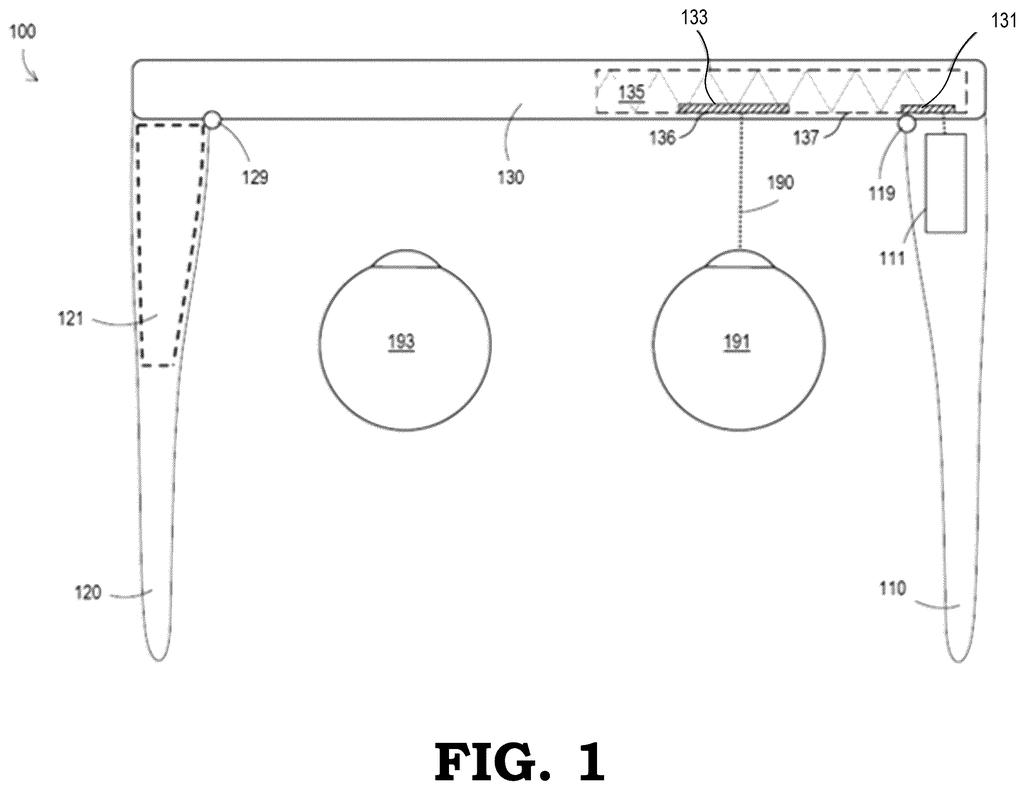
What Google's variable-mirror waveguide actually fixes
A person puts on a pair of AR glasses and notices the image looks bright in the middle but fades toward the corners. That uneven glow has been one of the quiet frustrations of every augmented-reality headset shipped so far.
Google's patent tackles this at the hardware level. Inside AR lenses, light travels down a thin piece of glass called a waveguide, bouncing off a row of tiny mirrors called reflective facets that redirect it into your eye. The problem is that the first mirrors in the row intercept a lot of light, leaving less for the mirrors further along. Google's solution is to make those distant mirrors progressively more reflective, so each one grabs its fair share and your eye receives an even image across the whole frame.
The result, in theory, is a display where brightness stays consistent from one side of your view to the other. That sounds minor, but uneven brightness is one of the main reasons AR overlays look artificial rather than natural.
… a reflective structure to outcouple at least a portion of the display light toward an eyebox of the light guide, the reflective structure comprising a series of reflective facets having a respective reflective intensity that varies in accordance with a position of the respective facet along the propagation path.
Translation: Mirrors inside the lens bounce light toward your eye, and each mirror is specially tuned based on how far it sits from the light source.
How the facets scale their reflectivity along the light path
A waveguide is a thin optical slab, typically glass, that traps display light and walks it across a lens using total internal reflection (the same principle that keeps light inside fiber-optic cables). At intervals along the slab, small angled mirrors called reflective facets interrupt that trapped light and redirect a portion of it outward toward the viewer's eye.
The catch is that the first facet in the series intercepts a large fraction of the incoming light. The second facet sees what's left, the third even less, and so on. By the time light reaches the far end of the waveguide, very little remains, which is why the image dims at the edges.
Google's patent addresses this with a straightforward but precise change: the reflective intensity (how much light each facet redirects) increases with distance from the entry point of the light. Facets near the entry, called the incoupling structure, are made shallower or less reflective. Facets further away are deeper or more reflective. The geometry is calibrated so that each facet redirects roughly the same absolute amount of light into the eyebox regardless of its position.
The patent describes this varying depth as built into one or more optical substrates, meaning the variation is etched or formed into the physical glass rather than applied as a coating after the fact. The specific term for this style of angled facet array is a blazed grating, a known optics structure where the new contribution is making the blaze depth position-dependent rather than uniform.
The reflective structure includes a series of reflective facets having a respective reflective intensity that varies in accordance with a position of the respective facet along a path of propagation for the light guide, such as to increased reflective intensity for reflective facets positioned further from an incoupling structure of the light guide.
Translation: Mirrors farther away from the projector are made more reflective to ensure the image stays bright all the way across.
What even brightness means for wearable AR displays
For anyone who has tried a consumer AR headset, uneven brightness is immediately noticeable. Text or navigation arrows appear crisp in one zone and faint in another, which makes the overlay feel stuck to the glass rather than part of the scene. A waveguide that distributes light more evenly would let designers shrink the bright-center bias they currently bake in to compensate, potentially producing a larger usable viewing area and lower overall power draw from the display source.
Google has been filing around waveguide optics since at least 2022, which suggests the company is treating display uniformity as a core engineering problem rather than an afterthought. A fix that lives in the physical structure of the waveguide is also more durable than software brightness corrections, which vary by content and require real-time processing.
Google's 43rd filing we've tracked since May in our smart glasses display watchlist builds on earlier applications like keeping AR visuals steady and reducing 3D screen blur.
The core idea is simple: mirrors closer to the edge of a lens reflect less light than mirrors at the center, so if you gradually make the edge mirrors deeper, the image looks even from corner to corner. Google has patented a specific geometry to do exactly that.
The gap between this patent and a product you can buy is wide. The document describes the optical shapes in careful detail but says nothing about how to manufacture them at the precision required, across a full lens, at a cost that makes sense for a consumer device. That fabrication problem has to be solved first, and patents rarely solve it.
What this filing does tell you is that Google is treating display evenness as a real engineering priority, not a footnote. That matters for anyone waiting on AR glasses that actually look good.
There are more where this came from
We read every patent application Big Tech publishes and send you the ones worth knowing. Plain English, free, every week.
The drawings
6 drawing sheets from US 2026/0276992 A1 · click any drawing to enlarge


Want this weekly breakdown for a company we don't cover? Patentlyze Pro →
Be the first to weigh in