
Google Patents a Way for AI to Summarize Audiobooks Too Long to Fit in Its Memory
AI summarizers hit a wall when content is too long to process in one shot. Google's new patent describes a method for getting around that limit by summarizing long audio content in overlapping, chained segments.
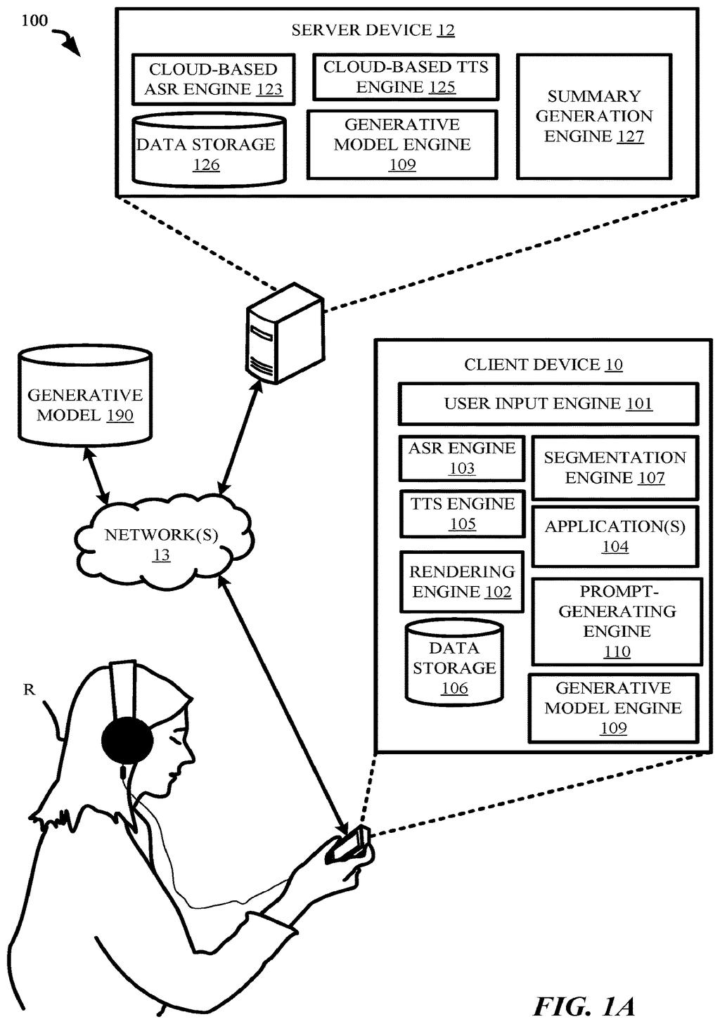
How Google's chunked audiobook summaries actually work
A listener opens an audiobook app after abandoning a 30-hour history epic halfway through. They want a quick recap before picking it back up. That sounds simple, but it bumps into a real technical problem that affects you every time you ask an AI to summarize something very long.
AI language models can only read so much text at one time. Feed them something too long and they simply can't take it all in. Google's patent describes a fix: split the long content into pieces small enough for the AI to handle. Summarize the first piece, then pass that summary along with the second piece into the next round, so the AI always has context from what came before.
The result is a rolling, connected summary that covers the whole audiobook, podcast, or lecture, stitched together at the end into one overall recap. You could hear it read aloud or read it on screen.
Implementations utilize a LLM to generate one or more summaries for long-form content such as an audiobook. Implementations determine whether the long-form content has a token length that exceeds a maximum token length for the LLM.
Translation: The system checks if an audiobook is too long for the AI to process at once.
How the LLM chains summaries across content chunks
The patent targets a specific technical constraint called the context window (the maximum amount of text a large language model can process in a single pass). Audiobooks, long podcasts, and lectures routinely exceed that limit, making a single-pass summary impossible.
Google's method works in a chain:
- The system first checks whether the content's total length exceeds the model's limit.
- If it does, the content (or its text transcript) is split into segments, each small enough to fit.
- The AI summarizes the first segment on its own.
- For the second segment, the AI receives both the second segment and the summary of the first, so it can write a summary that acknowledges what came before.
- This chain continues across all segments until an overall summary is assembled.
The key design choice is feeding each new summary forward. Without that, each chunk would be summarized in isolation and the final result would miss how ideas build across the whole piece. By including the prior summary in each new prompt, the model maintains a thread.
The final summary can be rendered as text on screen or converted to audio and played back, depending on what the user requests.
generating a second text prompt that includes the generated first summary that is summarizing the first long-form content portion, that includes the second long-form content portion, that includes a second natural language instruction to generate a summary for the second long-form content portion, and that excludes the first long-form content portion; …
Translation: The AI reads the summary of the first part along with the second part to keep the context flowing.
What this means for audiobook and podcast listeners
For anyone using AI-powered reading or listening apps, this is the difference between a tool that genuinely helps you catch up on long content and one that only works on short articles. Audiobooks average eight to ten hours; a lot of educational and professional audio runs longer. Without a method like this, on-demand AI summaries of those formats simply don't work reliably.
Google already operates Google Play Books and the Gemini AI assistant, both of which interact with long-form content. A shipping version of this feature could let users ask for a chapter recap, a full-book overview, or a mid-book refresh before resuming, all generated on demand and either read back or displayed as text.
Google's 40th patent in our AI vision coverage since May builds on ideas like locking video call backgrounds and letting users redesign maps.
The gap between this patent and a working feature is small. Everything it describes runs on software that already exists inside Google: the AI models, the audio transcription tools, the content library. No new hardware needs to be invented and no long chain of dependencies needs to fall into place first.
The method works by breaking a long audiobook into sections, summarizing the first section, then feeding that summary into the next pass so the model carries the thread forward. A listener who abandoned a book halfway through could get a spoken recap before picking it back up.
That is a modest, practical improvement to something millions of people already use. Patents like this one tend to move quickly from filing to feature because the hardest engineering work is already done.
There are more where this came from
We read every patent application Big Tech publishes and send you the ones worth knowing. Plain English, free, every week.
The drawings
9 drawing sheets from US 2026/0290331 A1 · click any drawing to enlarge


Want this weekly breakdown for a company we don't cover? Patentlyze Pro →
Be the first to weigh in