
Google Patents a Way to Train One AI Model to Both Recognize and Describe Images
Most AI systems that understand images are trained to do one thing well. Google's new patent describes a training method that pushes a single model to do two things at once: match an image to the right text, and write a full caption from scratch.
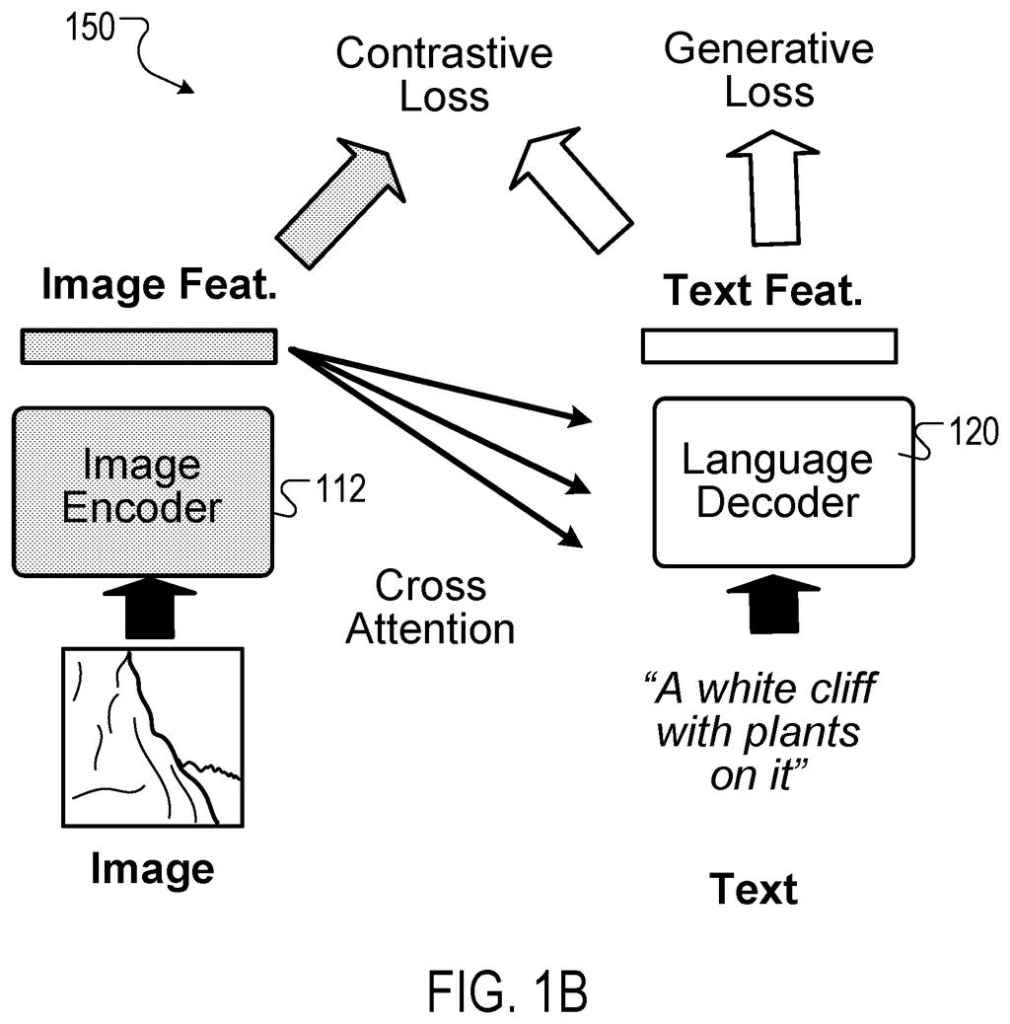
How Google teaches one AI to see and talk at once
Ever searched your photo library and wished it actually understood what was in the picture? That's the kind of problem Google's engineers are working on, and training the AI behind such features is harder than it looks.
This patent covers a technique for teaching a single AI model two skills simultaneously. One skill is matching: given an image and a sentence, does this sentence describe this image? The other skill is generation: given an image, write a caption for it from scratch. Normally these are trained separately, but Google's method trains both at the same time using a combined scoring system.
The idea is that each skill reinforces the other. An AI that can write accurate captions learns what matters in a scene, which helps it match images to descriptions more reliably, and vice versa. The result is a multi-modal model, one that works across both images and language, trained more efficiently in a single pass.
a visual encoder neural network that is configured to process a visual input that includes one or more images to generate an encoded representation of the visual input; and a decoder-only language model neural network …
Translation: The system combines a visual analyzer with a text generator to handle images and words together.
How the two training signals shape the same model
The system pairs two neural network components. The first is a visual encoder, a network that processes one or more images and compresses them into a compact mathematical representation called an embedding. The second is a decoder-only language model, the same architecture used in text-generation systems like GPT, which generates text one word (or token) at a time by predicting what comes next.
During training, the system uses two separate scoring mechanisms, called loss functions (a loss function measures how wrong the model is, so minimizing it makes the model more accurate):
- Contrastive loss: This compares the image embeddings from the visual encoder against text embeddings from the language model and penalizes the model when it fails to match paired image-text examples. It's the same principle behind models like CLIP, where images and their correct descriptions should score as highly similar.
- Image captioning loss: This measures how well the language model generates an accurate written caption for a given image, word by word.
The patent's core contribution is combining these two losses into one overall loss function and training a single model to minimize both at the same time. The training data is a large set of image-and-text pairs. Rather than needing separate specialist models for retrieval and generation, one model learns both capabilities from the same training run.
Methods, systems, and apparatus, including computer programs encoded on computer storage media, for training a multi-modal neural network using contrastive and image captioning losses.
Translation: Google patented a technique for teaching a single artificial intelligence system to both look at and describe pictures.
What this means for AI that reasons about photos and text
For everyday users, better multi-modal AI means photo search that actually understands context, assistants that can accurately describe what's in an image, and tools that can answer questions about pictures without needing a separate pipeline for each task. These capabilities feed into products like Google Lens, Google Photos, and AI assistants.
The deeper significance is architectural efficiency. the pattern in Google's multimodal AI filings points toward consolidating vision and language into fewer, more capable models. Training one model to do both matching and generation reduces engineering complexity, and if the quality holds up, it could lower the cost of deploying these systems at scale. Whether this specific training recipe outperforms existing approaches is a question the patent doesn't settle, but the direction is clear.
Google's 36th filing in the AI vision patents we cover since May follows work like focusing video AI on objects and porting learned camera angles as the company keeps building out this space.
Running two separate AI systems to handle image search and image description is not a minor inefficiency. For any organization doing this at scale, the duplicated computing costs, duplicated engineering teams, and duplicated maintenance cycles add up to a substantial and ongoing drain.
The core problem Google is attacking here is expensive and well-defined: most AI pipelines that handle images treat searching and describing as fundamentally different jobs, which forces organizations to build and run them separately. A single model that handles both cuts that overhead roughly in half.
Whether a patent can be built around this particular approach is a legal question this article cannot settle. What is clear is that the problem is large enough to justify serious engineering attention, and the solution is scoped to match it.
There are more where this came from
We read every patent application Big Tech publishes and send you the ones worth knowing. Plain English, free, every week.
The drawings
5 drawing sheets from US 2026/0278340 A1 · click any drawing to enlarge


Want this weekly breakdown for a company we don't cover? Patentlyze Pro →
Be the first to weigh in