
Adobe Patents a System That Traces AI-Written Text Back to Its Source Data
When an AI writes a summary of your data, how do you know it didn't make something up? Adobe is patenting a system that automatically tracks which part of the underlying data each sentence came from.
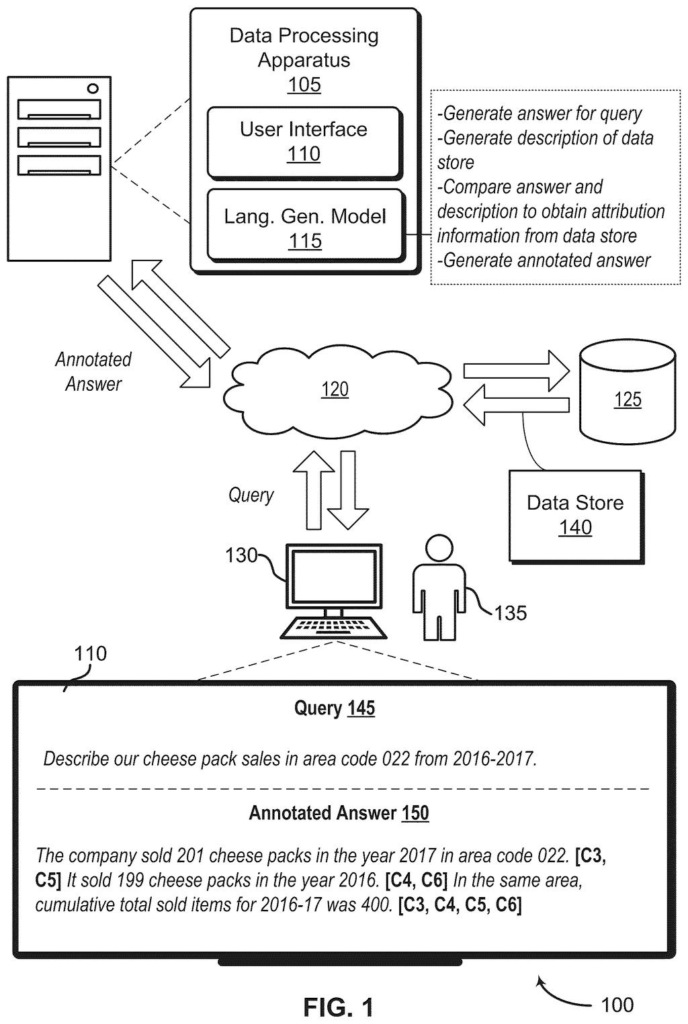
What Adobe's auto-attribution system actually does
Ever tried to figure out whether a number in an AI-generated report actually came from your spreadsheet, or whether the system just hallucinated it? That uncertainty is one of the biggest practical problems with AI writing tools today.
Adobe's filing describes a system that works alongside a language model (the kind of AI that writes text) to generate what it calls attribution information: a trail showing which specific piece of source data each part of the AI's output corresponds to. Feed it a database and ask it to describe what's in there, and the system doesn't just write the description. It also produces a map linking each claim back to the data that supports it.
Think of it like footnotes that write themselves. Instead of trusting the AI's output on faith, you get a way to verify it, automatically, without having to cross-reference everything by hand.
… generating a description of a structural element of the data, and generating attribution information for the input text based on the description of the structural element.
Translation: The system explains the structure of the source data to trace where the AI text came from.
How the model maps input text to data structures
The system takes two inputs: a data store (a structured collection of data, like a database, spreadsheet, or dataset) and input text that describes or summarizes that data. A language generation model (an AI that produces human-readable text) then does two jobs in sequence.
First, it analyzes the structural elements of the data. A structural element could be a column header in a table, a field name in a database, or a category label in a dataset. The model generates a description of what each element represents.
Second, using those descriptions as anchors, the model generates attribution information for the input text. Attribution information means a mapping that links portions of the written text to the specific structural elements in the data that support them.
- Obtain a data store and a text description of that data
- Generate descriptions of the data's structural elements
- Map the written text back to those elements as attribution
The key design choice here is that the same language model handles both steps. Rather than bolting a separate citation engine onto an existing AI writer, Adobe's approach builds attribution into the generation process itself.
What this means for AI-generated reports and trust
AI writing tools already draft reports, summaries, and analyses from structured data inside products like Adobe Acrobat and Experience Cloud. The problem is verification: when an AI says "revenue grew 12% in Q3," there's no automatic way to confirm it pulled that figure from the actual data rather than approximating or confabulating it. That gap erodes trust, especially in business or legal documents where accuracy carries real consequences.
A built-in attribution layer would let you spot-check AI-generated text the way you'd check a cited research paper, without doing the citation work yourself. Adobe has been filing around AI document intelligence for several years, and this patent fits into that broader effort to make AI-written content auditable rather than just fluent.
Adobe's ninth filing we've tracked since July in the AI guardrails race, following one on self-correcting code and one on caption fact-checking, continues the company's work on keeping AI outputs in check.
The problem this patent addresses is real and expensive. Enterprises using AI to summarize internal data currently face a trust gap: the output looks authoritative, but verifying it requires a human to retrace the AI's steps manually. That's a lot of labor, and in high-stakes settings like financial reporting or regulatory compliance, it's a genuine blocker to adoption.
What's notable here is the scope of the ambition versus the scope of the claim. The patent's independent claim is fairly broad: use a language model to generate descriptions of data structure, then use those descriptions to produce attribution. That's a reasonable direction, but the technical specifics of how the model actually grounds text to source elements are not spelled out in the filing's claim language. The hard part, making attribution accurate enough to trust, remains an open engineering question.
Still, filing in this space signals that Adobe sees verifiability as a feature, not an afterthought. For anyone whose job involves signing off on AI-generated documents, that's a meaningful shift in priorities.
There are more where this came from
We read every patent application Big Tech publishes and send you the ones worth knowing. Plain English, free, every week.
The drawings
13 drawing sheets from US 2026/0289153 A1 · click any drawing to enlarge


Want this weekly breakdown for a company we don't cover? Patentlyze Pro →
Be the first to weigh in